Palgi Yuval, Shrira Amit, Avidor Sharon, Hoffman Yaakov, Bodner Ehud, Ben-Ezra Menachem
Department of Gerontology, and the Center for Research and Study of Aging, University of Haifa, Haifa, Israel.
The Interdisciplinary Department of Social Sciences, Bar-Ilan University, Ramat-Gan, Israel.
Eur J Psychotraumatol. 2019 Mar 25;10(1):1583523. doi: 10.1080/20008198.2019.1583523. eCollection 2019.
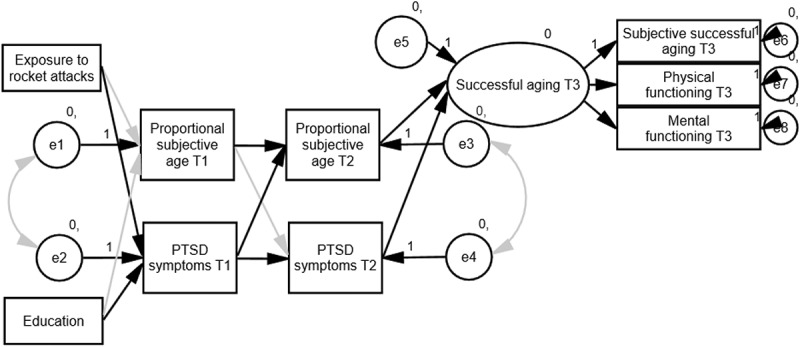
: The nature of the reciprocal relationships between posttraumatic stress disorder (PTSD) symptoms, proportional subjective age, and their effects on successful aging are important issues that have been so far under-studied. Clarifying the relationships between these variables has many theoretical and practical implications for the understanding of how individuals age in the shadow of traumatic exposure. : The present study examined the reciprocal relationships between PTSD symptoms and proportional subjective age in a longitudinal design, and how these variables predict successful aging. : Using in-region random digit dialling, we collected a stratified sample of community-dwelling older adults residing in the south of Israel. Of that sample, 132 midlife and older adults (T1 age range = 50-87, mean age = 65.84, = 9.12) were interviewed three times across a period of two years and four months (2014-2016). Participants completed measures of PTSD symptoms and proportional subjective age in the first two interviews (T1 and T2) and successful aging indices in the third interview (T3). PTSD symptoms and proportional subjective age measured at both T1 and T2 served as predictors and outcomes in a cross-lagged model and as predictors of successful aging at T3. : T1 PTSD symptoms predicted an older proportional subjective age at T2, whereas the reverse relationship (i.e. T1 proportional subjective age to T2 PTSD symptoms) was non-significant. Moreover, higher PTSD symptoms and an older proportional subjective age at T2 predicted lower successful aging at T3. : In addition to clarifying the temporal sequencing of PTSD and proportional subjective age, the study further suggests that PTSD and proportional subjective age identity could each render midlife and older adults more susceptible to less successful aging. Accordingly, we advocate to further explore the mechanisms underlining these complicated relationships.
创伤后应激障碍(PTSD)症状、相对主观年龄之间的相互关系的本质,以及它们对成功老龄化的影响,是迄今为止研究不足的重要问题。阐明这些变量之间的关系对于理解个体在创伤暴露阴影下的老龄化过程具有许多理论和实践意义。本研究采用纵向设计考察了PTSD症状与相对主观年龄之间的相互关系,以及这些变量如何预测成功老龄化。通过在该地区随机拨号,我们收集了居住在以色列南部的社区老年居民的分层样本。在该样本中,132名中年及老年成年人(T1年龄范围=50-87岁,平均年龄=65.84岁,标准差=9.12)在两年零四个月(2014-2016年)的时间里接受了三次访谈。参与者在前两次访谈(T1和T2)中完成了PTSD症状和相对主观年龄的测量,并在第三次访谈(T3)中完成了成功老龄化指标的测量。在T1和T2测量的PTSD症状和相对主观年龄在交叉滞后模型中作为预测因素和结果,并作为T3成功老龄化的预测因素。T1期的PTSD症状预测了T2期较高的相对主观年龄,而相反的关系(即T1期相对主观年龄对T2期PTSD症状)不显著。此外,T2期较高的PTSD症状和较高的相对主观年龄预测了T3期较低的成功老龄化。除了阐明PTSD和相对主观年龄的时间顺序外,该研究进一步表明,PTSD和相对主观年龄认同都可能使中年及老年成年人更容易出现不太成功的老龄化。因此,我们主张进一步探索这些复杂关系背后的机制。