Steed Robert J, Fuenzalida Amaya, Bossu Rémy, Bondár István, Heinloo Andres, Dupont Aurelien, Saul Joachim, Strollo Angelo
European-Mediterranean Seismological Centre, c/o CEA, 91297 Arpajon, Cedex, France.
CEA, DAM, DIF, F-91297 Arpajon, France.
Sci Adv. 2019 Apr 3;5(4):eaau9824. doi: 10.1126/sciadv.aau9824. eCollection 2019 Apr.
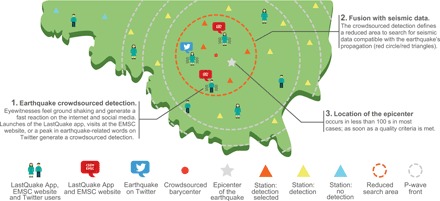
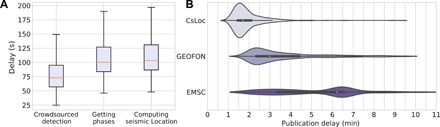
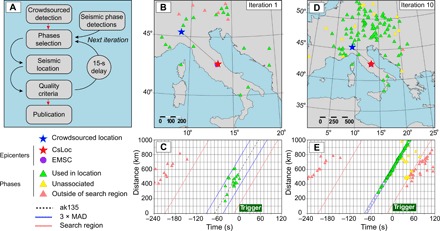
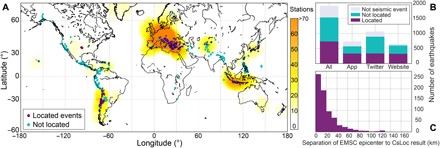
In many cases, it takes several minutes after an earthquake to publish online a seismic location with confidence. Via monitoring for specific types of increased website, app, or Twitter usage, crowdsourced detection of seismic activity can be used to "seed" the search in the seismic data for an earthquake and reduce the risk of false detections, thereby accelerating the publication of locations for felt earthquakes. We demonstrate that this low-cost approach can work at the global scale to produce reliable and rapid results. The system was retroactively tested on a set of real crowdsourced detections of earthquakes made during 2016 and 2017, with 50% of successful locations found within 103 s, 76 s faster than GEOFON and 271 s faster than the European-Mediterranean Seismological Centre's publication times, and 90% of successful locations found within 54 km of the final accepted epicenter.
在许多情况下,地震发生后需要几分钟才能在网上发布可靠的地震定位信息。通过监测特定类型网站、应用程序或推特使用量的增加,利用众包地震活动检测可在地震数据中“引导”对地震的搜索,降低误报风险,从而加快有感地震定位信息的发布。我们证明,这种低成本方法可在全球范围内发挥作用,产生可靠且快速的结果。该系统对2016年和2017年期间一组实际众包地震检测进行了追溯测试,50%的成功定位在103秒内完成,比德国地球科学研究中心(GEOFON)快76秒,比欧洲地中海地震中心的发布时间快271秒,90%的成功定位在最终认可的震中54公里范围内。