Esteyrie Vincent, Gleyzolle Baptiste, Lusque Amélie, Graff Pierre, Modesto Anouchka, Rives Michel, Lapeyre Michel, Desrousseaux Jacques, Graulières Eliane, Hangard Gregory, Arnaud François-Xavier, Ferrand Regis, Delord Jean-Pierre, Poublanc Muriel, Mounier Muriel, Filleron Thomas, Laprie Anne
Radiation Oncology, Institut Claudius Regaud, Institut Universitaire du Cancer de Toulouse, Oncopole, Toulouse, France.
Radiation Oncology, Centre Jean Perrin, Clermont-Ferrand, France.
Clin Transl Radiat Oncol. 2019 Mar 9;16:34-39. doi: 10.1016/j.ctro.2019.02.006. eCollection 2019 May.
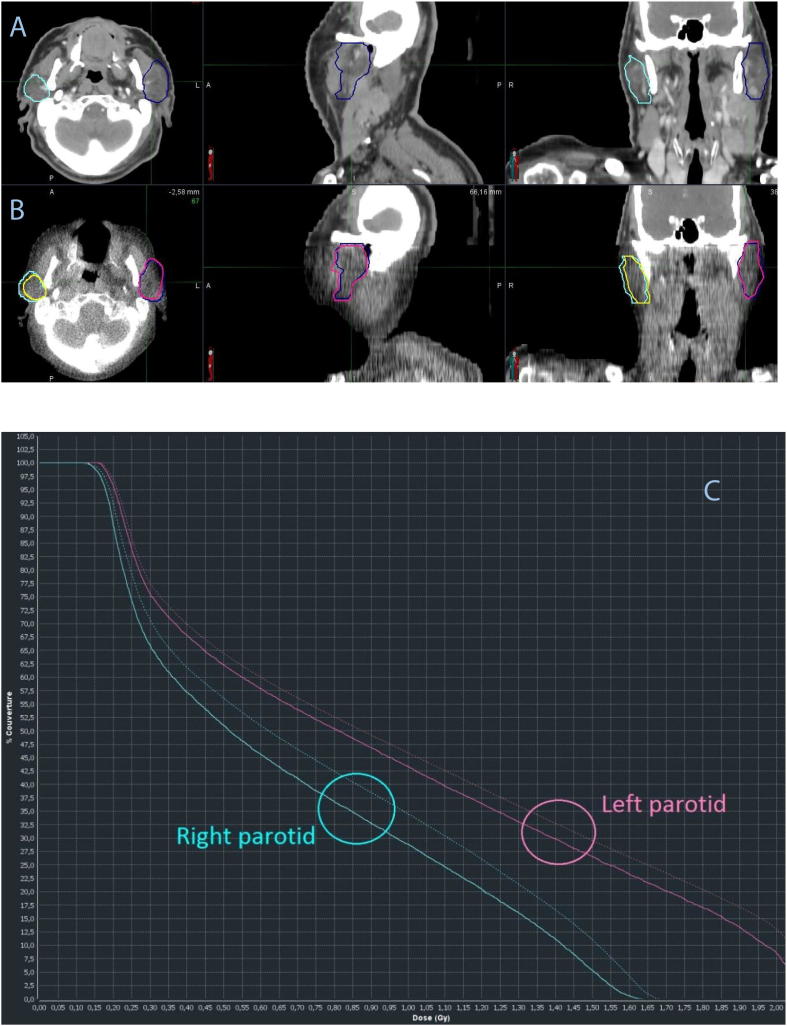
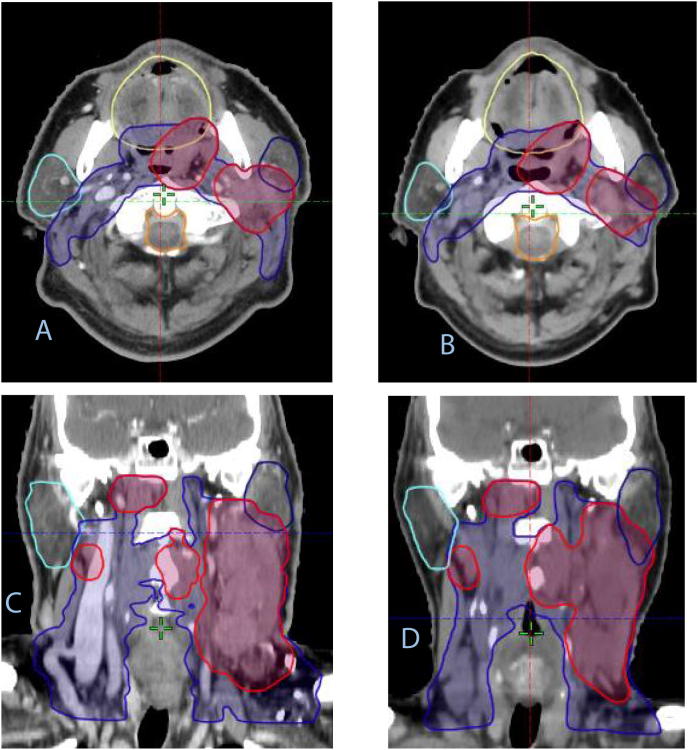
During exclusive curative radiotherapy for head and neck tumors, the patient's organs at risk (OAR) and target volumes frequently change size and shape, leading to a risk of higher toxicity and lower control than expected on planned dosimetry. Adaptive radiotherapy is often necessary but 1) tools are needed to define the optimal time for replanning, and 2) the subsequent workflow is time-consuming. We designed a prospective study to evaluate 1) the validity of automatically deformed contours on the daily MVCT, in order to safely use the "dose-of the day" tool to check daily if replanning is necessary; 2) the automatically deformed contours on the replanning CT and the time gained in the replanning workflow. Forty-eight patients with T3-T4 and/or involved node >2 cm head and neck squamous cell carcinomas, planned for curative radiotherapy without surgery, will be enrolled. They will undergo treatment with helical IMRT including daily repositioning MVCTs. The contours proposed will be compared weekly on intermediate planning CTs (iCTs) on weeks 3, 4, 5 and 6. On these iCTs both manual recontouring and automated deformable registration of the initial contours will be compared with the contours automatically defined on the MVCT. The primary objective is to evaluate the Dice similarity coefficient (DSC) of the volumes of each parotid gland. The secondary objectives will evaluate, for target volumes and all OARs: the DSC, the mean distance to agreement, and the average surface-to-surface distance. Time between the automatic and the manual recontouring workflows will be compared.
在对头颈部肿瘤进行单纯根治性放疗期间,患者的危及器官(OAR)和靶区体积经常改变大小和形状,导致出现毒性高于预期以及在计划剂量测定时控制效果低于预期的风险。自适应放疗通常是必要的,但1)需要工具来确定重新计划的最佳时间,并且2)后续工作流程耗时较长。我们设计了一项前瞻性研究,以评估1)每日MVCT上自动变形轮廓的有效性,以便安全地使用“当日剂量”工具每日检查是否需要重新计划;2)重新计划CT上的自动变形轮廓以及重新计划工作流程中节省的时间。将招募48例T3 - T4和/或受累淋巴结>2 cm的头颈部鳞状细胞癌患者,计划进行非手术根治性放疗。他们将接受螺旋调强放疗,包括每日的MVCT重新定位。在第3、4、5和6周的中间计划CT(iCT)上每周比较所提出的轮廓。在这些iCT上,将初始轮廓的手动重新勾画和自动可变形配准与MVCT上自动定义的轮廓进行比较。主要目的是评估每个腮腺体积的骰子相似系数(DSC)。次要目的将针对靶区体积和所有OAR评估:DSC、平均一致距离和平均表面到表面距离。比较自动和手动重新勾画工作流程之间的时间。