Zhang Lian, Wang Zhi, Shi Chengyu, Long Tengfei, Xu X George
Center of Radiological Medical Physics, University of Science and Technology of China, Hefei, Anhui Province, China.
Department of Radiation Oncology, The First Affiliated Hospital of Anhui Medical University, Hefei, Anhui Province, China.
J Appl Clin Med Phys. 2018 Jul;19(4):185-194. doi: 10.1002/acm2.12361. Epub 2018 May 30.
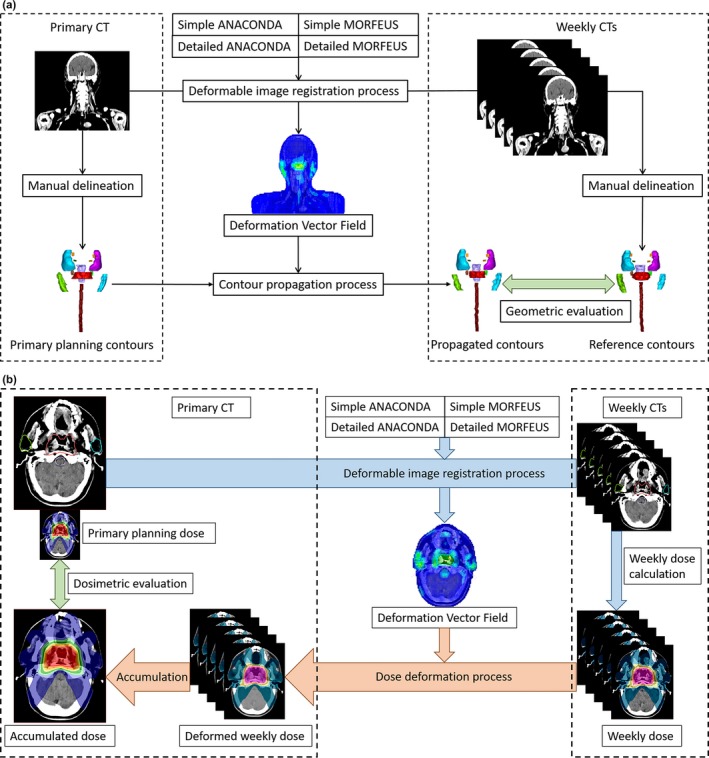
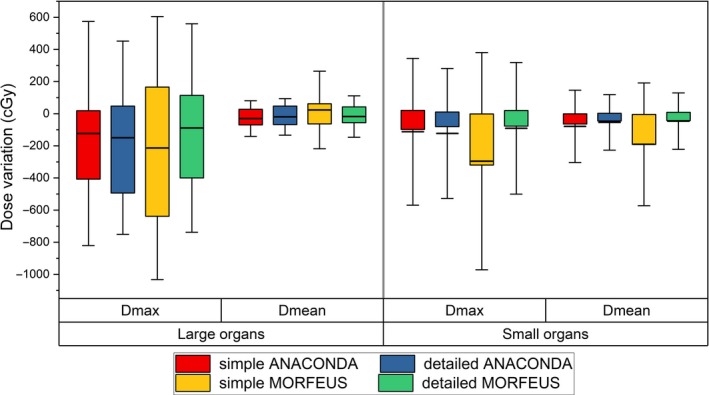
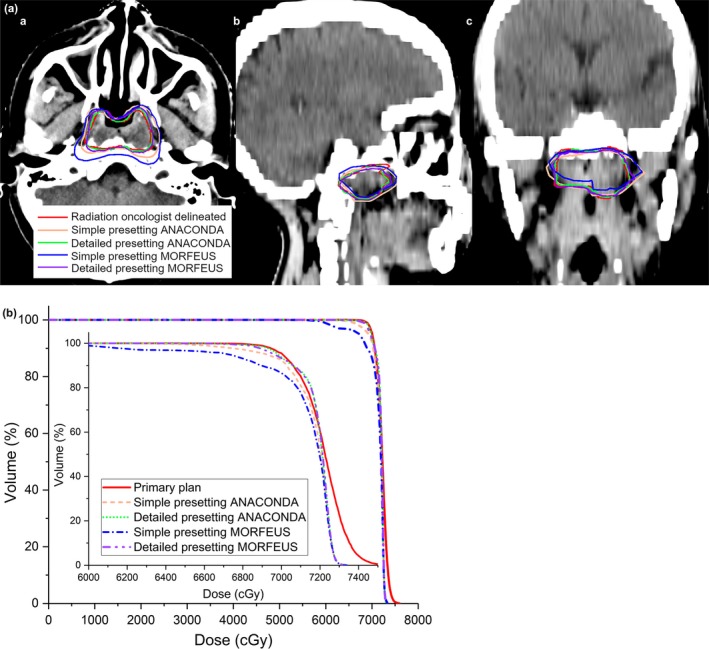
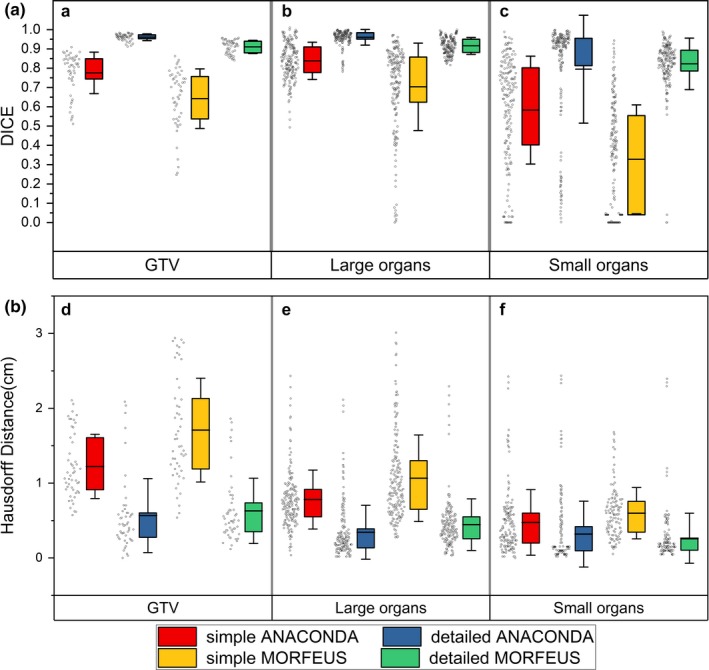
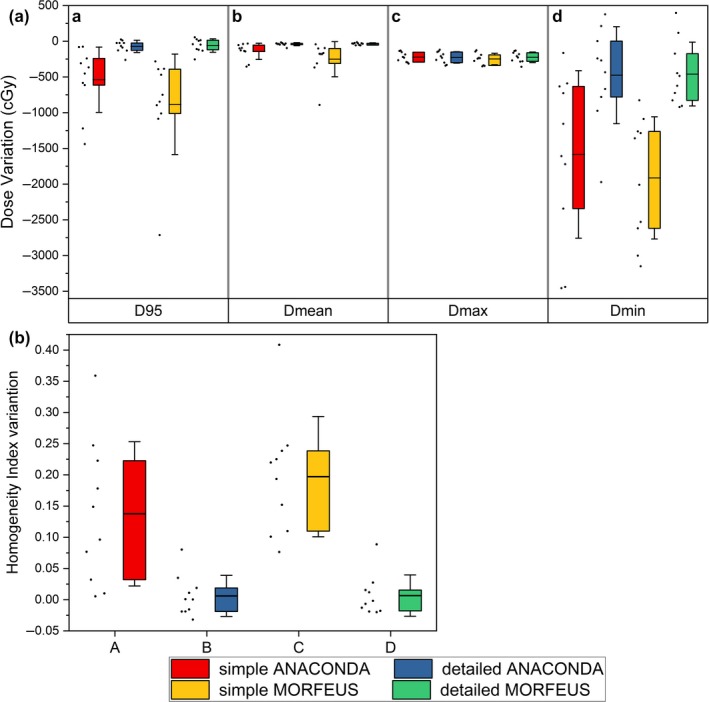
Deformable image registration (DIR) is the key process for contour propagation and dose accumulation in adaptive radiation therapy (ART). However, currently, ART suffers from a lack of understanding of "robustness" of the process involving the image contour based on DIR and subsequent dose variations caused by algorithm itself and the presetting parameters. The purpose of this research is to evaluate the DIR caused variations for contour propagation and dose accumulation during ART using the RayStation treatment planning system. Ten head and neck cancer patients were selected for retrospective studies. Contours were performed by a single radiation oncologist and new treatment plans were generated on the weekly CT scans for all patients. For each DIR process, four deformation vector fields (DVFs) were generated to propagate contours and accumulate weekly dose by the following algorithms: (a) ANACONDA with simple presetting parameters, (b) ANACONDA with detailed presetting parameters, (c) MORFEUS with simple presetting parameters, and (d) MORFEUS with detailed presetting parameters. The geometric evaluation considered DICE coefficient and Hausdorff distance. The dosimetric evaluation included D , D , D , D , and Homogeneity Index. For geometric evaluation, the DICE coefficient variations of the GTV were found to be 0.78 ± 0.11, 0.96 ± 0.02, 0.64 ± 0.15, and 0.91 ± 0.03 for simple ANACONDA, detailed ANACONDA, simple MORFEUS, and detailed MORFEUS, respectively. For dosimetric evaluation, the corresponding Homogeneity Index variations were found to be 0.137 ± 0.115, 0.006 ± 0.032, 0.197 ± 0.096, and 0.006 ± 0.033, respectively. The coherent geometric and dosimetric variations also consisted in large organs and small organs. Overall, the results demonstrated that the contour propagation and dose accumulation in clinical ART were influenced by the DIR algorithm, and to a greater extent by the presetting parameters. A quality assurance procedure should be established for the proper use of a commercial DIR for adaptive radiation therapy.
可变形图像配准(DIR)是自适应放射治疗(ART)中轮廓传播和剂量累积的关键过程。然而,目前ART对于基于DIR的图像轮廓相关过程的“稳健性”以及算法本身和预设参数导致的后续剂量变化缺乏了解。本研究的目的是使用RayStation治疗计划系统评估ART期间DIR引起的轮廓传播和剂量累积变化。选择了10例头颈癌患者进行回顾性研究。轮廓由一名放射肿瘤学家绘制,并为所有患者在每周的CT扫描上生成新的治疗计划。对于每个DIR过程,通过以下算法生成四个变形矢量场(DVF)来传播轮廓并累积每周剂量:(a)具有简单预设参数的ANACONDA,(b)具有详细预设参数的ANACONDA,(c)具有简单预设参数的MORFEUS,以及(d)具有详细预设参数的MORFEUS。几何评估考虑了DICE系数和豪斯多夫距离。剂量学评估包括D 、D 、D 、D 以及均匀性指数。对于几何评估,发现简单ANACONDA、详细ANACONDA、简单MORFEUS和详细MORFEUS的GTV的DICE系数变化分别为0.78±0.11、0.96±0.02、0.64±0.15和0.91±0.03。对于剂量学评估,相应地发现均匀性指数变化分别为0.137±0.115、0.006±0.032、0.197±0.096和0.006±0.033。大器官和小器官中也存在一致的几何和剂量学变化。总体而言,结果表明临床ART中的轮廓传播和剂量累积受DIR算法影响,并且在更大程度上受预设参数影响。应建立质量保证程序以正确使用用于自适应放射治疗的商用DIR。