Department of Neurology, Feinberg School of Medicine, Northwestern University, Chicago, United States.
Intramural Research Program of the National Institute on Drug Abuse, National Institutes of Health, Baltimore, United States.
Elife. 2019 Apr 5;8:e43962. doi: 10.7554/eLife.43962.
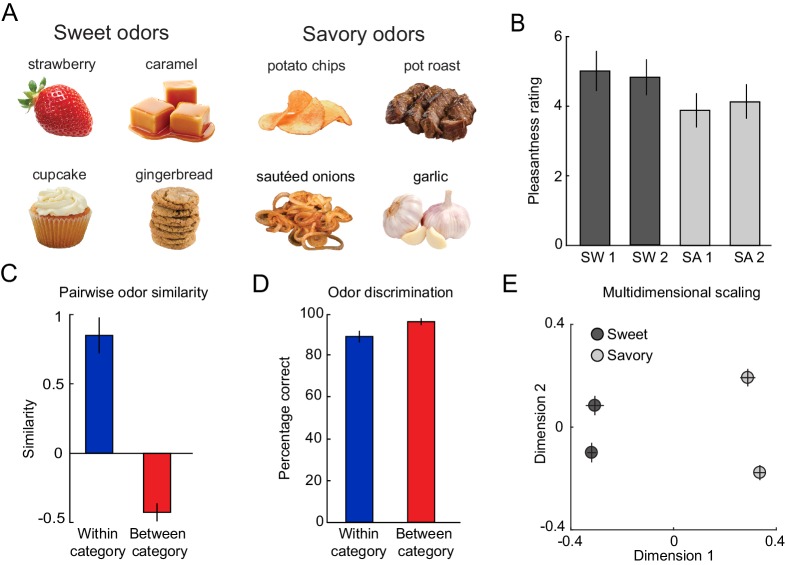
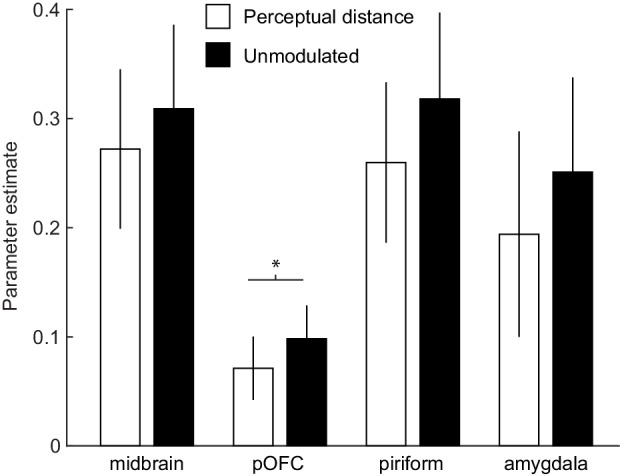
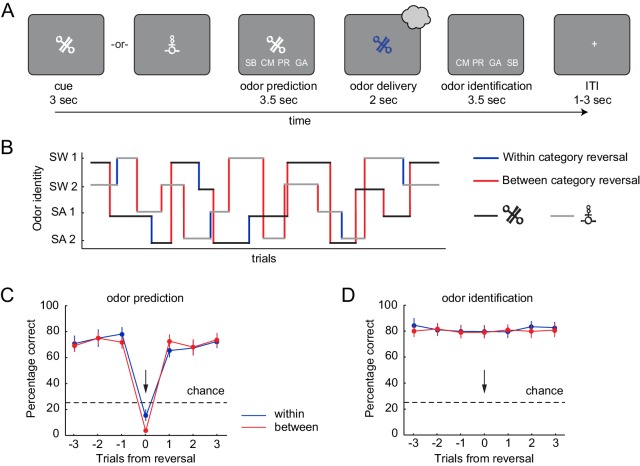
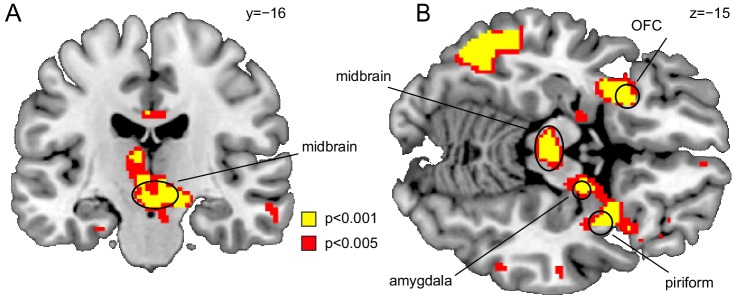
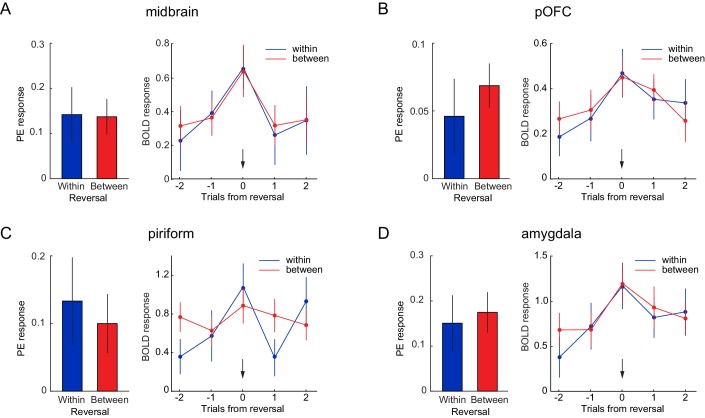
The firing of dopaminergic midbrain neurons is thought to reflect prediction errors (PE) that depend on the difference between the value of expected and received rewards. However, recent work has demonstrated that unexpected changes in value-neutral outcome features, such as identity, can evoke similar responses. It remains unclear whether the magnitude of these identity PEs scales with the perceptual dissimilarity of expected and received rewards, or whether they are independent of perceptual similarity. We used a Pavlovian transreinforcer reversal task to elicit identity PEs for value-matched food odor rewards, drawn from two perceptual categories (sweet, savory). Replicating previous findings, identity PEs were correlated with fMRI activity in midbrain, OFC, piriform cortex, and amygdala. However, the magnitude of identity PE responses was independent of the perceptual distance between expected and received outcomes, suggesting that identity comparisons underlying sensory PEs may occur in an abstract state space independent of straightforward sensory percepts.
中脑多巴胺能神经元的放电被认为反映了预测误差 (PE),它取决于预期和获得奖励之间的价值差异。然而,最近的研究表明,价值中立的结果特征(例如身份)的意外变化也可以引起类似的反应。目前尚不清楚这些身份 PE 的幅度是否与预期和获得的奖励的感知差异成正比,或者它们是否与感知相似性无关。我们使用了一种条件性强化逆转任务来引发价值匹配的食物气味奖励的身份 PE,这些奖励来自两个感知类别(甜、咸)。与先前的发现一致,身份 PE 与中脑、OFC、梨状皮层和杏仁核的 fMRI 活动相关。然而,身份 PE 反应的幅度与预期和获得的结果之间的感知距离无关,这表明感知 PE 背后的身份比较可能发生在一个与直接的感知觉无关的抽象状态空间中。