Pöhland Ralf, Souza-Cácares Mirela Brochado, Datta Tirtha Kumar, Vanselow Jens, Martins Maria Isabel Mello, da Silva Wilian Aparecido Leite, Cardoso Christopher Junior Tavares, Melo-Sterza Fabiana de Andrade
Institute of Reproductive Biology, Leibniz Institute for Farm Animal Biology, Dummerstorf, Germany.
Programa de Pós-graduação em Ciência Animal, Universidade Estadual de Londrina, Londrina, PR, Brasil.
Anim Reprod. 2020 Aug 27;17(3):e20190085. doi: 10.1590/1984-3143-AR2019-0085.
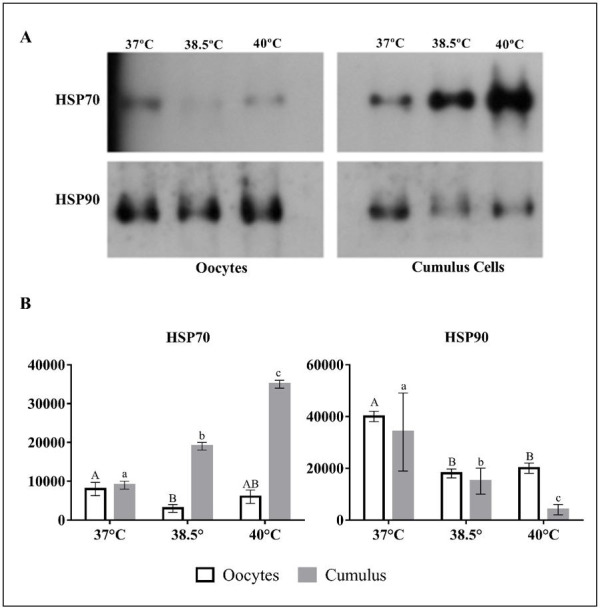
The objective of this study was to investigate the influence of long-term temperature stress during the maturation (IVM) of oocytes on the embryo production (IVP) and the abundance of HSP70 and HSP90 in zebu cattle. Viable cumulus-oocyte complexes (COCs) were incubated for 24 h at 37 °C, 38.5 °C, or 40 °C for the low-, physiological, and high-temperature stress treatments, respectively. Thereafter, they were subjected to fertilization and culture. Temperature did not affect the polar body extrusion. However, IVP was adversely affected when IVM took place at 37 °C and 40 °C. The highest abundance of HSP70 was observed in cumulus cells after maturation of COCs at 40 °C. In contrast, HSP70 was more abundant in oocytes at both 37 °C and 40 °C; however, at 40 °C, the difference to the control group (38.5 °C) was not significant. In contrast, the highest abundance of HSP90 was observed in oocytes and cumulus cells at 37 °C. It appears that HSP70 and HSP90 respond to cold and heat stress in different ways. In conclusion, moderately high (40 °C) and low (37 °C) thermal stress for 24 h during IVM is detrimental to the developmental competence of oocyte and is accompanied by changes in the abundances of HSP70 and HSP90, especially in cumulus cells.
本研究的目的是调查卵母细胞成熟(体外成熟,IVM)过程中的长期温度应激对瘤牛胚胎生产(体外受精,IVP)以及热休克蛋白70(HSP70)和热休克蛋白90(HSP90)丰度的影响。将有活力的卵丘-卵母细胞复合体(COCs)分别在37°C、38.5°C或40°C下孵育24小时,以进行低温、生理温度和高温应激处理。此后,对它们进行受精和培养。温度不影响极体排出。然而,当IVM在37°C和40°C进行时,IVP受到不利影响。在40°C下使COCs成熟后,在卵丘细胞中观察到HSP70的丰度最高。相比之下,在37°C和40°C时,卵母细胞中的HSP70更丰富;然而,在40°C时,与对照组(38.5°C)的差异不显著。相比之下,在37°C时,卵母细胞和卵丘细胞中观察到HSP90的丰度最高。看来HSP70和HSP90以不同方式对冷应激和热应激作出反应。总之,IVM期间24小时的适度高温(40°C)和低温(37°C)热应激对卵母细胞的发育能力有害,并伴随着HSP70和HSP90丰度的变化,尤其是在卵丘细胞中。