Erasmus MC, Department of Internal Medicine, Academic Center for Thyroid Diseases, European Neuroendocrine Tumor Society center of excellence, P.O Box 2040, 3000, CA, Rotterdam, the Netherlands.
Erasmus MC, Department of Radiology & Nuclear Medicine, Erasmus University Medical Center, P.O Box 2040, 3000, CA, Rotterdam, the Netherlands.
BMC Cancer. 2019 Apr 5;19(1):325. doi: 10.1186/s12885-019-5540-5.
For progressive metastatic medullary thyroid carcinoma (MTC), the available treatment options with tyrosine kinase inhibitors result in grade 3-4 adverse events in a large number of patients. Peptide Receptor Radionuclide Therapy (PRRT), which has also been suggested to be a useful treatment for MTC, is usually well tolerated, but evidence on its effectivity is very limited.
Retrospective evaluation of treatment effects of PRRT in a highly selected group of MTC patients, with progressive disease or refractory symptoms. In addition, a retrospective evaluation of uptake on historical In-DTPA-octreotide scans was performed in patients with detectable tumor size > 1 cm.
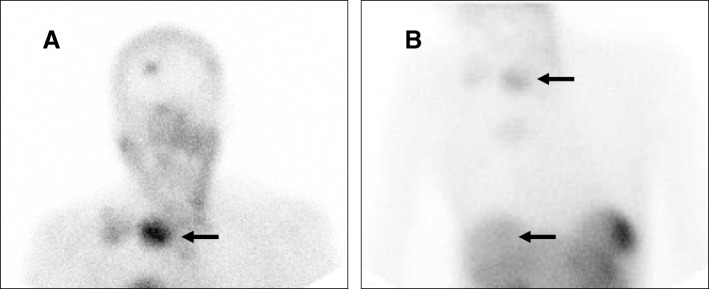
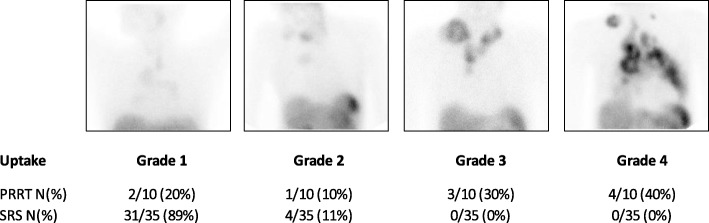
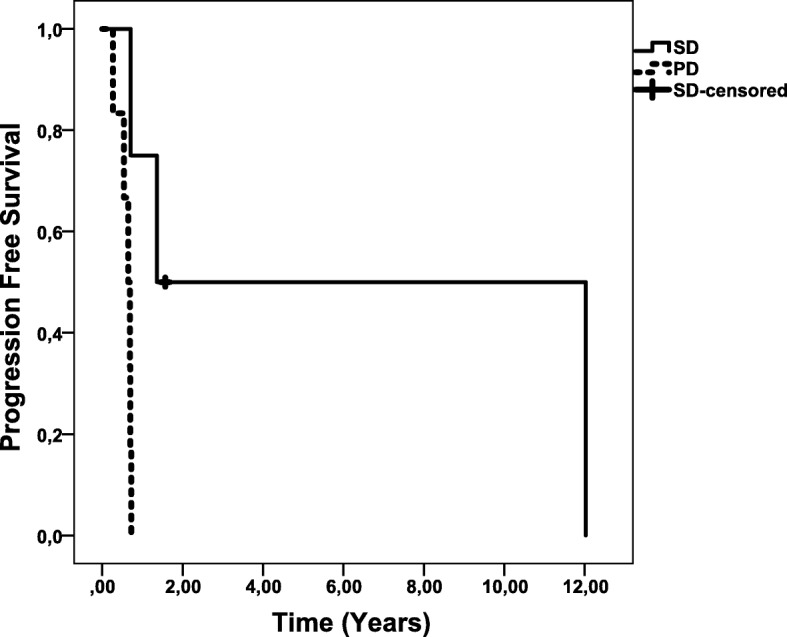
Over the last 17 years, 10 MTC patients were treated with PRRT. Four out of 10 patients showed stable disease at first follow-up (8 months after start of therapy) whereas the other 6 were progressive. Patients with stable disease were characterized by a combination of both a high uptake on In-DTPA-octreotide scan (uptake grade ≥ 3) and a positive somatostatin receptor type 2a (SSTR2a) expression of the tumor by immunohistochemistry. Retrospective evaluation of historical In-DTPA-octreotide scans of 35 non-treated MTC patients revealed low uptake (uptake grade 1) in the vast majority of patients 31/35 (89%) with intermediate uptake (uptake grade 2) in the remaining 4/35 (11%).
PRRT using Lu-octreotate could be considered as a treatment in those patients with high uptake on In-DTPA-octreotide scan (uptake grade 3) and positive SSTR2a expression in tumor histology. Since this high uptake was present in a very limited number of patients, this treatment is only suitable in a selected group of MTC patients.
对于进展性转移性甲状腺髓样癌(MTC),已有多种酪氨酸激酶抑制剂可供治疗,但大量患者会出现 3-4 级不良反应。肽受体放射性核素疗法(PRRT)也被建议用于治疗 MTC,通常具有良好的耐受性,但关于其疗效的证据非常有限。
回顾性评估了一组高度选择的 MTC 患者(疾病进展或出现难治性症状)接受 PRRT 的治疗效果。此外,还对历史上可检测肿瘤大小> 1 cm 的患者的 In-DTPA-奥曲肽扫描摄取情况进行了回顾性评估。
在过去的 17 年中,有 10 名 MTC 患者接受了 PRRT 治疗。10 名患者中有 4 名在首次随访(治疗开始后 8 个月)时显示疾病稳定,而其余 6 名则进展。疾病稳定的患者的特点是 In-DTPA-奥曲肽扫描摄取量高(摄取分级≥3),且肿瘤的生长抑素受体 2a(SSTR2a)表达阳性。对 35 名未经治疗的 MTC 患者的历史 In-DTPA-奥曲肽扫描进行回顾性评估,发现绝大多数患者(31/35,89%)的摄取量低(摄取分级 1),其余 4/35(11%)的摄取量中等(摄取分级 2)。
使用 Lu-octreotate 进行 PRRT 可以考虑用于那些 In-DTPA-奥曲肽扫描摄取量高(摄取分级 3)且肿瘤组织学中 SSTR2a 表达阳性的患者。由于这种高摄取仅存在于极少数患者中,因此该治疗方法仅适用于 MTC 患者的一个选定群体。