Fertility Clinic, Dept. of Gynecology and Obstetrics, Zealand University Hospital, Lykkebækvej 14, 4600, Køge, Denmark.
Department of Natural Science and Environment, Universitetsvej 1, 4000, Roskilde, Denmark.
Reprod Biol Endocrinol. 2019 Apr 5;17(1):34. doi: 10.1186/s12958-019-0478-7.
Women with Polycystic Ovary Syndrome (PCOS) present a heterogeneous reproductive and metabolic profile with an increased lifetime risk of Type 2 Diabetes (T2D). Early biomarkers of these metabolic disturbances in PCOS women have not been identified. The abundance of circulating insulin gene promotor cell-free DNA (INS cfDNA) was shown to be valuable as a predictive biomarker of β-cell death in individuals with Type 1 diabetes (T1D) as well as with gestational diabetes. Since β-cell death is common to the development of T1D as well as in T2D, we aimed to investigate if insulin-coding DNA is more abundant in circulation of PCOS women (vs Controls) and if their levels change after 6 yr. follow-up as a potential measure to predict future T2D.
A cohort of 40 women diagnosed with PCOS according to Rotterdam 2003 criteria and eight healthy controls were examined at baseline and 6 years follow-up. Clinical measurements for evaluation of glucose homeostasis as well as blood/serum samples were obtained at each visit. Methylated and unmethylated INS cfDNA were quantified using droplet digital PCR. Differences between groups were assessed using Kruskall-Wallis test and Wilcoxon Signed rank test.
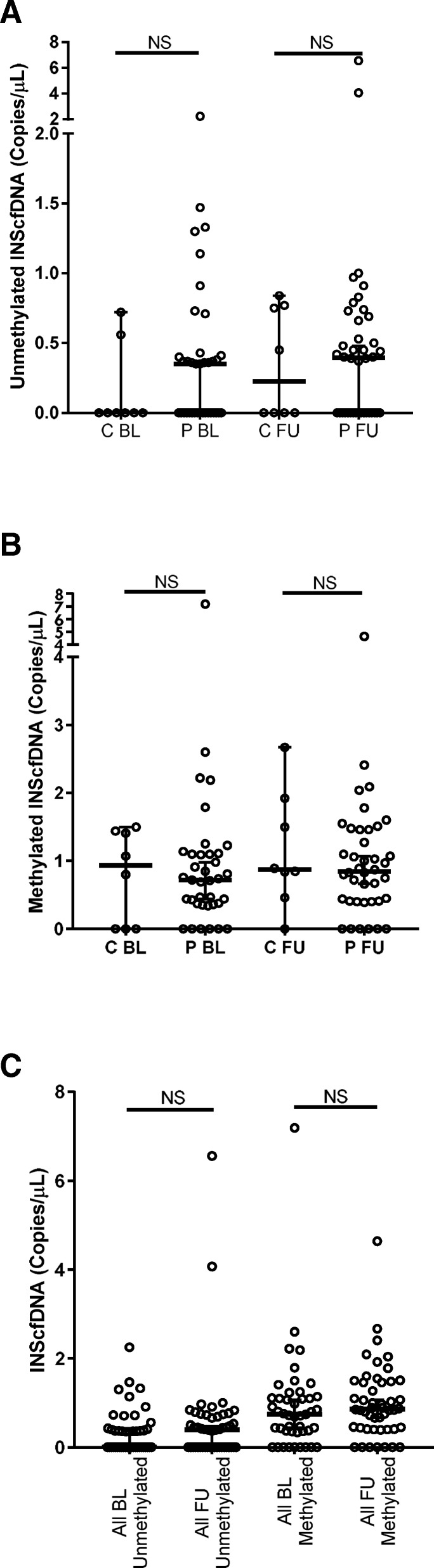
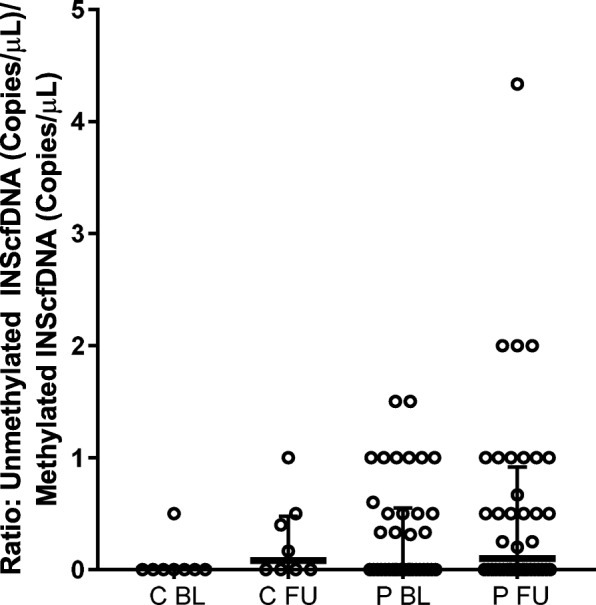
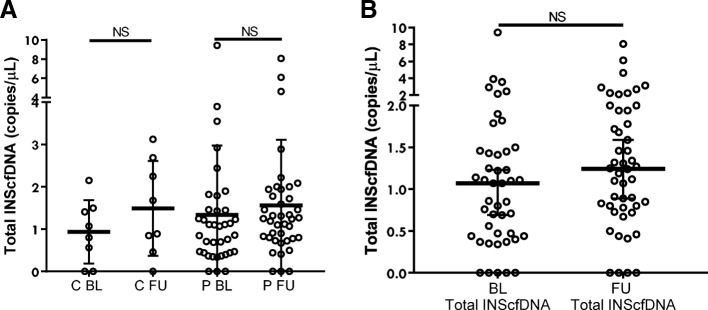
At baseline, there was no detectable difference in copy number (copies/μL) of methylated (p = 0.74) or unmethylated INS cfDNA (p = 0.34) between PCOS and Control groups. At follow up, neither methylated (p = 0.50) nor unmethylated INScfDNA levels (p = 0.48) differed significantly between these groups. Likewise, when pooling the groups, there was no difference between baseline and follow up, in terms of copies of methylated or unmethylated INS cfDNA (p = 0.38 and p = 0.52, respectively). There were no significant correlations between counts of unmethylated or methylated cfDNA and the clinical measurements of β-cell function and pre-diabetes.
The circulating level of unmethylated and methylated INScfDNA is similar between PCOS and Controls and cannot be used to predict islet β-cell loss and progression to Type 2 diabetes in a 6-year follow-up.
The Danish Data Protection Agency (REG-31-2016. Approval: 01-12-2015) and by the Danish Scientific Ethical committee of Region Zealand (Journal no. SJ-525. Approval: 13-06-2016), Clinicaltrials.gov, ( NCT03142633 , registered 1. March, 2017, Retrospectively registered).
多囊卵巢综合征(PCOS)患者具有异质性的生殖和代谢特征,一生中患 2 型糖尿病(T2D)的风险增加。尚未确定 PCOS 女性这些代谢紊乱的早期生物标志物。胰岛素基因启动子无细胞 DNA(INS cfDNA)的循环丰度已被证明是预测 1 型糖尿病(T1D)和妊娠期糖尿病患者β细胞死亡的有价值的生物标志物。由于β细胞死亡是 T1D 和 T2D 发展的共同特征,我们旨在研究胰岛素编码 DNA是否在 PCOS 女性(与对照组相比)的循环中更为丰富,以及它们在 6 年随访后是否会发生变化,作为预测未来 T2D 的潜在指标。
根据 2003 年鹿特丹标准诊断为 PCOS 的 40 名女性和 8 名健康对照组在基线和 6 年随访时进行检查。每次就诊时均获得用于评估葡萄糖稳态的临床测量值以及血液/血清样本。使用液滴数字 PCR 定量测定甲基化和非甲基化 INS cfDNA。使用 Kruskal-Wallis 检验和 Wilcoxon 符号秩检验评估组间差异。
在基线时,PCOS 和对照组之间的甲基化(p=0.74)或非甲基化 INS cfDNA 的拷贝数(copies/μL)没有差异(p=0.34)。在随访时,两组之间的甲基化(p=0.50)或非甲基化 INScfDNA 水平(p=0.48)均无显著差异。同样,当将两组合并时,甲基化或非甲基化 INS cfDNA 的基线和随访之间没有差异(分别为 p=0.38 和 p=0.52)。非甲基化或甲基化 cfDNA 的计数与胰岛β细胞功能和糖尿病前期的临床测量值之间没有显著相关性。
在 6 年的随访中,PCOS 和对照组之间循环的未甲基化和甲基化 INScfDNA 水平相似,不能用于预测胰岛β细胞的丢失和发展为 2 型糖尿病。
丹麦数据保护局(REG-31-2016. 批准:2015 年 12 月 1 日)和丹麦西兰地区科学伦理委员会(期刊号 SJ-525. 批准:2016 年 6 月 13 日),Clinicaltrials.gov(NCT03142633,2017 年 3 月 1 日注册,回顾性注册)。