Fedorec Alex J H, Ozdemir Tanel, Doshi Anjali, Ho Yan-Kay, Rosa Luca, Rutter Jack, Velazquez Oscar, Pinheiro Vitor B, Danino Tal, Barnes Chris P
Department of Cell and Developmental Biology, University College London, London WC1E 6BT, UK; Centre for Mathematics, Physics and Engineering in the Life Sciences and Experimental Biology, University College London, London WC1E 6BT, UK.
Department of Cell and Developmental Biology, University College London, London WC1E 6BT, UK.
iScience. 2019 Apr 26;14:323-334. doi: 10.1016/j.isci.2019.03.019. Epub 2019 Mar 22.
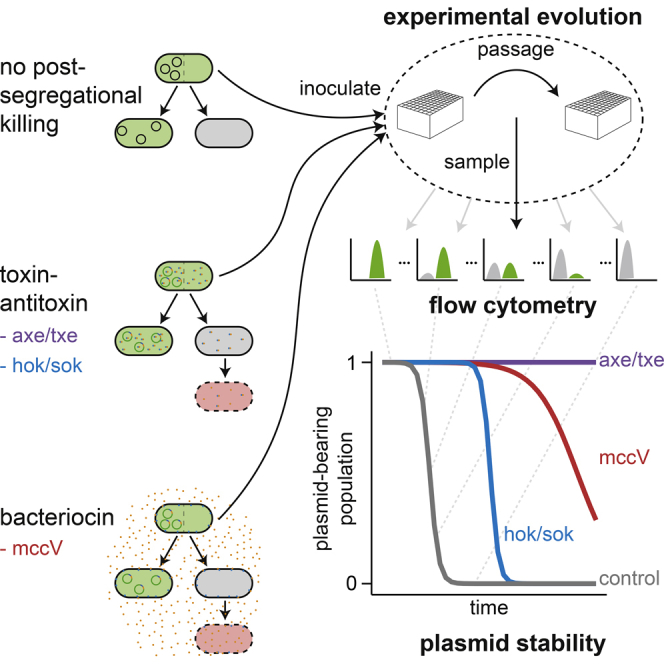
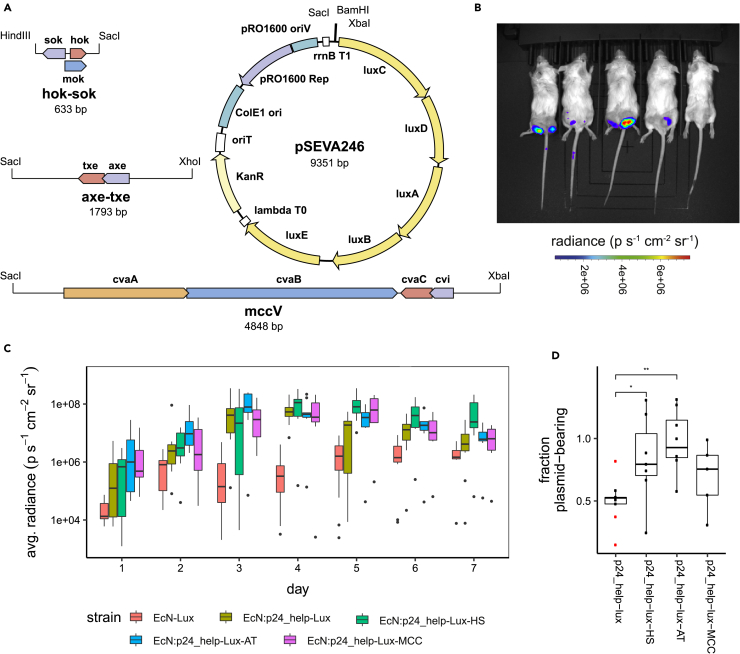
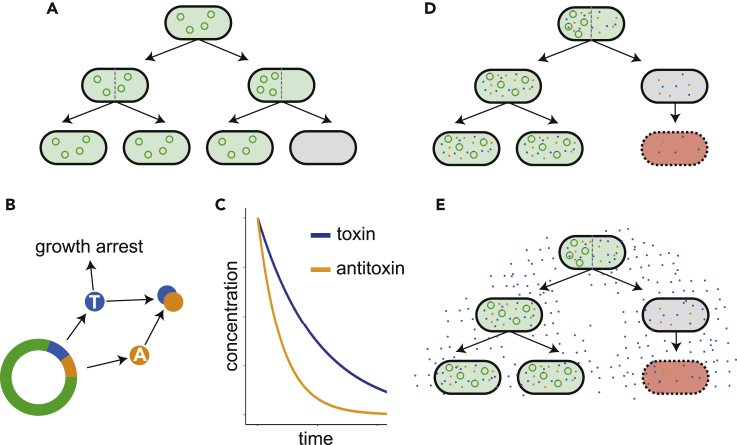
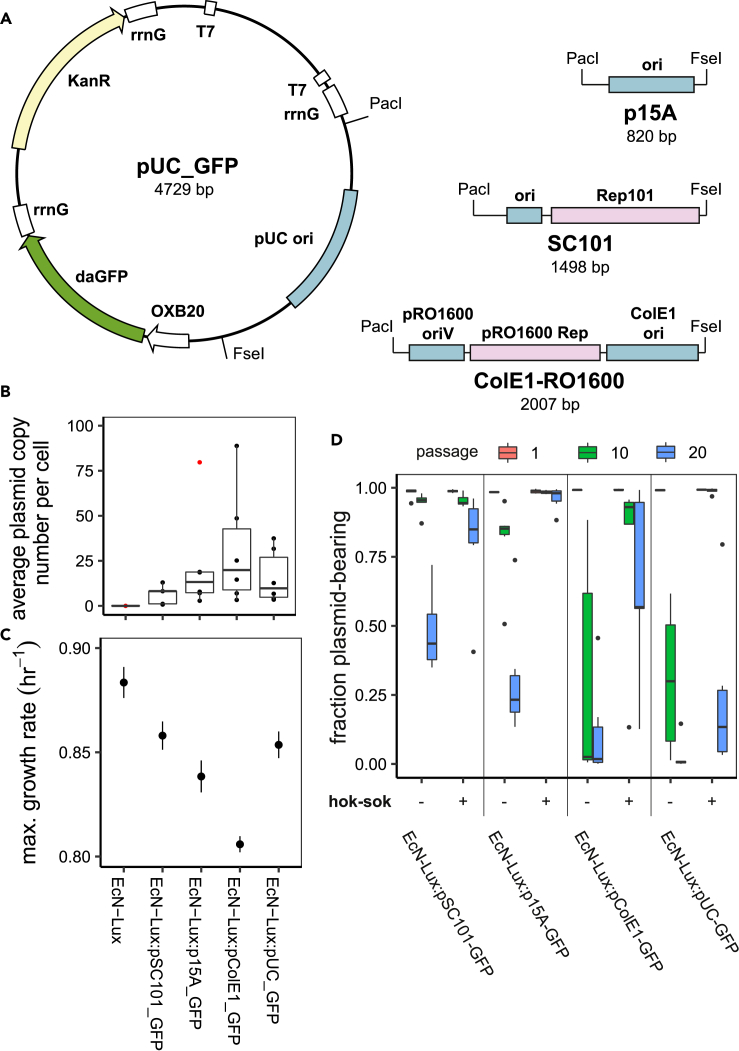
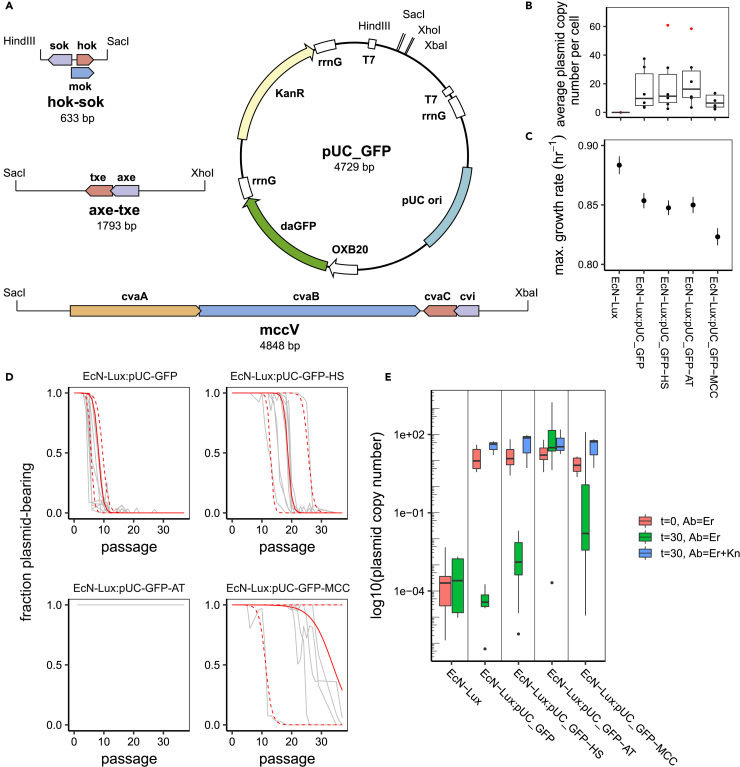
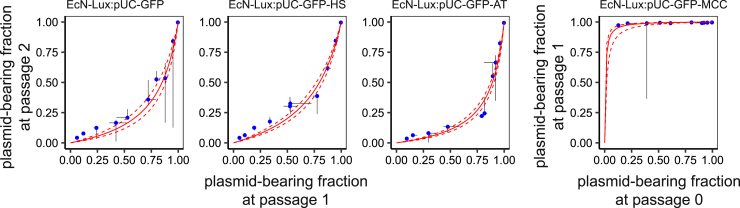
Plasmids are the workhorse of both industrial biotechnology and synthetic biology, but ensuring they remain in bacterial cells is a challenge. Antibiotic selection cannot be used to stabilize plasmids in most real-world applications, and inserting dynamical gene networks into the genome remains challenging. Plasmids have evolved several mechanisms for stability, one of which, post-segregational killing (PSK), ensures that plasmid-free cells do not survive. Here we demonstrate the plasmid-stabilizing capabilities of the axe/txe toxin-antitoxin system and the microcin-V bacteriocin system in the probiotic bacteria Escherichia coli Nissle 1917 and show that they can outperform the commonly used hok/sok. Using plasmid stability assays, automated flow cytometry analysis, mathematical models, and Bayesian statistics we quantified plasmid stability in vitro. Furthermore, we used an in vivo mouse cancer model to demonstrate plasmid stability in a real-world therapeutic setting. These new PSK systems, plus the developed Bayesian methodology, will have wide applicability in clinical and industrial biotechnology.
质粒是工业生物技术和合成生物学的主力军,但确保它们留在细菌细胞中是一项挑战。在大多数实际应用中,抗生素选择不能用于稳定质粒,并且将动态基因网络插入基因组仍然具有挑战性。质粒已经进化出几种稳定性机制,其中一种是后分离杀伤(PSK),可确保无质粒的细胞无法存活。在这里,我们展示了斧/毒素-抗毒素系统和微菌素-V细菌素系统在益生菌大肠杆菌Nissle 1917中的质粒稳定能力,并表明它们可以优于常用的hok/sok。我们使用质粒稳定性测定、自动流式细胞术分析、数学模型和贝叶斯统计方法在体外量化了质粒稳定性。此外,我们使用体内小鼠癌症模型来证明在实际治疗环境中的质粒稳定性。这些新的PSK系统以及开发的贝叶斯方法将在临床和工业生物技术中具有广泛的适用性。