Omorotionmwan Bunmi B, Wang Hengzheng, Baker Jonathan P, Gizynski Krzysztof, Yoo Minyeong, Akaluka Cynthia, Zhang Ying, Minton Nigel P
Clostridia Research Group, BBSRC/EPSRC Synthetic Biology Research Centre (SBRC), Biodiscovery Institute, School of Life Sciences, The University of Nottingham, Nottingham, United Kingdom.
NIHR Nottingham Biomedical Research Centre, Nottingham University Hospitals NHS Trust and the University of Nottingham, Nottingham, United Kingdom.
Front Bioeng Biotechnol. 2023 Jun 16;11:1218099. doi: 10.3389/fbioe.2023.1218099. eCollection 2023.
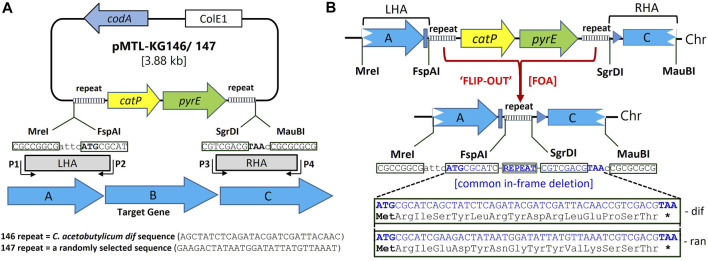
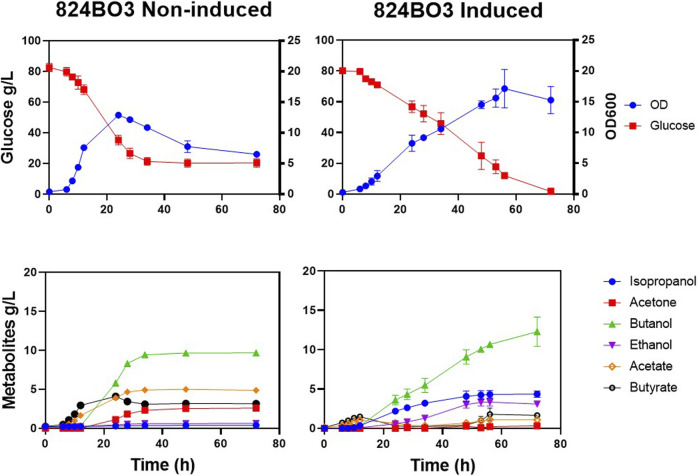
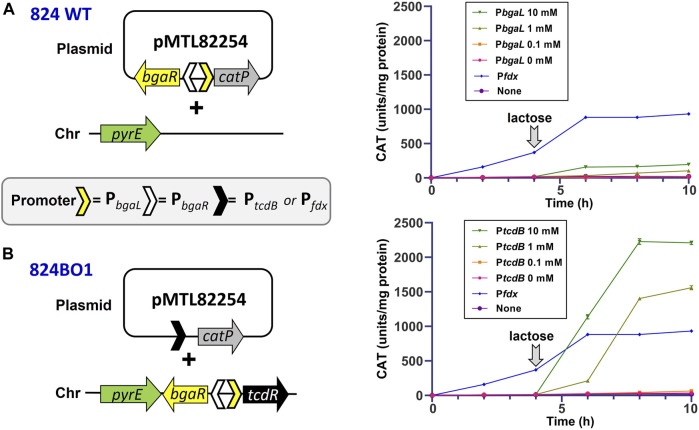
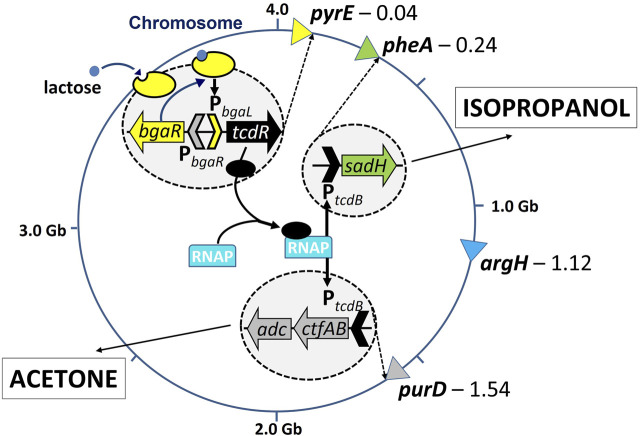
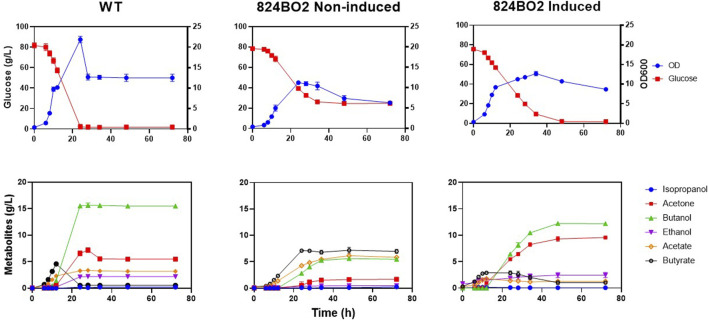
The use of environmentally damaging petrochemical feedstocks can be displaced by fermentation processes based on engineered microbial chassis that recycle biomass-derived carbon into chemicals and fuels. The stable retention of introduced genes, designed to extend product range and/or increase productivity, is essential. Accordingly, we have created multiply marked auxotrophic strains of that provide distinct loci (, , , ) at which heterologous genes can be rapidly integrated using allele-coupled exchange (ACE). For each locus, ACE-mediated insertion is conveniently selected on the basis of the restoration of prototrophy on minimal media. The gene () encoding an orthogonal sigma factor (TcdR) was integrated at the locus under the control of the lactose-inducible, P promoter to allow the simultaneous control of genes/operons inserted at other disparate loci ( and ) that had been placed under the control of the P promoter. In control experiments, dose-dependent expression of a reporter gene was observed with increasing lactose concentration. At the highest doses tested (10 mM) the level of expression was over 10-fold higher than if was placed directly under the control of P and over 2-fold greater than achieved using the strong P promoter of the ferredoxin gene. The utility of the system was demonstrated in the production of isopropanol by the strain carrying an integrated copy of following the insertion of a synthetic acetone operon () at the locus and a gene () encoding a secondary dehydrogenase at . Lactose induction (10 mM) resulted in the production of 4.4 g/L isopropanol and 19.8 g/L Isopropanol-Butanol-Ethanol mixture.
基于工程化微生物底盘的发酵过程可以取代对环境有破坏作用的石化原料,这种发酵过程能将生物质衍生的碳循环转化为化学品和燃料。稳定保留引入的基因对于扩大产品范围和/或提高生产力至关重要。因此,我们构建了多重标记的营养缺陷型菌株,这些菌株提供了不同的位点( 、 、 、 ),利用等位基因偶联交换(ACE)可在这些位点快速整合异源基因。对于每个位点,基于在基本培养基上原养型的恢复,可方便地选择ACE介导的插入。编码正交σ因子(TcdR)的 基因( )在乳糖诱导型P启动子的控制下整合到 位点,以便同时控制插入到其他不同位点( 和 )且已置于P启动子控制下的基因/操纵子。在对照实验中,随着乳糖浓度增加,观察到 报告基因的剂量依赖性表达。在测试的最高剂量(10 mM)下,表达水平比直接置于P启动子控制下高出10倍以上,比使用 铁氧化还原蛋白基因的强P启动子高出2倍以上。该系统的实用性在携带整合拷贝 的 菌株生产异丙醇的过程中得到了证明,该菌株在 位点插入了合成丙酮操纵子( ),并在 位点插入了编码次级脱氢酶的基因( )。乳糖诱导(10 mM)导致产生4.4 g/L异丙醇和19.8 g/L异丙醇 - 丁醇 - 乙醇混合物。