Moreira Paulo A S, Pinto Márcia, Cloninger C Robert, Rodrigues Daniela, da Silva Carlos Fernandes
Instituto de Psicologia e de Ciências da Educação, Universidade Lusíada-Norte (Porto), Porto, Portugal.
Centro de Investigação em Psicologia para o Desenvolvimento, CIPD, Porto, Portugal.
PeerJ. 2019 Mar 29;7:e6647. doi: 10.7717/peerj.6647. eCollection 2019.
To fully understand the dynamics of Intimate Partner Violence (IPV) it is necessary to understand the role of personality. The current understanding of which personality characteristics are associated with IPV victimization is, however, far from comprehensive. Given this gap in the literature, our objective was to examine the associations between the dimensions of the psychobiological model of personality and psychopathological symptoms in women who had experienced IPV.
Using a case-control design, a group of women who had experienced IPV and who were living in shelters ( = 50) were compared to a group of control women who had not experienced IPV ( = 50). All women completed the Temperament and Character Inventory-Revised and the Brief Symptom Inventory.
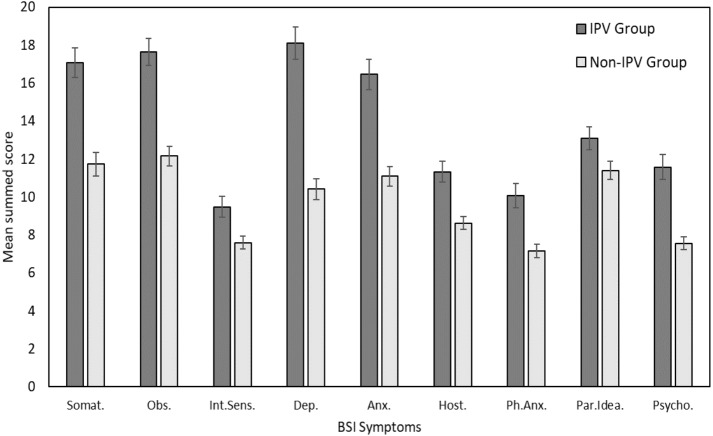
Victims of IPV showed significantly higher levels of Harm Avoidance and Self-Transcendence, and lower levels of Reward Dependence and Self-Directedness, than the non-IPV control group. Victims of IPV also reported elevated levels of psychopathological symptoms. Personality dimensions showed a broadly consistent pattern of associations across different psychopathological symptoms. A regression analysis indicated that Novelty Seeking was negatively associated with psychopathological symptoms in victims of IPV, but not significantly associated in non-victims.
The study highlights the important role of Harm Avoidance and Self-Directedness for understanding psychopathological symptoms. Novelty Seeking appears to play an important role in the expression of individuals' experiences of IPV. These results have important implications for research and practice, particularly the development and implementation of interventions.
要全面了解亲密伴侣暴力(IPV)的动态,有必要了解人格的作用。然而,目前对于哪些人格特征与IPV受害相关的理解还远不全面。鉴于文献中的这一空白,我们的目的是研究经历过IPV的女性的人格心理生物学模型维度与心理病理症状之间的关联。
采用病例对照设计,将一组经历过IPV且住在庇护所的女性(n = 50)与一组未经历过IPV的对照女性(n = 50)进行比较。所有女性都完成了修订版气质与性格量表以及简明症状量表。
与非IPV对照组相比,IPV受害者表现出显著更高水平的回避伤害和自我超越,以及更低水平的奖赏依赖和自我导向。IPV受害者还报告了更高水平的心理病理症状。人格维度在不同心理病理症状中呈现出大致一致的关联模式。回归分析表明,寻求新奇与IPV受害者的心理病理症状呈负相关,但在非受害者中无显著关联。
该研究突出了回避伤害和自我导向在理解心理病理症状方面的重要作用。寻求新奇似乎在个体IPV经历的表达中起重要作用。这些结果对研究和实践具有重要意义,特别是在干预措施的制定和实施方面。