Khan Md Hafijur Rahaman, Rahman Ananna, Luo Chuanxiu, Kumar Sazal, Islam G M Ariful, Hossain Mohammad Akram
Key Laboratory of Ocean and Marginal Sea Geology, South China Sea Institute of Oceanology, Chinese Academy of Sciences, Guangzhou, 510301, China.
University of Chinese Academy of Sciences, Beijing, 100049, China.
Heliyon. 2019 Mar 20;5(3):e01268. doi: 10.1016/j.heliyon.2019.e01268. eCollection 2019 Mar.
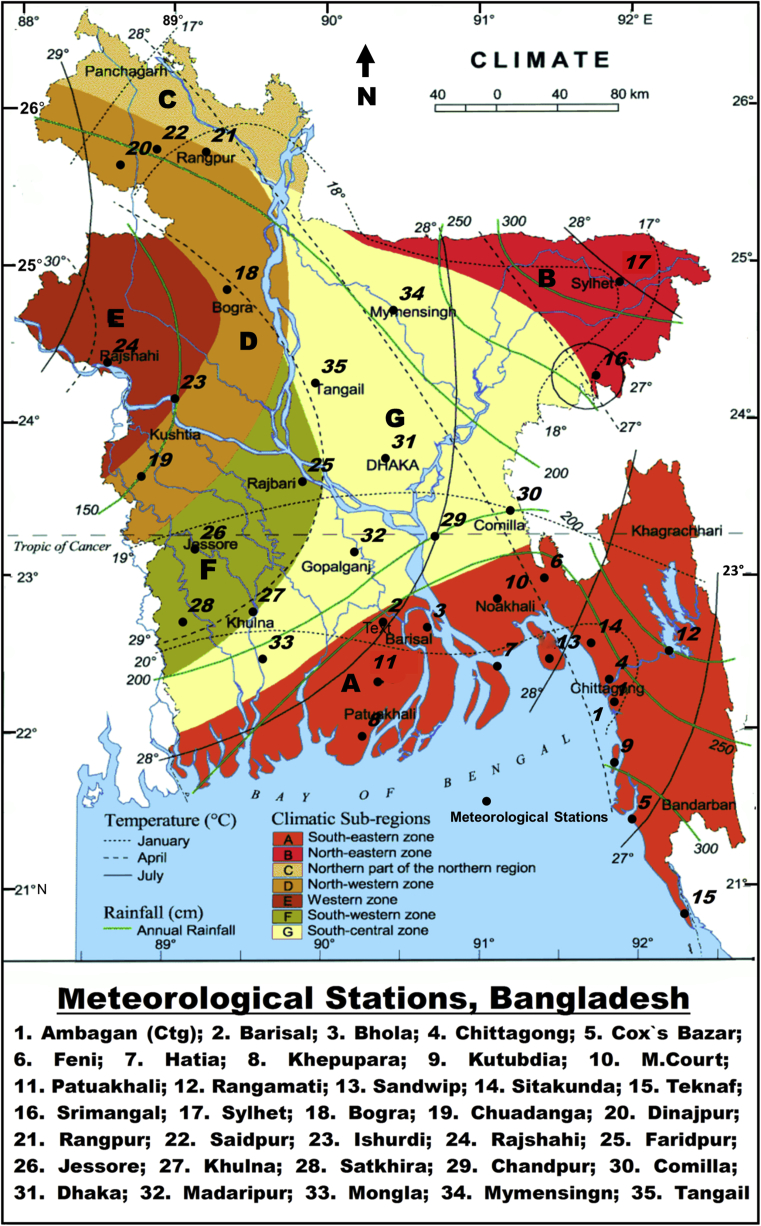
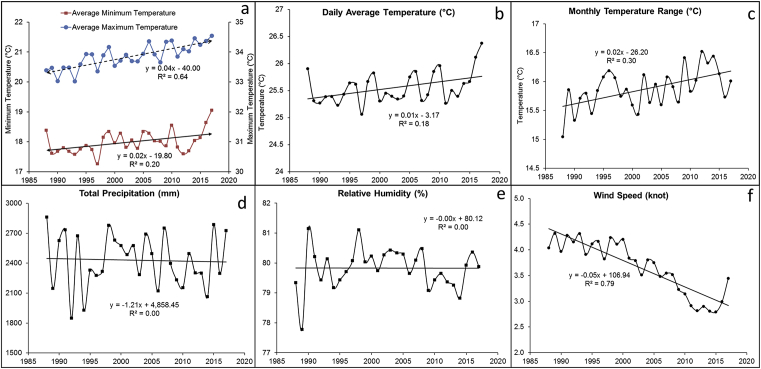
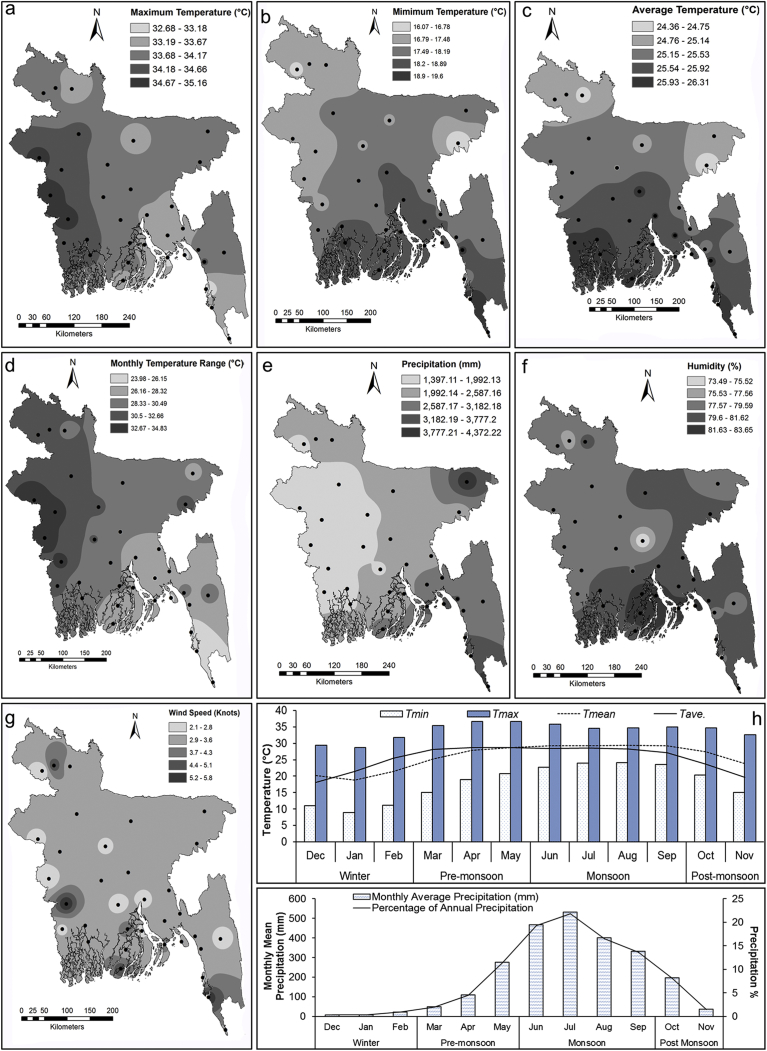
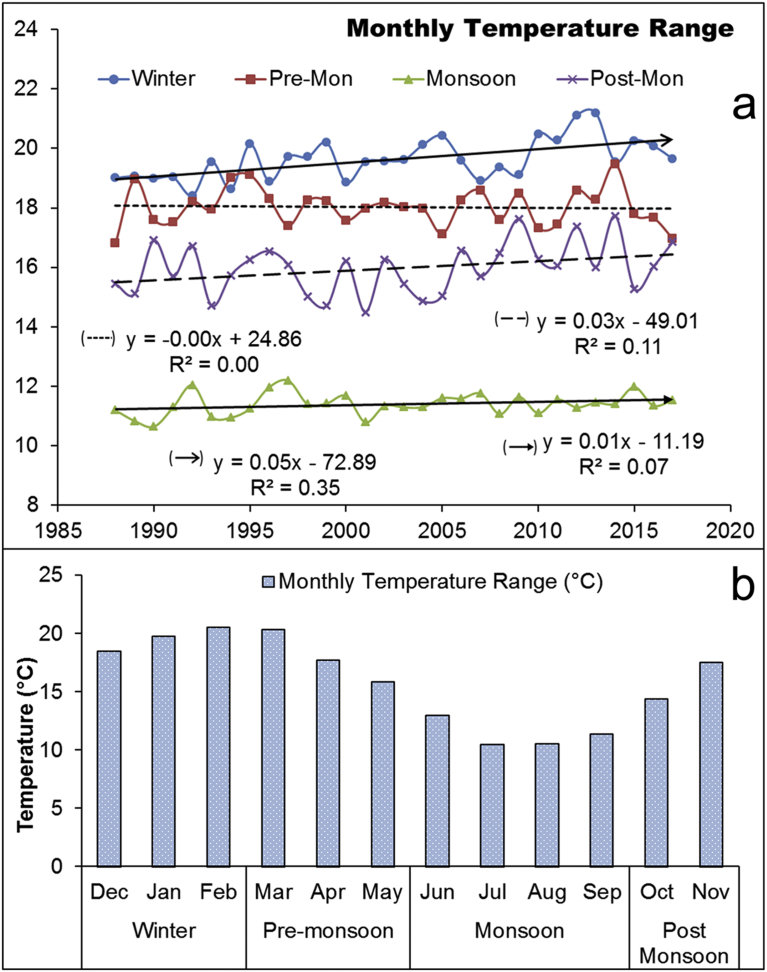
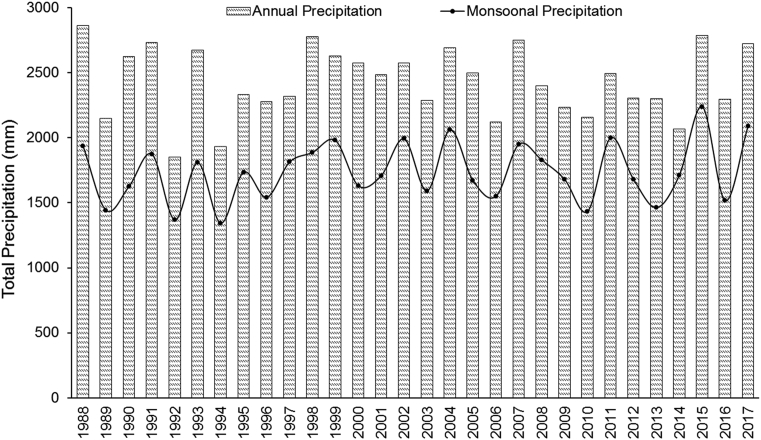
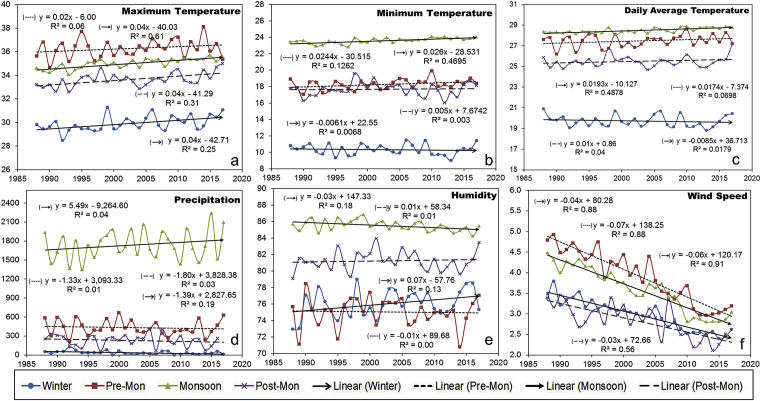
Due to the importance of climatic variability, an assessment detecting the changes and trends has been carried out over different time series of major climatic variables from the records of meteorological stations over Bangladesh from 1988-2017. Linear regression, the Mann-Kendall test, and Sen's slope method were used to analyze the significant trends and magnitude of the variables' changes, while the Pearson and Spearman rho correlation test have been applied to correlate between the variables. The results show that the average monthly maximum temperature ( ) and minimum temperature ( ) have increased significantly by 0.35 °C/decade and 0.16 °C/decade, respectively. However, the increase in is comparatively higher than and caused significant increases in the monthly temperature range (MTR) at a higher rate in winter than in the monsoon season. The trend patterns of , , and MTR reveal that most of the regions of the country (especially the south-eastern and north-eastern) have been colder during winter and hotter during the monsoon. In contrast, the wind speed (WS) has decreased significantly all over the country and decreased by a higher rate in the north-western (NW) region (monsoon, 0.60 and annual, 0.51 kt/decade) than other regions, while the monsoonal and annual precipitation have decreased by 87.35 mm/decade and 107 mm/decade, respectively. The monsoonal and (0.47 °C/decade and 0.38 °C/decade, respectively) have increased significantly in the NW; consequently, this region has been warmed by 0.27 °C/decade. The increase in temperature and decrease in WS may cause a decrease in rainfall in the NW region. Humidity changes are not significant except in the monsoon season across the country. Precipitation, WS, and humidity are negatively correlated with the temperature variables. The declination of WS may influence the rising trend in temperature and the falling trend in precipitation and humidity, suggesting the need for further advanced study on the negative effects of climate change in Bangladesh.
由于气候变率的重要性,已基于1988 - 2017年孟加拉国气象站记录的主要气候变量的不同时间序列开展了一项检测变化和趋势的评估。采用线性回归、曼 - 肯德尔检验和森斜率法分析变量变化的显著趋势和幅度,同时应用皮尔逊和斯皮尔曼秩相关检验来关联变量。结果表明,月平均最高温度( )和最低温度( )分别以0.35℃/十年和0.16℃/十年的幅度显著上升。然而, 的增幅相对高于 ,并导致冬季月温度范围(MTR)的显著增加速率高于季风季节。 、 和MTR的趋势模式表明,该国大部分地区(特别是东南部和东北部)冬季更冷,季风季节更热。相比之下,全国风速(WS)显著下降,且西北(NW)地区下降速率更高(季风期为0.60,年平均为0.51节/十年),而季风期和年降水量分别下降了87.35毫米/十年和107毫米/十年。西北地区季风期的 和 (分别为0.47℃/十年和0.38℃/十年)显著增加;因此,该地区已以0.27℃/十年的速度变暖。温度升高和风速下降可能导致西北地区降雨量减少。除全国季风季节外,湿度变化不显著。降水量、风速和湿度与温度变量呈负相关。风速的下降可能影响温度的上升趋势以及降水量和湿度的下降趋势,这表明需要对孟加拉国气候变化的负面影响开展进一步的深入研究。