Laboratory of Neurogenetics, National Institute on Aging, National Institutes of Health, Bethesda, Maryland, USA.
Neurodegenerative Diseases Research Unit, National Institute of Neurological Disorders and Stroke, National Institutes of Health, Bethesda, Maryland, USA.
Mov Disord. 2019 Jun;34(6):866-875. doi: 10.1002/mds.27659. Epub 2019 Apr 7.
Increasing evidence supports an extensive and complex genetic contribution to PD. Previous genome-wide association studies (GWAS) have shed light on the genetic basis of risk for this disease. However, the genetic determinants of PD age at onset are largely unknown.
To identify the genetic determinants of PD age at onset.
Using genetic data of 28,568 PD cases, we performed a genome-wide association study based on PD age at onset.
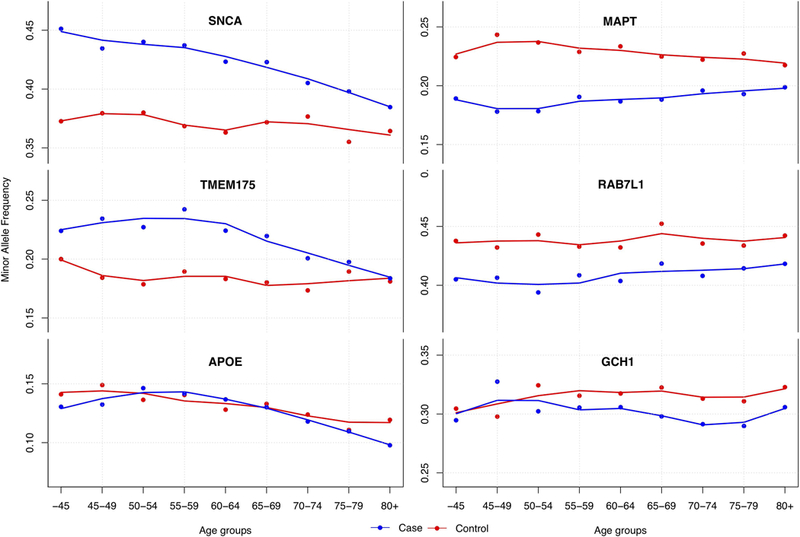
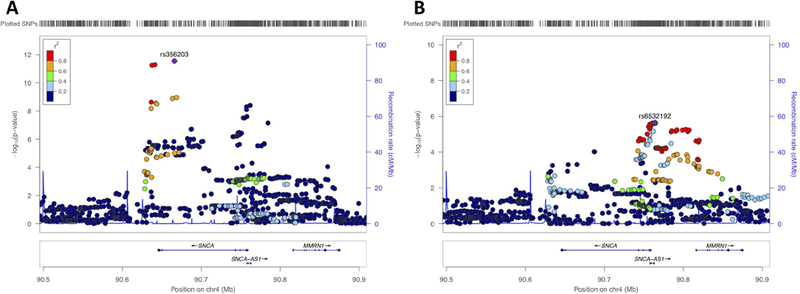
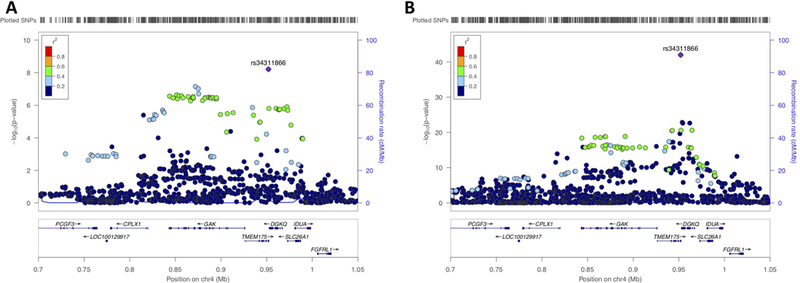
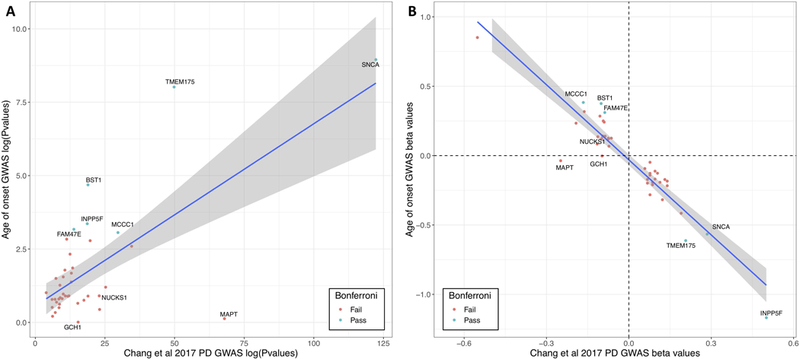
We estimated that the heritability of PD age at onset attributed to common genetic variation was ∼0.11, lower than the overall heritability of risk for PD (∼0.27), likely, in part, because of the subjective nature of this measure. We found two genome-wide significant association signals, one at SNCA and the other a protein-coding variant in TMEM175, both of which are known PD risk loci and a Bonferroni-corrected significant effect at other known PD risk loci, GBA, INPP5F/BAG3, FAM47E/SCARB2, and MCCC1. Notably, SNCA, TMEM175, SCARB2, BAG3, and GBA have all been shown to be implicated in α-synuclein aggregation pathways. Remarkably, other well-established PD risk loci, such as GCH1 and MAPT, did not show a significant effect on age at onset of PD.
Overall, we have performed the largest age at onset of PD genome-wide association studies to date, and our results show that not all PD risk loci influence age at onset with significant differences between risk alleles for age at onset. This provides a compelling picture, both within the context of functional characterization of disease-linked genetic variability and in defining differences between risk alleles for age at onset, or frank risk for disease. © 2019 International Parkinson and Movement Disorder Society.
越来越多的证据支持 PD 存在广泛而复杂的遗传因素。先前的全基因组关联研究(GWAS)揭示了这种疾病风险的遗传基础。然而,PD 发病年龄的遗传决定因素在很大程度上尚不清楚。
确定 PD 发病年龄的遗传决定因素。
利用 28568 例 PD 病例的遗传数据,我们基于 PD 发病年龄进行了全基因组关联研究。
我们估计,常见遗传变异引起的 PD 发病年龄的遗传率约为 0.11,低于 PD 总体风险的遗传率(约 0.27),部分原因可能是这种测量方法具有主观性。我们发现了两个全基因组显著关联信号,一个位于 SNCA,另一个位于 TMEM175 中的一个蛋白编码变异,这两个都是已知的 PD 风险基因座,并且在其他已知的 PD 风险基因座(GBA、INPP5F/BAG3、FAM47E/SCARB2 和 MCCC1)中也存在 Bonferroni 校正后的显著效应。值得注意的是,SNCA、TMEM175、SCARB2、BAG3 和 GBA 均已被证明与 α-突触核蛋白聚集途径有关。值得注意的是,其他已确立的 PD 风险基因座,如 GCH1 和 MAPT,对 PD 的发病年龄没有显著影响。
总的来说,我们进行了迄今为止最大的 PD 发病年龄全基因组关联研究,我们的研究结果表明,并非所有 PD 风险基因座都会对发病年龄产生显著影响,不同的风险等位基因之间存在显著差异。这为疾病相关遗传变异性的功能特征以及发病年龄或疾病的真正风险的风险等位基因之间的差异提供了强有力的说明。 © 2019 国际帕金森病和运动障碍学会。