Yang Fei, Zhao Li Na, Sun Yi, Chen Zhuang
Department of Critical Care Medicine, Chi Feng City Hospital, Inner Mongolia Province, Chifeng, China.
J Int Med Res. 2019 May;47(5):1817-1828. doi: 10.1177/0300060519837103. Epub 2019 Apr 8.
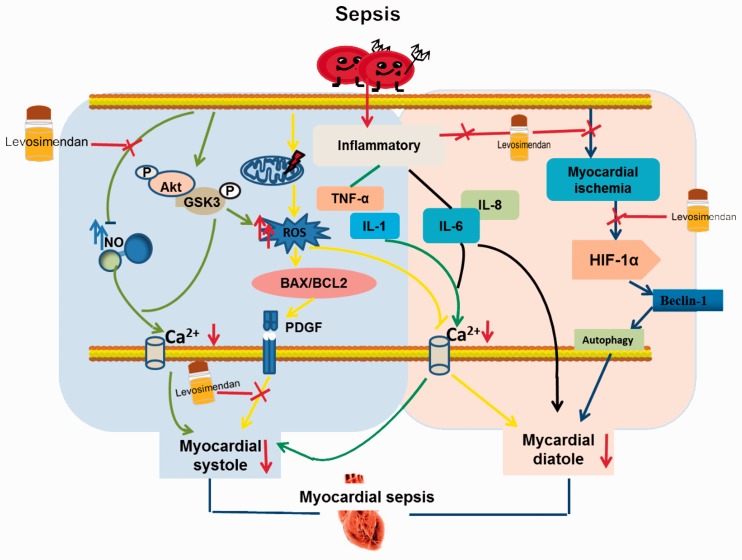
The heart is one of the organs most vulnerable to sepsis. This review describes the general characteristics of sepsis-induced cardiomyopathy and the main pathogenesis of myocardial dysfunction in sepsis. Levosimendan is a novel drug for treatment of sepsis-induced myocardial dysfunction. This review also elaborates on the pathogenesis of levosimendan, including the mechanisms of its anti-inflammatory effects, improvement of myocardial ischaemia, increased synthesis of nitric oxide, vascular endothelial cell protection, increased myocardial contractility, improved diastolic function, and inhibition of hypoxia-inducible factor-1α expression. Many clinical studies have proven that levosimendan effectively prevents myocardial dysfunction in sepsis. In addition to the widespread use of levosimendan in patients with heart failure, the role of levosimendan in the treatment of patients with sepsis-induced cardiomyopathy will be increasingly studied and applied in the future.
心脏是最易受脓毒症影响的器官之一。本综述描述了脓毒症诱导的心肌病的一般特征以及脓毒症中心肌功能障碍的主要发病机制。左西孟旦是一种用于治疗脓毒症诱导的心肌功能障碍的新型药物。本综述还阐述了左西孟旦的发病机制,包括其抗炎作用机制、改善心肌缺血、增加一氧化氮合成、保护血管内皮细胞、增加心肌收缩力、改善舒张功能以及抑制缺氧诱导因子-1α表达。许多临床研究已证明左西孟旦可有效预防脓毒症中的心肌功能障碍。除了左西孟旦在心力衰竭患者中的广泛应用外,左西孟旦在治疗脓毒症诱导的心肌病患者中的作用在未来将得到越来越多的研究和应用。