Faculty of Health, University of Technology, Sydney, New South Wales, Australia.
Hunter New England Health, Newcastle, New South Wales, Australia.
PLoS One. 2019 Apr 8;14(4):e0214298. doi: 10.1371/journal.pone.0214298. eCollection 2019.
To describe the epidemiology of EOS including blood culture utilisation, across a large and geographically diverse Australian health district.
Sepsis in the first three days of life remains a leading cause of death and morbidity. In high-income countries, group B Streptococcus (GBS) and Escherichia coli (E. coli) have dominated as causes of EOS for five decades.
An 11-year retrospective cohort study to determine the epidemiology of EOS. Incidence rates were calculated per 1000 live births. Logistic regression with linear temporal trend and covariates for potential effect modifiers were employed. Blood culture utilisation was determined by examining the rate of babies undergoing blood culture within 72 hours of birth.
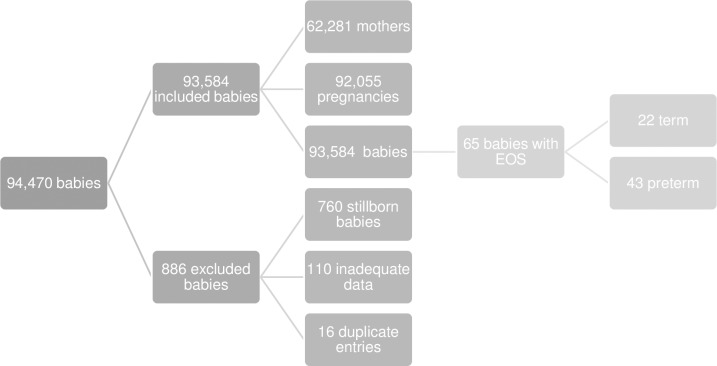
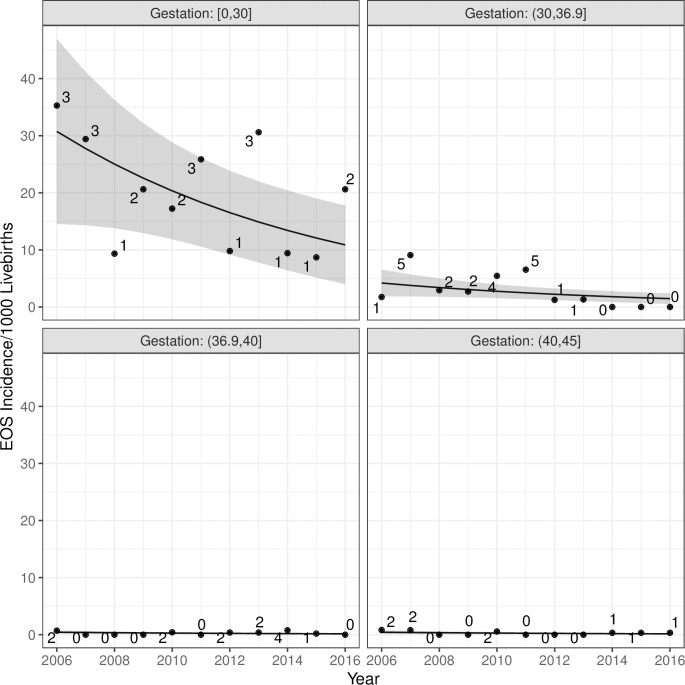
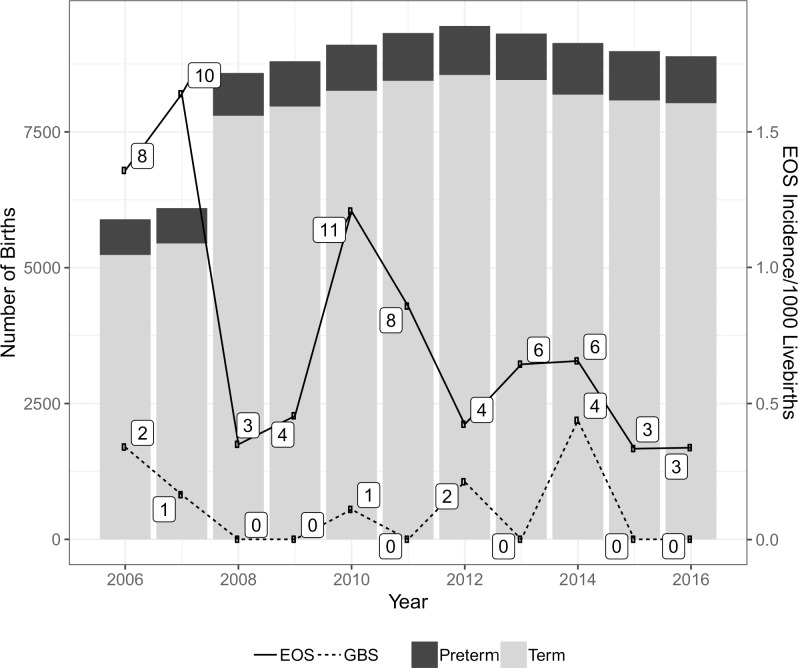
Among 93,584 live born babies, 65 had confirmed EOS (0.69/1000 live births); 22 term, 43 preterm. Across the 4 largest birth units, the proportion of babies having blood culture within 72 hours of birth varied from 1.9-5.1% for term and 21-35% for preterm babies. The annual change in the EOS rate was significant, OR 0.91 (95% CI, 0.84 to 0.99, p = 0.03). Group B Streptococcus was the most common cause of EOS in term neonates at 0.35/1000 live births (95% CI, 0.07-0.63) in 2006 and 0.1/1000 live births (95% CI, 0-0.2) in 2016. Escherichia coli was the most common cause in preterm babies at 3.4/1000 (95% CI, 0.11-6.76) in 2006 reducing significantly to 1.35/1000 live births (95% CI, -0.07-2.78) by 2016.
Escherichia coli and GBS were the most common causes of EOS in preterm and term babies respectively. Rates of all cause term and preterm EOS declined significantly as did preterm sepsis due to E. coli. While rate of sepsis due to early-onset GBS declined, this did not reach significance. Given the high proportion of preterm babies undergoing blood culture, it is unlikely that any EOS events were missed.
描述包括血培养利用在内的 EOS 的流行病学情况,该研究覆盖了一个大型且地域多样化的澳大利亚卫生区。
生命最初三天的败血症仍然是死亡和发病的主要原因。在高收入国家,B 组链球菌(GBS)和大肠杆菌(E. coli)作为 EOS 的病因已经主导了五十年。
这是一项回顾性队列研究,旨在确定 EOS 的流行病学情况。发病率按每 1000 例活产计算。采用具有线性时间趋势和潜在效应修饰因子的逻辑回归进行分析。通过检查出生后 72 小时内进行血培养的婴儿比例来确定血培养的利用情况。
在 93584 例活产婴儿中,有 65 例确诊为 EOS(0.69/1000 例活产);22 例足月,43 例早产。在 4 个最大的分娩单位中,足月婴儿在出生后 72 小时内进行血培养的比例为 1.9-5.1%,而早产儿的比例为 21-35%。EOS 发生率的年度变化具有统计学意义,OR 为 0.91(95%CI,0.84-0.99,p=0.03)。GBS 是足月新生儿 EOS 最常见的病因,在 2006 年为 0.35/1000 例活产(95%CI,0.07-0.63),在 2016 年为 0.1/1000 例活产(95%CI,0-0.2)。大肠杆菌是早产儿 EOS 最常见的病因,在 2006 年为 3.4/1000(95%CI,0.11-6.76),到 2016 年显著减少至 1.35/1000 例活产(95%CI,-0.07-2.78)。
大肠杆菌和 GBS 分别是早产儿和足月儿 EOS 的最常见病因。所有病因导致的足月和早产儿 EOS 发生率以及由大肠杆菌引起的早产儿败血症发生率均显著下降。虽然早发型 GBS 引起的败血症发生率有所下降,但没有达到统计学意义。鉴于接受血培养的早产儿比例较高,不太可能遗漏任何 EOS 事件。