Yong Loo Lin School of Medicine, National University of Singapore, Singapore 119228, Singapore.
Department of Medicine, Yong Loo Lin School of Medicine, National University of Singapore, Singapore 119228, Singapore.
Cells. 2019 Apr 6;8(4):323. doi: 10.3390/cells8040323.
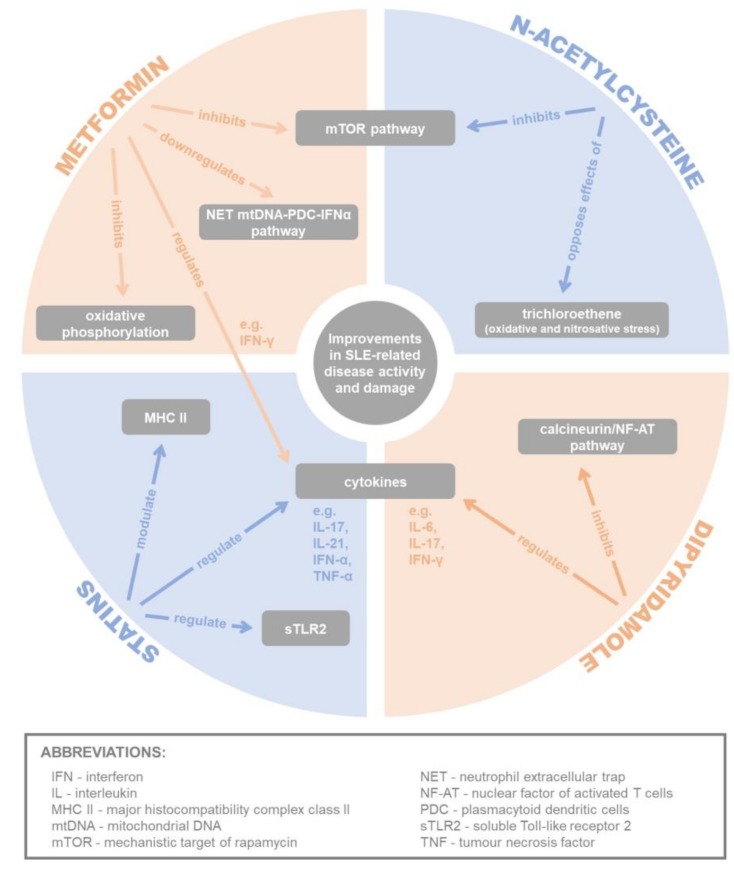
Systemic lupus erythematosus (SLE) is a chronic inflammatory autoimmune condition that can potentially affect every single organ during the course of the disease, leading to increased morbidity and mortality, and reduced health-related quality of life. While curative treatment is currently non-existent for SLE, therapeutic agents such as glucocorticoids, mycophenolate, azathioprine, cyclosporine, cyclophosphamide and various biologics are the mainstay of treatment based on their immunomodulatory and immunosuppressive properties. As a result of global immunosuppression, the side-effect profile of the current therapeutic approach is unfavourable, with adverse effects including myelosuppression, infection and malignancies. Hydroxychloroquine, one of the very few Food and Drug Administration (FDA)-approved medications for the treatment of SLE, has been shown to offer a number of therapeutic benefits to SLE patients independent of its immunomodulatory effect. As such, it is worth exploring drugs similar to hydroxychloroquine that confer additional clinical benefits unrelated to immunosuppressive mechanisms. Indeed, apart from hydroxychloroquine, a number of studies have explored the use of a few conventionally non-immunosuppressive drugs that are potentially useful in the management of SLE. In this review, non-immunosuppressive therapeutic agents, namely metformin, dipyridamole, N-acetylcysteine and statins, will be critically discussed with regard to their mechanisms of action and efficacy pertaining to their potential therapeutic role in SLE.
系统性红斑狼疮(SLE)是一种慢性炎症性自身免疫性疾病,在疾病过程中可能会影响到每一个器官,导致发病率和死亡率增加,以及健康相关生活质量降低。虽然目前针对 SLE 还没有治愈性的治疗方法,但糖皮质激素、霉酚酸酯、硫唑嘌呤、环孢素、环磷酰胺和各种生物制剂等治疗药物基于其免疫调节和免疫抑制特性,是治疗的主要手段。由于全球免疫抑制,当前治疗方法的副作用谱不理想,包括骨髓抑制、感染和恶性肿瘤等不良反应。羟氯喹是 FDA 批准用于治疗 SLE 的少数几种药物之一,它除了具有免疫调节作用外,还能为 SLE 患者带来许多治疗益处。因此,值得探索类似于羟氯喹的药物,这些药物具有与免疫抑制机制无关的额外临床益处。事实上,除了羟氯喹之外,还有一些研究探索了几种传统上非免疫抑制性药物的用途,这些药物在 SLE 的治疗中可能有用。在这篇综述中,我们将重点讨论非免疫抑制性治疗药物,即二甲双胍、双嘧达莫、N-乙酰半胱氨酸和他汀类药物,讨论它们的作用机制和疗效,以及它们在 SLE 中的潜在治疗作用。