Zheng Bing, Deng Tianzhengxiong, Li Maoyuan, Huang Zhigao, Zhou Huamin, Li Dequn
State Key Laboratory of Material Processing and Die & Mold Technology, Huazhong University of Science and Technology, Wuhan 430074, China.
Polymers (Basel). 2018 Dec 23;11(1):18. doi: 10.3390/polym11010018.
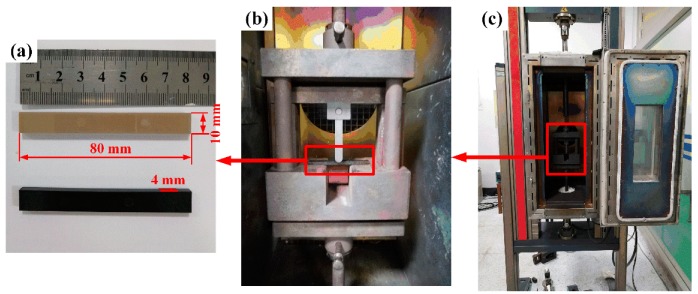
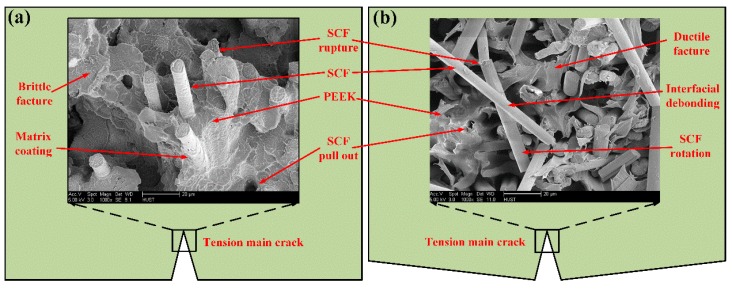
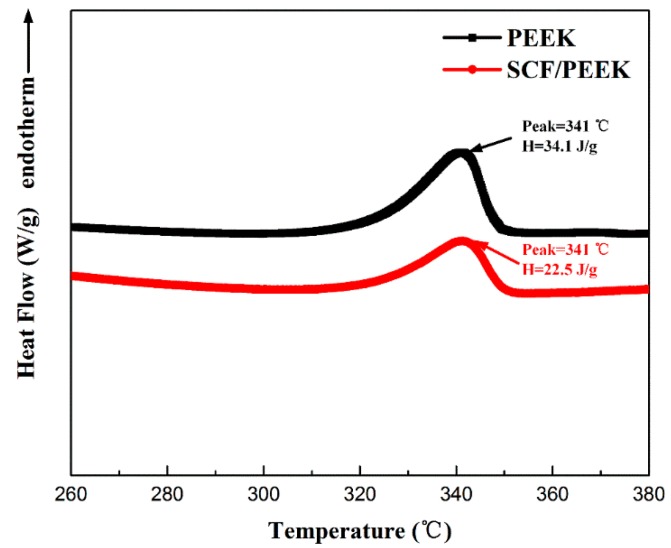
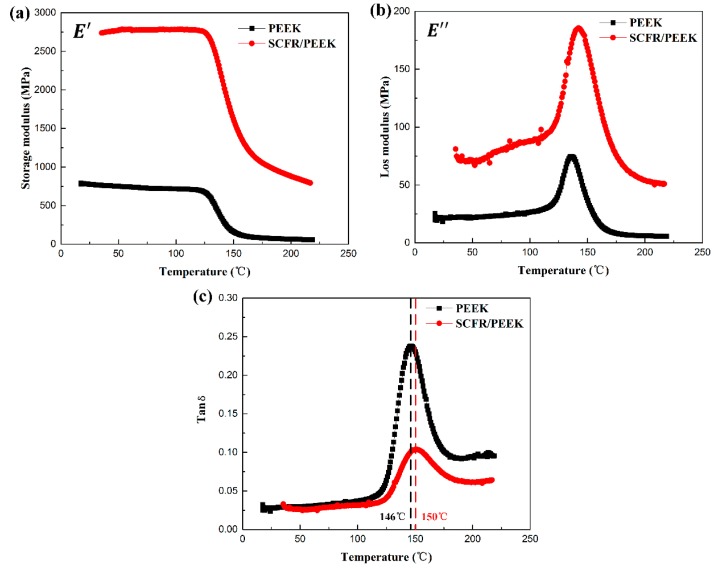
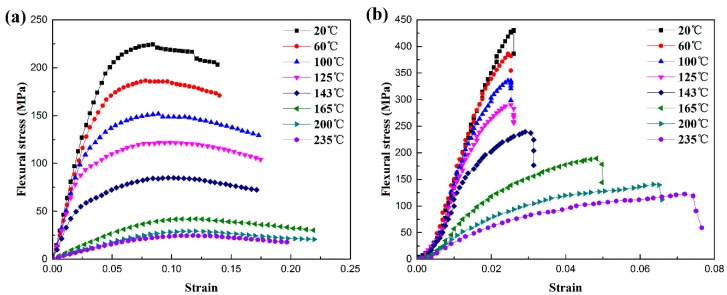
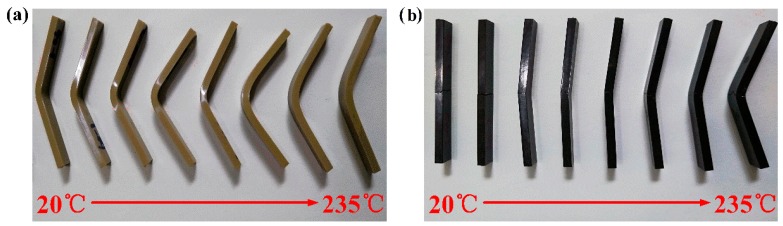
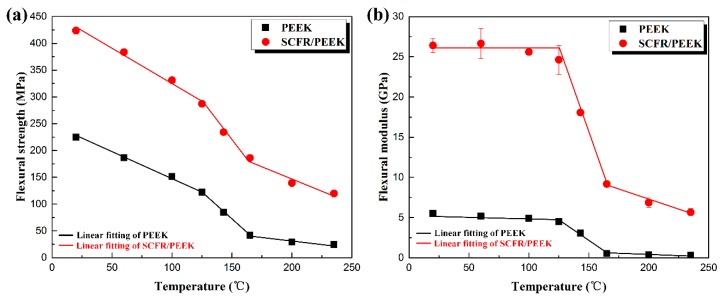
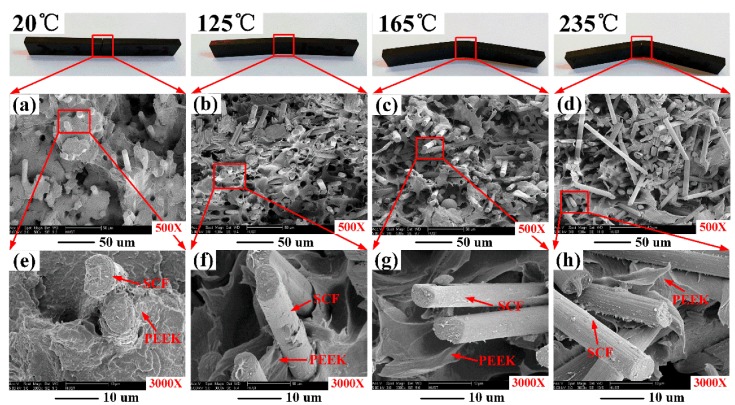
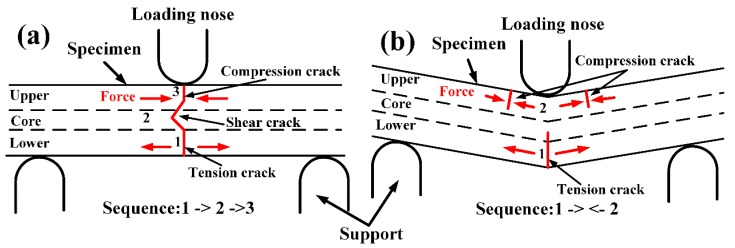
In this study, the flexural behavior and fracture mechanisms of short carbon fiber reinforced polyether-ether-ketone (SCFR/PEEK) composites at various ambient temperatures were investigated. First, the crystallinity and glass transition temperature () of PEEK and SCFR/PEEK were analyzed by differential scanning calorimetry analysis and dynamic mechanical analysis tests, respectively. The addition of SCFs increases the but does not change the crystallinity of the PEEK matrix. Then, the three-point flexural tests of PEEK and SCFR/PEEK were performed over the temperature range of 20 to 235 °C, and the temperature-dependencies of the flexural properties of PEEK and SCFR/PEEK were discussed in detail. Finally, the microstructure of SCFR/PEEK was observed using a digital microscope and scanning electron microscope. The results show that the tension crack occurs first, and the crack extends upward leading to the shear crack and compression crack at room temperature. The fracture of SCFR/PEEK is mainly due to the extraction and rupture of SCFs. At high temperatures (above ), the tension crack and compression crack both occur, and the strong ductility of the matrix prevents the generation of shear crack. The fracture of SCFR/PEEK is mainly due to the rotation and extraction of SCFs, while the SCFs rupture plays a minor role.
在本研究中,对短碳纤维增强聚醚醚酮(SCFR/PEEK)复合材料在不同环境温度下的弯曲行为和断裂机制进行了研究。首先,分别通过差示扫描量热分析和动态力学分析试验对PEEK和SCFR/PEEK的结晶度和玻璃化转变温度()进行了分析。短碳纤维的加入提高了玻璃化转变温度,但并未改变PEEK基体的结晶度。然后,在20至235°C的温度范围内对PEEK和SCFR/PEEK进行了三点弯曲试验,并详细讨论了PEEK和SCFR/PEEK弯曲性能的温度依赖性。最后,使用数码显微镜和扫描电子显微镜观察了SCFR/PEEK的微观结构。结果表明,在室温下,拉伸裂纹首先出现,裂纹向上扩展导致剪切裂纹和压缩裂纹。SCFR/PEEK的断裂主要是由于短碳纤维的拔出和断裂。在高温(高于)下,拉伸裂纹和压缩裂纹均会出现,基体的强韧性阻止了剪切裂纹的产生。SCFR/PEEK的断裂主要是由于短碳纤维的旋转和拔出,而短碳纤维的断裂起次要作用。