Materials Science Division, Argonne National Laboratory, Argonne, IL 60439.
Materials Science Division, Argonne National Laboratory, Argonne, IL 60439;
Proc Natl Acad Sci U S A. 2019 May 21;116(21):10291-10296. doi: 10.1073/pnas.1817417116. Epub 2019 Apr 8.
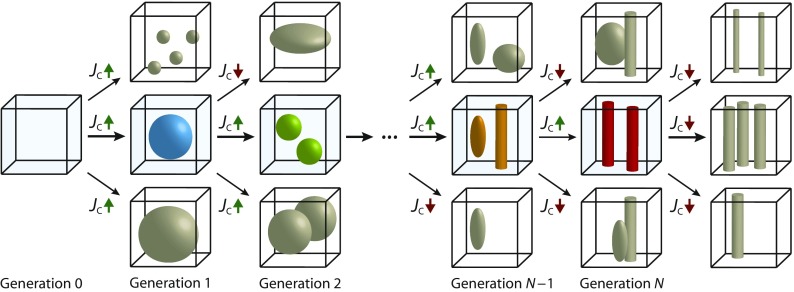
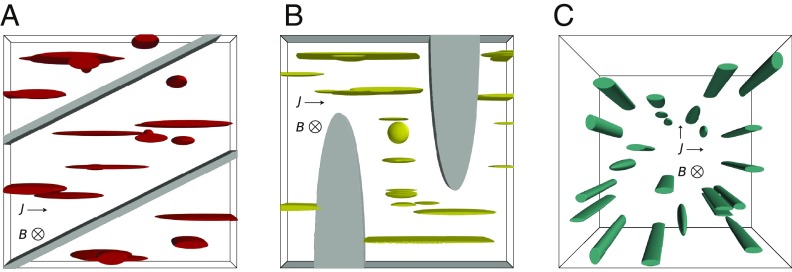
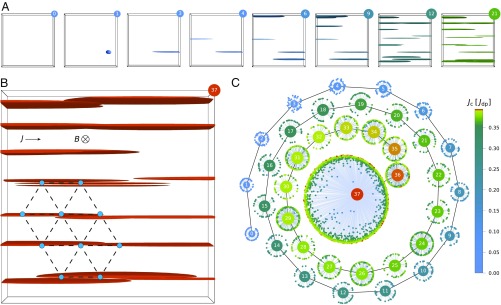
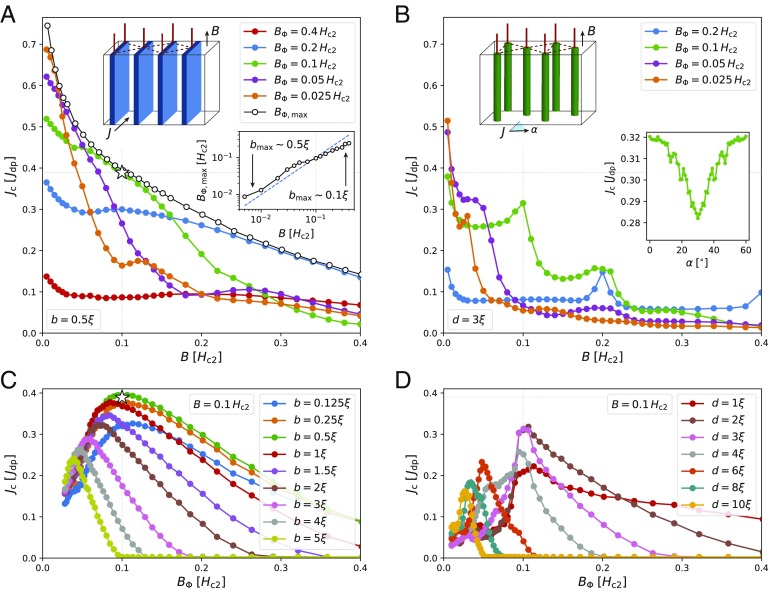
The ability of type II superconductors to carry large amounts of current at high magnetic fields is a key requirement for future design innovations in high-field magnets for accelerators and compact fusion reactors, and largely depends on the vortex pinning landscape comprised of material defects. The complex interaction of vortices with defects that can be grown chemically, e.g., self-assembled nanoparticles and nanorods, or introduced by postsynthesis particle irradiation precludes a priori prediction of the critical current and can result in highly nontrivial effects on the critical current. Here, we borrow concepts from biological evolution to create a vortex pinning genome based on a genetic algorithm, naturally evolving the pinning landscape to accommodate vortex pinning and determine the best possible configuration of inclusions for two different scenarios: a natural evolution process initiating from a pristine system and one starting with preexisting defects to demonstrate the potential for a postprocessing approach to enhance critical currents. Furthermore, the presented approach is even more general and can be adapted to address various other targeted material optimization problems.
II 型超导体在强磁场中承载大电流的能力是未来加速器用强磁场磁体和紧凑型聚变反应堆设计创新的关键要求,在很大程度上取决于由材料缺陷组成的涡旋钉扎景观。涡旋与可以通过化学方法生长的缺陷(例如,自组装纳米粒子和纳米棒)的复杂相互作用,或者通过合成后粒子辐照引入,排除了对临界电流的先验预测,并可能对临界电流产生高度非平凡的影响。在这里,我们借鉴生物进化的概念,基于遗传算法创建一个涡旋钉扎基因组,自然地演化钉扎景观以适应涡旋钉扎,并确定两种不同情况的最佳夹杂物配置:一个从原始系统开始的自然进化过程和一个从预先存在的缺陷开始的过程,以证明后处理方法增强临界电流的潜力。此外,所提出的方法更加通用,可以适应各种其他有针对性的材料优化问题。