Pressman Alice, Lockhart Stephen, Petersen John, Robinson Sarah, Moreno Maria, Azar Kristen M J
Sutter Health Research Enterprise, Center for Health Systems Research, Walnut Creek, California.
Sutter Health Quality Improvement, Office of Patient Experience, Sacramento, California.
Health Equity. 2019 Apr 3;3(1):92-98. doi: 10.1089/heq.2018.0092. eCollection 2019.
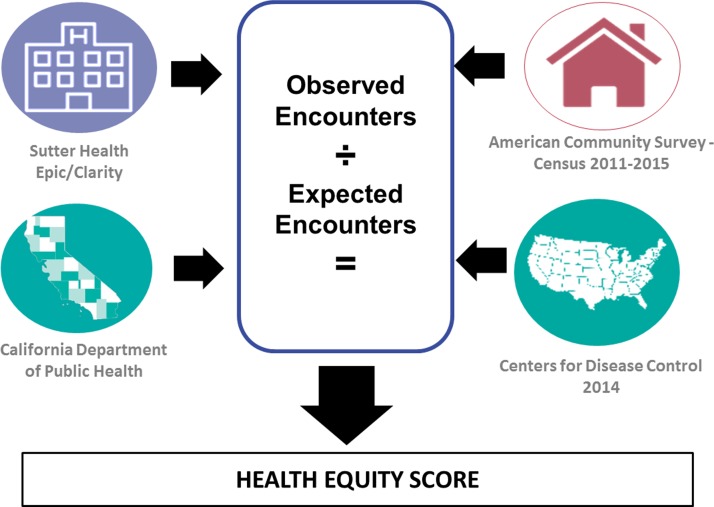
Disparities in outcomes for preventive and primary health care services often result when vulnerable patients rely on episodic encounters for emergency services that do not meet their long-term health needs. Understanding health outcomes in socially or economically disadvantaged subgroups is crucial to improving community health, and it requires innovative analytics and dynamic application of clinical and population data. While it is common practice to use proxy indicators, such as quality of life and mortality, when discussing health equity, these have shown limited utility and are rarely applied at a population-level within a health system. Therefore, we designed and implemented an index, calculated as the ratio of observed-to-expected encounters, to identify and quantify health inequalities in health care systems. Providing equitable care, as measured by health outcomes, is analogous to precision medicine applied to social determinants. For health systems, the use of this index will facilitate the development of specially-tailored interventions to address inequity and provides a tool to measure the impact of such programs.
当弱势患者依赖针对急诊服务的偶发性就诊,而这些服务无法满足他们的长期健康需求时,预防性和初级卫生保健服务的结果往往会出现差异。了解社会或经济弱势群体的健康结果对于改善社区健康至关重要,这需要创新的分析方法以及临床和人群数据的动态应用。虽然在讨论健康公平性时使用诸如生活质量和死亡率等替代指标是常见做法,但这些指标的效用有限,并且很少在卫生系统内的人群层面应用。因此,我们设计并实施了一个指数,该指数通过观察到的就诊次数与预期就诊次数的比率来计算,以识别和量化卫生保健系统中的健康不平等现象。以健康结果衡量提供公平的医疗服务类似于应用于社会决定因素的精准医疗。对于卫生系统而言,使用该指数将有助于制定专门定制的干预措施以解决不平等问题,并提供一种衡量此类项目影响的工具。