Wang Ai-Qin, Kong Li-Na, Meng Ming-Zhu, Zhao Xiu-He, Chen Si, Wang Xiao-Tang
Qilu Hospital of Shandong University, Jinan, Shandong Province, China.
Neural Regen Res. 2019 Aug;14(8):1438-1444. doi: 10.4103/1673-5374.253527.
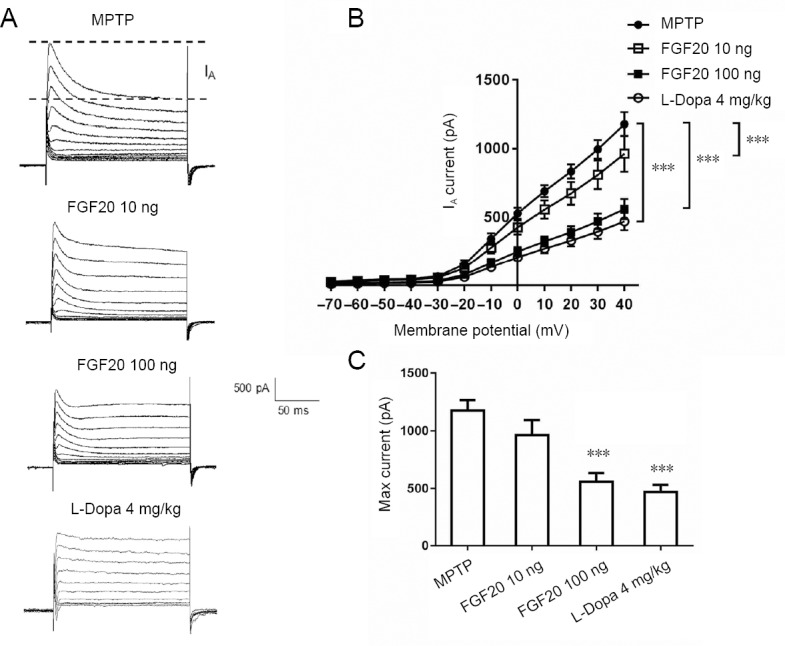
Genome-wide studies have reported that Parkinson's disease is associated with abnormal expression of various growth factors. In this study, male C57BL/6 mice aged 10 weeks were used to establish Parkinson's disease models using an intraperitoneal injection of 60 mg/kg 1-methyl-4-phenyl-1,2,3,6-tetrahydropyridine. 28 days later, 10 or 100 ng fibroblast growth factor 20 was injected intracerebroventricularly. The electrophysiological changes in the mouse hippocampus were recorded using a full-cell patch clamp. Expression of Kv4.2 in the substantia nigra was analyzed using a western blot assay. Serum malondialdehyde levels were analyzed by enzyme-linked immunosorbent assay. The motor coordination of mice was evaluated using the rotarod test. The results showed that fibroblast growth factor 20 decreased A-type potassium current in neurons of the substantia nigra, increased long-term potentiation amplitude in the hippocampus, and downregulated Kv4.2 expression. A high dose of fibroblast growth factor 20 reduced serum malondialdehyde levels and enhanced the motor coordination of mice. These findings confirm that fibroblast growth factor 20 has a therapeutic effect on the toxicity induced by 1-methyl-4-phenyl-1,2,3,6-tetrahydropyridine, and its mechanism of action is associated with the inhibition of A-type K currents and Kv4.2 expression. All animal procedures were approved by the Animal Care and Use Committee of Qilu Hospital of Shandong University, China in 2017 (approval No. KYLL-2017-0012).
全基因组研究报告称,帕金森病与多种生长因子的异常表达有关。在本研究中,使用10周龄的雄性C57BL/6小鼠,通过腹腔注射60 mg/kg 1-甲基-4-苯基-1,2,3,6-四氢吡啶来建立帕金森病模型。28天后,将10或100 ng成纤维细胞生长因子20脑室内注射。使用全细胞膜片钳记录小鼠海马体的电生理变化。通过蛋白质免疫印迹分析黑质中Kv4.2的表达。通过酶联免疫吸附测定分析血清丙二醛水平。使用转棒试验评估小鼠的运动协调性。结果表明,成纤维细胞生长因子20降低了黑质神经元中的A型钾电流,增加了海马体中的长时程增强幅度,并下调了Kv4.2的表达。高剂量的成纤维细胞生长因子20降低了血清丙二醛水平,并增强了小鼠的运动协调性。这些发现证实,成纤维细胞生长因子20对1-甲基-4-苯基-1,2,3,6-四氢吡啶诱导的毒性具有治疗作用,其作用机制与抑制A型钾电流和Kv4.2表达有关。所有动物实验程序均于2017年获得中国山东大学齐鲁医院动物护理与使用委员会的批准(批准号:KYLL-2017-0012)。