Singh Shamsher, Jamwal Sumit, Kumar Puneet
Department of Pharmacology, I.S.F College of Pharmacy, Ferozepur Road, Moga, Punjab, India.
I.K. Gujral Punjab Technical University, Jalandhar, Punjab, India.
Neural Regen Res. 2017 Jul;12(7):1137-1144. doi: 10.4103/1673-5374.211194.
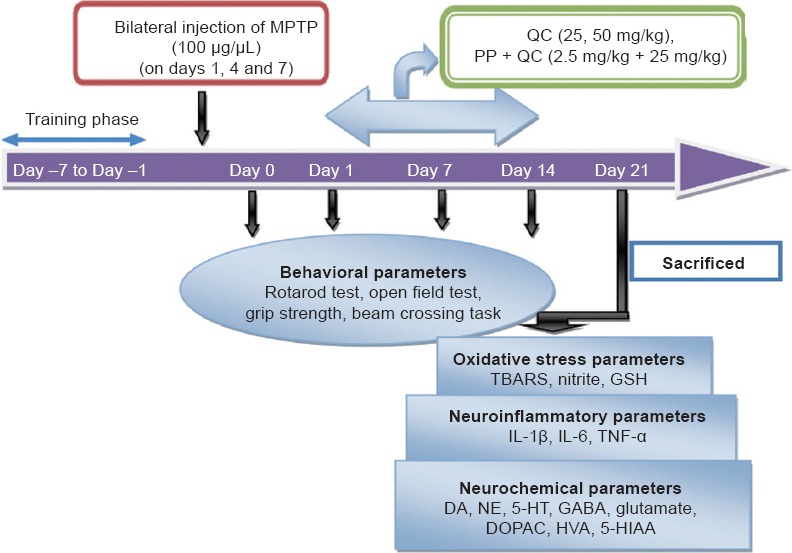
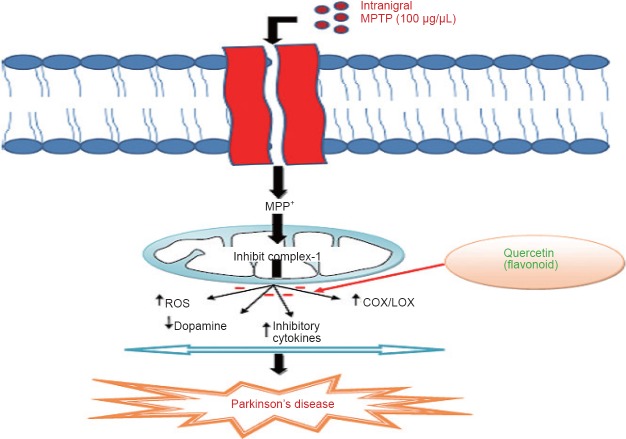
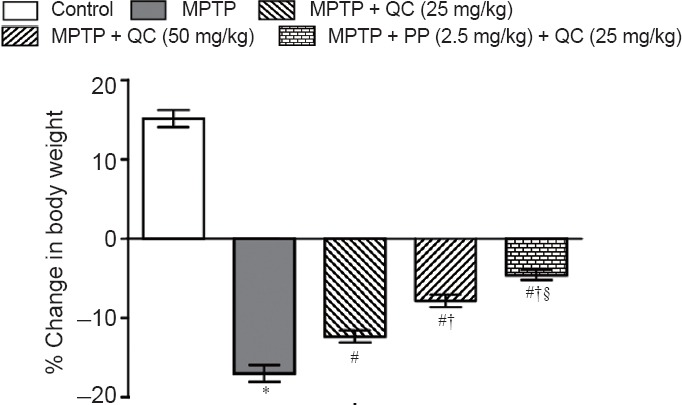
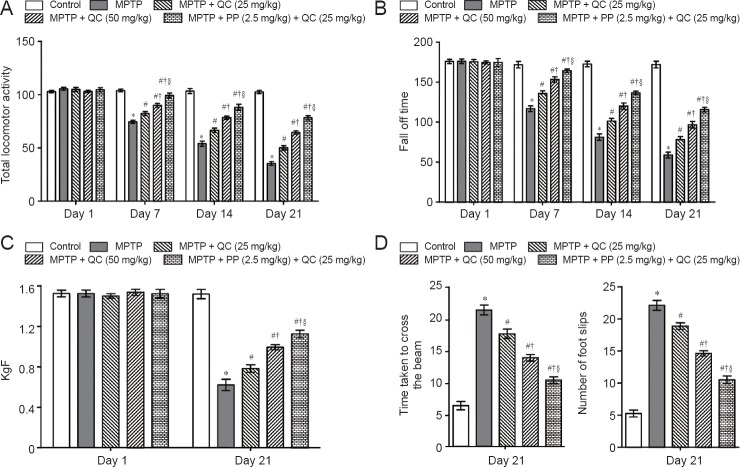
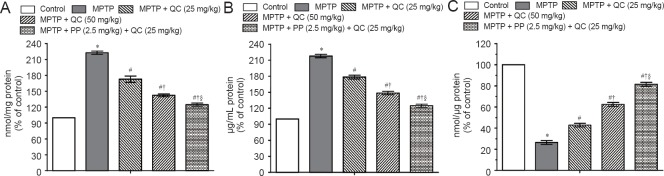
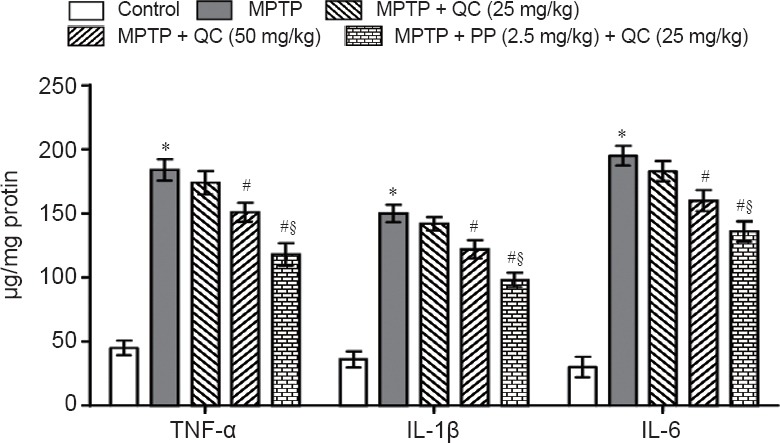
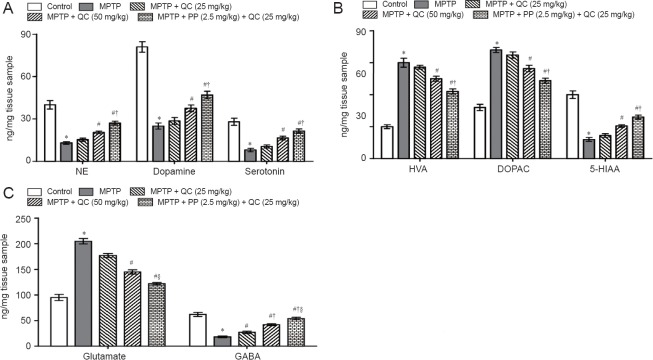
1-Methy-4-phenyl-1,2,3,6-tetrahydropyridine (MPTP) is a neurotoxin that selectively damages dopaminergic neurons in the substantia nigra pars compacta and induces Parkinson's like symptoms in rodents. Quercetin (QC) is a natural polyphenolic bioflavonoid with potent antioxidant and anti-inflammatory properties but lacks of clinical attraction due to low oral bioavailability. Piperine is a well established bioavailability enhancer used pre-clinically to improve the bioavailability of antioxidants (., Quercetin). Therefore, the present study was designed to evaluate the neuroprotective potential of QC together with piperine against MPTP-induced neurotoxicity in rats. MPTP (100 μg/μL/rat, bilaterally) was injected intranigrally on days 1, 4 and 7 using a digital stereotaxic apparatus. QC (25 and 50 mg/kg, intragastrically) and QC (25 mg/kg, intragastrically) in combination with piperine (2.5 mg/kg, intragastrically) were administered daily for 14 days starting from day 8 after the 3 injection of MPTP. On day 22, animals were sacrificed and the striatum was isolated for oxidative stress parameter (thiobarbituric acid reactive substances, nitrite and glutathione), neuroinflammatory cytokine (interleukin-1β, interleukin-6, and tumor necrosis factor-α) and neurotransmitter (dopamine, norepinephrine, serotonin, gamma-aminobutyric acid, glutamate, 3,4-dihydroxyphenylacetic acid, homovanillic acid, and 5-hydroxyindoleacetic acid) evaluations. Bilateral infusion of MPTP into substantia nigra pars compacta led to significant motor deficits as evidenced by impairments in locomotor activity and rotarod performance in open field test and grip strength and narrow beam walk performance. Both QC (25 and 50 mg/kg) and QC (25 mg/kg) in combination with piperine (2.5 mg/kg), in particular the combination therapy, significantly improved MPTP-induced behavioral abnormalities in rats, reversed the abnormal alterations of neurotransmitters in the striatum, and alleviated oxidative stress and inflammatory response in the striatum. These findings indicate that piperine can enhance the antioxidant and anti-inflammatory properties of QC, and QC in combination with piperine exhibits strong neuroprotective effects against MPTP-induced neurotoxicity.
1-甲基-4-苯基-1,2,3,6-四氢吡啶(MPTP)是一种神经毒素,可选择性损害黑质致密部的多巴胺能神经元,并在啮齿动物中诱发帕金森样症状。槲皮素(QC)是一种天然多酚生物类黄酮,具有强大的抗氧化和抗炎特性,但由于口服生物利用度低而缺乏临床吸引力。胡椒碱是一种成熟的生物利用度增强剂,临床前用于提高抗氧化剂(如槲皮素)的生物利用度。因此,本研究旨在评估槲皮素与胡椒碱联合对MPTP诱导的大鼠神经毒性的神经保护潜力。使用数字立体定位仪在第1、4和7天双侧脑内注射MPTP(100μg/μL/大鼠)。从MPTP三次注射后的第8天开始,每天灌胃给予QC(25和50mg/kg)以及QC(25mg/kg)与胡椒碱(2.5mg/kg)的组合,持续14天。在第22天,处死动物并分离纹状体,用于评估氧化应激参数(硫代巴比妥酸反应性物质、亚硝酸盐和谷胱甘肽)、神经炎性细胞因子(白细胞介素-1β、白细胞介素-6和肿瘤坏死因子-α)和神经递质(多巴胺、去甲肾上腺素、5-羟色胺、γ-氨基丁酸、谷氨酸、3,4-二羟基苯乙酸、高香草酸和5-羟基吲哚乙酸)。双侧向黑质致密部注入MPTP导致明显的运动缺陷,如旷场试验中的运动活动受损、转棒试验表现、握力和窄梁行走表现。QC(25和50mg/kg)以及QC(25mg/kg)与胡椒碱(2.5mg/kg)的组合,特别是联合治疗,显著改善了MPTP诱导的大鼠行为异常,逆转了纹状体中神经递质的异常改变,并减轻了纹状体中的氧化应激和炎症反应。这些发现表明,胡椒碱可以增强QC的抗氧化和抗炎特性,并且QC与胡椒碱联合对MPTP诱导的神经毒性具有强大的神经保护作用。