Hong Haeleen, Kim Jong Uk, Kim Tae-Il
School of Chemical Engineering, Sungkyunkwan University (SKKU), 2066 Seobu-ro Jangan-gu, Suwon 16419, Korea.
Center for Neuroscience Imaging Research (CNIR), Institute for Basic Scienece (IBS), 2066 Seobu-ro Jangan-gu, Suwon 16419, Korea.
Polymers (Basel). 2017 Sep 5;9(9):413. doi: 10.3390/polym9090413.
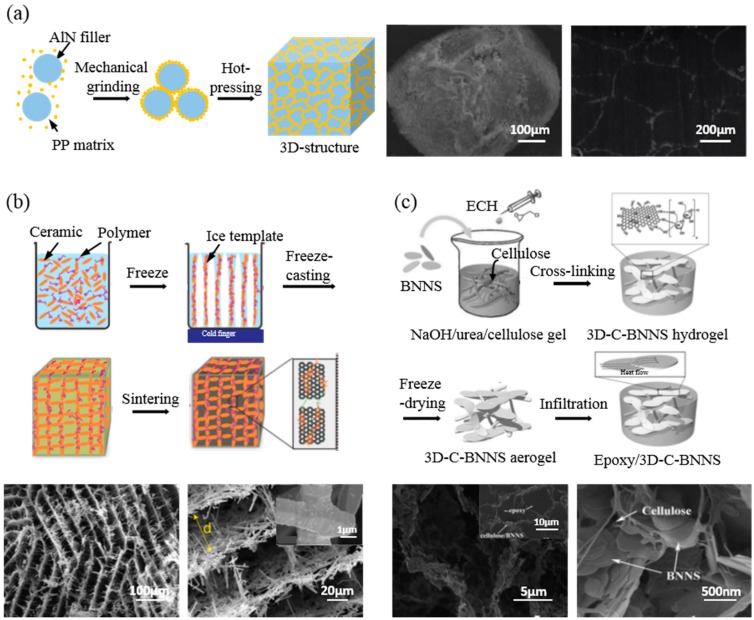
Recently, anisotropic heat dissipation and its management have drawn attention as a promising technique for highly integrated electrical devices. Among many potentially challenging materials such as carbon nanotube, graphene, metal particles, and inorganic ceramics commonly used for high thermally conductive fillers in a composite form, nanoscale ceramic fillers are considered ideal candidates due to their thermal conductivity, electrical insulation, and low thermal expansion coefficient. However, enhancing the thermal conductivity of a randomly dispersed ceramic-polymer composite is limited by its discontinuous filler contact and thermal expansion coefficient mismatch. Thus, recent research has focused on how to assemble and generate highly networked filler contacts to make effective pathways for heat flow, with minimized concentration of the filler in the composite. In this review, we will introduce several essential strategies to assemble fillers with a two- or three-dimensional networked composite for highly enhanced anisotropic heat dissipation. Moreover, this review elucidates filler alignment effects compared to randomly dispersed ceramic composites.
最近,各向异性热耗散及其管理作为一种用于高度集成电子器件的有前景的技术受到了关注。在许多潜在具有挑战性的材料中,如通常以复合形式用作高导热填料的碳纳米管、石墨烯、金属颗粒和无机陶瓷,纳米级陶瓷填料因其热导率、电绝缘性和低热膨胀系数而被认为是理想的候选材料。然而,提高随机分散的陶瓷 - 聚合物复合材料的热导率受到其不连续的填料接触和热膨胀系数不匹配的限制。因此,最近的研究集中在如何组装并产生高度网络化的填料接触,以形成有效的热流路径,同时使复合材料中填料的浓度最小化。在这篇综述中,我们将介绍几种基本策略,用于将填料组装成二维或三维网络复合材料,以实现高度增强的各向异性热耗散。此外,本综述阐明了与随机分散的陶瓷复合材料相比,填料排列的效果。