Mumtaz Nighat, Li Yanchun, Artiaga Ramón, Farooq Zunaira, Mumtaz Amina, Guo Qian, Nisa Fakhr-Un
School of Chemistry and Chemical Engineering, Nanjing University of Science and Technology, Nanjing 210094, China.
Centro de Investigación en Tecnologías Navales e Industriales. Campus Industrial de Ferrol, University of A Coruña, Avda. Mendizábal s/n, 15403 Ferrol, Spain.
Heliyon. 2024 Feb 1;10(3):e25381. doi: 10.1016/j.heliyon.2024.e25381. eCollection 2024 Feb 15.
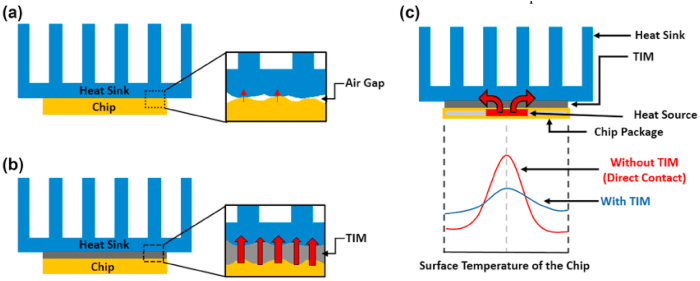
The internet of things and growing demand for smaller and more advanced devices has created the problem of high heat production in electronic equipment, which greatly reduces the work performance and life of the electronic instruments. Thermal interface material (TIM) is placed in between heat generating micro-chip and the heat dissipater to conduct all the produced heat to the heat sink. The development of suitable TIM with excellent thermal conductivity (TC) in both in-plane and through-plane directions is a very important need at present. For efficient thermal management, polymer composites are potential candidates. But in general, their thermal conductivity is low compared to that of metals. The filler integration into the polymer matrix is one of the two approaches used to increase the thermal conductivity of polymer composites and is also easy to scale up for industrial production. Another way to achieve this is to change the structure of polymer chains, which fall out of the scope of this work. In this review, considering the first approach, the authors have summarized recent developments in many types of fillers with different scenarios by providing multiple cases with successful strategies to improve through-plane thermal conductivity (TPTC) (k). For a better understanding of TC, a comprehensive background is presented. Several methods to improve the effective (out-plane) thermal conductivity of polymer composites and different theoretical models for the calculation of TC are also discussed. In the end, it is given a detailed conclusion that provides drawbacks of some fillers, multiple significant routes recommended by other researchers to build thermally conductive polymer composites, future aspects along with direction so that the researchers can get a guideline to design an effective polymer-based thermal interface material.
物联网以及对更小、更先进设备不断增长的需求导致了电子设备产生高热量的问题,这极大地降低了电子仪器的工作性能和使用寿命。热界面材料(TIM)置于发热微芯片和散热器之间,将产生的所有热量传导至散热器。目前非常需要开发在面内和面外方向均具有优异热导率(TC)的合适TIM。为了实现高效的热管理,聚合物复合材料是潜在的候选材料。但一般来说,它们的热导率与金属相比很低。将填料融入聚合物基体是提高聚合物复合材料热导率的两种方法之一,并且也易于扩大规模用于工业生产。实现这一目标的另一种方法是改变聚合物链的结构,这不在本工作的范围内。在这篇综述中,考虑到第一种方法,作者通过提供多种成功提高面内热导率(TPTC)(k)策略的案例,总结了许多不同类型填料的最新进展。为了更好地理解热导率,还介绍了全面的背景知识。还讨论了提高聚合物复合材料有效(面外)热导率的几种方法以及热导率计算的不同理论模型。最后,给出了详细的结论,其中指出了一些填料的缺点、其他研究人员推荐的构建导热聚合物复合材料的多条重要途径、未来的方向,以便研究人员能够获得设计有效聚合物基热界面材料的指导方针。