Applied Exercise Science, School of Kinesiology, University of Michigan, Ann Arbor, Michigan, USA
Arnold School of Public Health, University of South Carolina, Columbia, South Carolina, USA.
J Epidemiol Community Health. 2019 Jul;73(7):598-604. doi: 10.1136/jech-2018-211456. Epub 2019 Apr 9.
Few studies have examined the moderating role of neighbourhood environments on the relation between psychosocial factors and physical activity, and results of these studies are mixed. This study examined this relationship in 636 fifth to seventh graders from South Carolina, USA.
From 2010 to 2013, children and their parent/guardian completed annual self-reported surveys assessing psychosocial factors, and children wore accelerometers for 1 week each year. Neighbourhood environments were classified as supportive or non-supportive for physical activity (PA) based on in-person audits of facilities near children's homes and windshield surveys of children's streets. Growth curve analyses were completed to assess the moderating effect of the neighbourhood physical activity environment (NPAE) on the relation between psychosocial factors and total physical activity (TPA) over time.
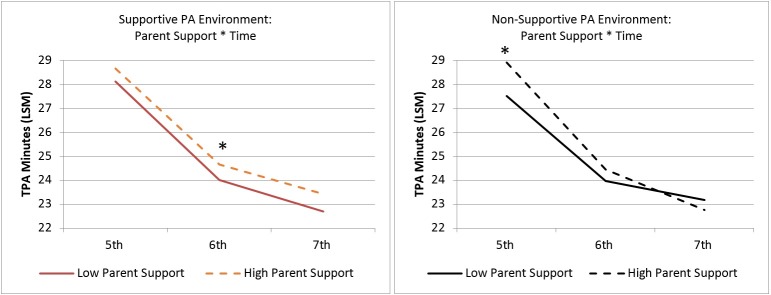
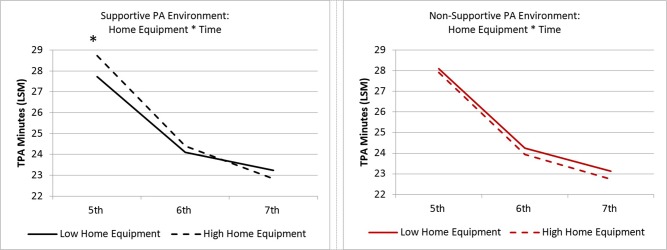
Significant interactions on TPA were found for (1) time, NPAE and parent-reported parent support for PA; (2) time, NPAE and child-reported equipment in the home; (3) child-reported parental support for PA and time; (4) child-reported parental support for PA and NPAE; (5) PA self-schema and time and (6) child-reported parental encouragement and time. Parental support and a supportive NPAE were important for TPA, especially as children transitioned to middle school, whereas home equipment and a supportive NPAE were important for fifth graders' TPA.
Consistent with the socioecological model, PA behaviour was dependent on interacting effects across levels of influence. Generally, both a supportive NPAE and positive psychosocial factors were needed to support TPA. Factors influencing PA across multiple levels should be addressed in PA interventions.
很少有研究探讨邻里环境对心理社会因素与身体活动之间关系的调节作用,而且这些研究的结果也不一致。本研究在美国南卡罗来纳州的 636 名五至七年级学生中检验了这种关系。
2010 年至 2013 年,儿童及其父母/监护人每年完成一次自我报告调查,评估心理社会因素,并且每年让儿童佩戴 1 周的加速度计。根据对儿童家庭附近设施的实地审计和对儿童街道的挡风玻璃调查,将邻里环境划分为支持或不支持身体活动(PA)。完成增长曲线分析,以评估邻里身体活动环境(NPAE)对心理社会因素与总身体活动(TPA)随时间变化的关系的调节作用。
在 TPA 方面发现了显著的交互作用:(1)时间、NPAE 和父母报告的对 PA 的支持;(2)时间、NPAE 和儿童报告的家中设备;(3)儿童报告的父母对 PA 的支持和时间;(4)儿童报告的父母对 PA 的支持和 NPAE;(5)PA 自我图式和时间;(6)儿童报告的父母鼓励和时间。父母支持和支持性的 NPAE 对 TPA 很重要,尤其是当孩子们过渡到中学时,而家庭设备和支持性的 NPAE 对五年级学生的 TPA 很重要。
与社会生态学模型一致,PA 行为取决于多个影响层面的相互作用。一般来说,支持性的 NPAE 和积极的心理社会因素都需要支持 TPA。在 PA 干预中,应解决跨多个层面影响 PA 的因素。