Shears Stephen B, Hayakawa Yoichi
Inositol Signalling Group, Signal Transduction Laboratory, National Institute of Environmental Health Sciences, National Institutes of Health, Durham, NC, United States.
Department of Applied Biological Sciences, Saga University, Saga, Japan.
Front Physiol. 2019 Mar 22;10:222. doi: 10.3389/fphys.2019.00222. eCollection 2019.
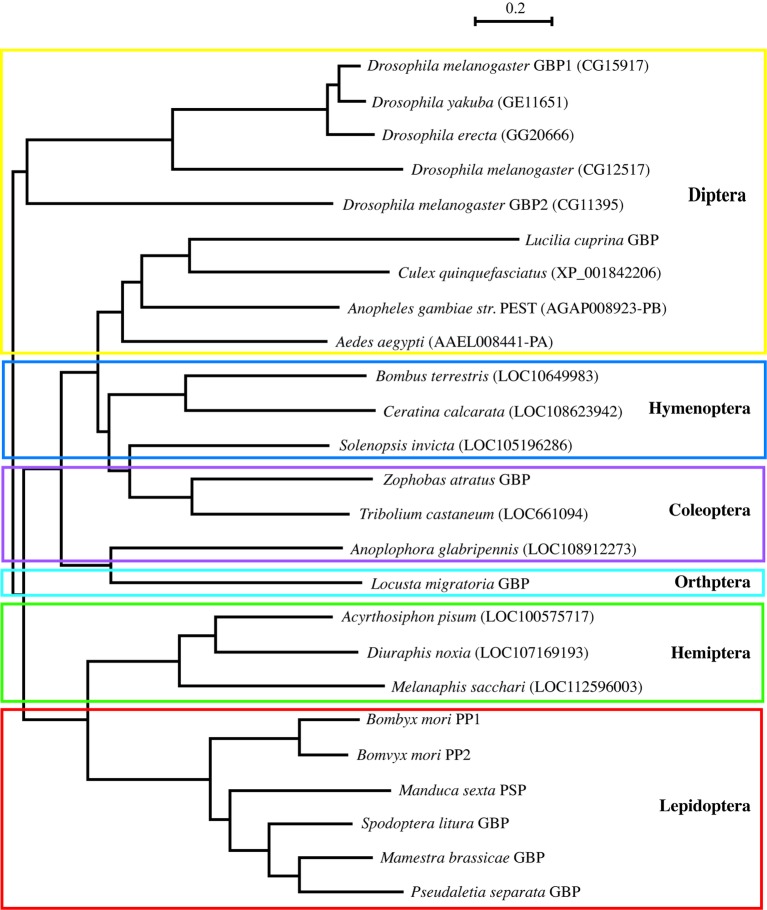
The widespread distribution of insects over many ecological niches owes much to evolution of multiple mechanisms to defend against environmental stress, especially because their ectothermic nature and small body size render them particularly susceptible to extremes in temperature and water availability. In this review, we will summarize the latest information describing a single, multifunctional cytokine family that is deployed by six orders of insect species to combat a diverse variety of environmental stresses. The originating member of this peptide family was identified in (formerly called ) armyworm; the cytokine was named growth-blocking peptide (GBP), reflecting its actions in combating parasitic invasion. The peptide's name has been retained, though the list of its regulatory activities has greatly expanded. All members of this family are small peptides, 19-25 amino acid residues, whose major source is fat body. They are now known to regulate embryonic morphogenesis, larval growth rates, feeding activities, immune responses, nutrition, and aging. In this review, we will describe recent developments in our understanding of the mechanisms of action of the GBP family, but we will also highlight remaining gaps in our knowledge.
昆虫在众多生态位中的广泛分布很大程度上归功于其多种抵御环境压力机制的进化,特别是因为它们的变温特性和小体型使它们特别容易受到温度极端变化和水分可利用性的影响。在这篇综述中,我们将总结最新信息,这些信息描述了一个单一的多功能细胞因子家族,该家族被六个目昆虫物种用于对抗各种各样的环境压力。这个肽家族的原始成员是在(以前称为)夜蛾中鉴定出来的;这种细胞因子被命名为生长阻滞肽(GBP),反映了其在对抗寄生虫入侵中的作用。尽管其调节活性的列表已大大扩展,但该肽的名称仍被保留。这个家族的所有成员都是小肽,由19 - 25个氨基酸残基组成,其主要来源是脂肪体。现在已知它们能调节胚胎形态发生、幼虫生长速率、摄食活动、免疫反应、营养和衰老。在这篇综述中,我们将描述我们对GBP家族作用机制理解的最新进展,但我们也将突出我们知识中仍然存在的空白。