Department of Immunology, Faculty of Medicine Siriraj Hospital, Mahidol University, Bangkok, Thailand.
Microbiology Laboratory, Faculty of Veterinary Science, Veterinary Diagnostic Center, Mahidol University, Nakhon Pathom, Thailand.
Front Cell Infect Microbiol. 2019 Mar 22;9:63. doi: 10.3389/fcimb.2019.00063. eCollection 2019.
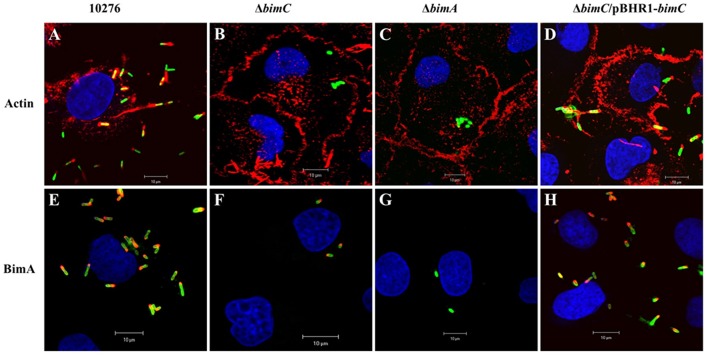
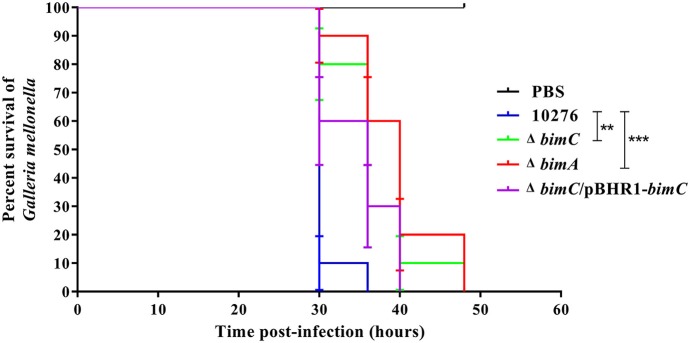
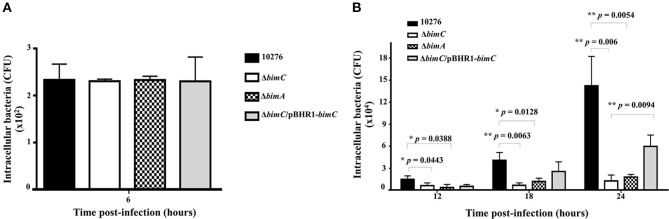
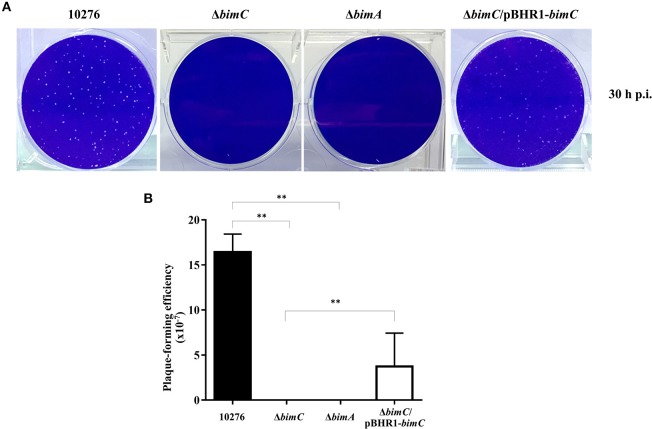
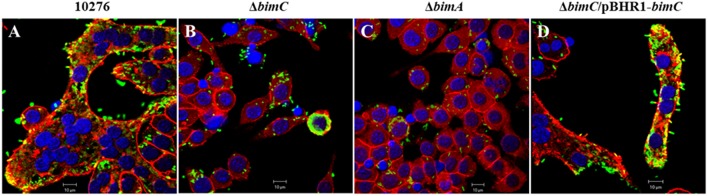
The intracellular pathogen , the etiological agent of melioidosis in humans and various animals, is capable of survival and movement within the cytoplasm of host cells by a process known as actin-based motility. The bacterial factor BimA is required for actin-based motility through its direct interaction with actin, and by mediating actin polymerization at a single pole of the bacterium to promote movement both within and between cells. However, little is known about the other bacterial proteins required for this process. Here, we have investigated the role of the gene () which lies immediately upstream of the gene () on the chromosome 2. Conserved amongst all and strains sequenced to date, this gene encodes an iron-binding protein with homology to a group of proteins known as the bacterial autotransporter heptosyltransferase (BAHT) family. We have constructed a deletion mutant and demonstrate that it is defective in intracellular survival in HeLa cells, but not in J774.1 macrophage-like cells. The mutant is defective in cell to cell spread as demonstrated by ablation of plaque formation in HeLa cells, and by the inability to form multi-nucleated giant cells in J774.1 cells. These phenotypes in intracellular survival and cell to cell spread are not due to the loss of expression and polar localization of the BimA protein on the surface of intracellular bacteria, however they do correlate with an inability of the bacteria to recruit and polymerize actin. Furthermore, we also establish a role for in virulence of using a larvae model of infection. Taken together, our findings indicate that BimC plays an important role in intracellular behavior and virulence of this emerging pathogen.
胞内病原体是人类和各种动物类鼻疽病的病原体,能够通过一种称为肌动蛋白依赖运动的过程在宿主细胞的细胞质中生存和运动。细菌因子 BimA 通过与肌动蛋白的直接相互作用以及介导细菌单一极的肌动蛋白聚合来促进细胞内和细胞间的运动,从而在肌动蛋白依赖运动中是必需的。然而,对于这一过程所需的其他细菌蛋白知之甚少。在这里,我们研究了位于 2 号染色体上的 基因()上游的 基因()的作用。该基因在迄今为止测序的所有 和 菌株中都保守,它编码一种具有与称为细菌自转运酶己糖基转移酶(BAHT)家族的一组蛋白同源性的铁结合蛋白。我们构建了一个 缺失突变体,并证明它在 HeLa 细胞中的细胞内存活能力有缺陷,但在 J774.1 巨噬样细胞中没有缺陷。 突变体在细胞间传播中存在缺陷,如在 HeLa 细胞中消除斑块形成和在 J774.1 细胞中无法形成多核巨细胞所证明的那样。这些细胞内存活和细胞间传播的表型不是由于 BimA 蛋白在细胞内细菌表面的表达和极性定位丧失所致,但是它们确实与细菌无法招募和聚合肌动蛋白有关。此外,我们还通过 幼虫感染模型建立了 在该病原体毒力中的作用。总之,我们的研究结果表明, BimC 在这种新兴病原体的细胞内行为和毒力中发挥着重要作用。