Joo Heesoo, Maskery Brian A, Berro Andre D, Rotz Lisa D, Lee Yeon-Kyeng, Brown Clive M
Heesoo Joo, PhD, is an Economist, Division of Global Migration and Quarantine, Centers for Disease Control and Prevention, Atlanta, Georgia.
Brian A. Maskery, PhD, is an Economist, Division of Global Migration and Quarantine, Centers for Disease Control and Prevention, Atlanta, Georgia.
Health Secur. 2019 Mar/Apr;17(2):100-108. doi: 10.1089/hs.2018.0115. Epub 2019 Apr 10.
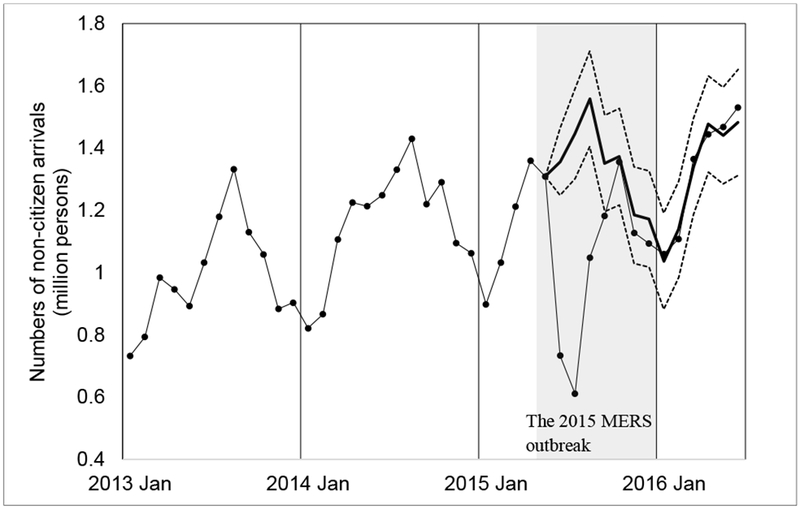
The 2015 Middle East respiratory syndrome (MERS) outbreak in the Republic of Korea (ROK) is an example of an infectious disease outbreak initiated by international travelers to a high-income country. This study was conducted to determine the economic impact of the MERS outbreak on the tourism and travel-related service sectors, including accommodation, food and beverage, and transportation, in the ROK. We projected monthly numbers of noncitizen arrivals and indices of services for 3 travel-related service sectors during and after the MERS outbreak (June 2015 to June 2016) using seasonal autoregressive integrated moving average models. Tourism losses were estimated by multiplying the monthly differences between projected and actual numbers of noncitizen arrivals by average tourism expenditure per capita. Estimated tourism losses were allocated to travel-related service sectors to understand the distribution of losses across service sectors. The MERS outbreak was correlated with a reduction of 2.1 million noncitizen visitors corresponding with US$2.6 billion in tourism loss for the ROK. Estimated losses in the accommodation, food and beverage service, and transportation sectors associated with the decrease of noncitizen visitors were US$542 million, US$359 million, and US$106 million, respectively. The losses were demonstrated by lower than expected indices of services for the accommodation and food and beverage service sectors in June and July 2015 and for the transportation sector in June 2015. The results support previous findings that public health emergencies due to traveler-associated outbreaks of infectious diseases can cause significant losses to the broader economies of affected countries.
2015年韩国中东呼吸综合征(MERS)疫情是由国际旅行者引发的高收入国家传染病疫情的一个例子。本研究旨在确定MERS疫情对韩国旅游业及与旅游相关的服务部门(包括住宿、餐饮和交通运输)的经济影响。我们使用季节性自回归积分移动平均模型预测了MERS疫情期间及之后(2015年6月至2016年6月)非公民入境人数的月度数据以及3个与旅游相关服务部门的服务指数。通过将预测的和实际的非公民入境人数的月度差异乘以人均旅游支出,估算出旅游业损失。将估算出的旅游业损失分配到与旅游相关的服务部门,以了解各服务部门的损失分布情况。MERS疫情导致韩国非公民游客减少210万,旅游业损失达26亿美元。与非公民游客减少相关的住宿、餐饮服务和交通运输部门的估算损失分别为5.42亿美元、3.59亿美元和1.06亿美元。2015年6月和7月住宿和餐饮服务部门以及2015年6月交通运输部门的服务指数低于预期,证明了这些损失。研究结果支持了先前的研究发现,即由旅行者引发的传染病疫情导致的公共卫生紧急情况会给受影响国家的整体经济造成重大损失。