a Department of Internal medicine intensive care , the central hospital of Linyi , Yishui , Shandong , China.
b Department of Anesthesia , the affiliated hospital of Qingdao University , Qingdao Shandong , China.
Bioengineered. 2019 Dec;10(1):121-132. doi: 10.1080/21655979.2019.1605812.
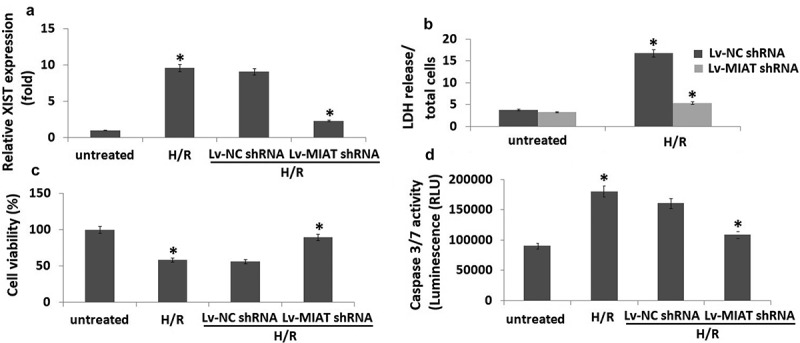
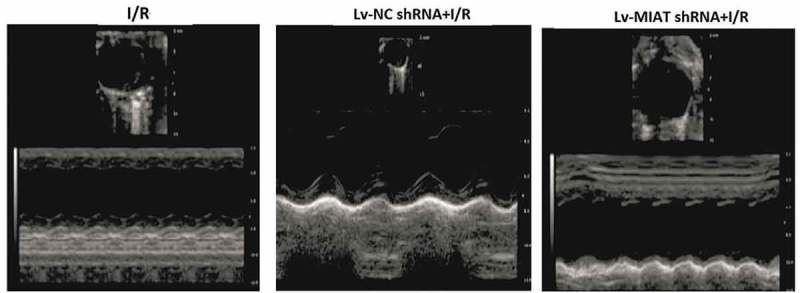
This study aims to investigate the role of targeting lncRNA myocardial infarction-associated transcript (MIAT) in protection against hypoxia/reoxygenation (H/R) injury in H9c2 cells in vitro and myocardial ischemia/reperfusion (I/R) injury in vivo by regulating expression of NF-kB and p53 upregulated modulator of apoptosis (PUMA). H9C2 cells were infected with lentivirus expressing the short-hairpin RNA direct against human MIAT gene (Lv-MIAT shRNA) or lentivirus expressing scrambled control (Lv-NC shRNA) or PUMA siRNA or p65 siRNA or their control siRNA respectively. Then the H9c2 cells were infected with Lv-shRNA to 2 hours of hypoxia (H) and 24 hour of reoxygenation (R). 100 ul of Lv-MIAT shRNA (1 × 10 PFU) or Lv-NC shRNA was transfected into mouse hearts, then the hearts were subjected to I/R (1h/72 h). We discovered targeting MIAT remarkably enhanced H9c2 cell viability, decreased H/R-induced cell apoptosis and LDH leakage and significantly decreased I/R-induced myocardial infarct size, reduced myocardial apoptosis and enhanced the heart function. Targeting MIAT downregulated p65 nuclear translocation, NF-κB activity and anti-apoptotic protein cleaved-caspase-3, Bax, and upregulated anti-apoptotic protein Bcl-2 induced by H/R or I/R. Our study suggests that targeting MIAT may protect against H9c2 cardiomyoblasts H/R injury or myocardial I/R injury via inhibition of cell apoptosis, mediated by NF-κB and PUMA signal pathway.
本研究旨在通过调节 NF-κB 和 p53 上调凋亡调节因子(PUMA)的表达,探讨靶向长链非编码 RNA 心肌梗死相关转录物(MIAT)在体外保护 H9c2 细胞缺氧/复氧(H/R)损伤和体内心肌缺血/再灌注(I/R)损伤中的作用。用表达针对人 MIAT 基因的短发夹 RNA 的慢病毒(Lv-MIAT shRNA)或表达乱序对照(Lv-NC shRNA)或 PUMA siRNA 或 p65 siRNA 或其对照 siRNA 分别感染 H9c2 细胞。然后,将 H9c2 细胞感染 Lv-shRNA 进行 2 小时缺氧(H)和 24 小时复氧(R)。将 100 ul 的 Lv-MIAT shRNA(1×10PFU)或 Lv-NC shRNA 转染到小鼠心脏中,然后心脏进行 I/R(1h/72h)。我们发现,靶向 MIAT 可显著提高 H9c2 细胞活力,降低 H/R 诱导的细胞凋亡和 LDH 漏出,并显著减少 I/R 诱导的心肌梗死面积,减少心肌细胞凋亡,增强心脏功能。靶向 MIAT 下调了 p65 核易位、NF-κB 活性和抗凋亡蛋白裂解的 caspase-3、Bax,并上调了 H/R 或 I/R 诱导的抗凋亡蛋白 Bcl-2。我们的研究表明,靶向 MIAT 可能通过抑制细胞凋亡,通过 NF-κB 和 PUMA 信号通路,保护 H9c2 心肌细胞免受 H/R 损伤或心肌 I/R 损伤。