Department of Neurosurgery, Stanford University School of Medicine, 1201 Welch Road, MSLS Building, Room P306, Stanford, CA, 94305, USA.
Department of Plant Biology, Carnegie Institution for Science, Stanford, CA, 94305, USA.
J Neuroinflammation. 2019 Apr 10;16(1):77. doi: 10.1186/s12974-019-1465-9.
During the acute stroke phase, neutrophils from the peripheral blood are first to arrive in the ischemic brain, which then attracts other immune cells that exacerbate neuroinflammation in the ischemic tissue. Myosin1f was reported to specifically mediate neutrophil migration in the peripheral tissues, but whether it plays a critical role in the neuroinflammatory response after ischemic stroke remains unknown. In this study, we aim to test the hypothesis that myosin1f-mediated neutrophil migration is critical in acute neuroinflammation induced by ischemic stroke.
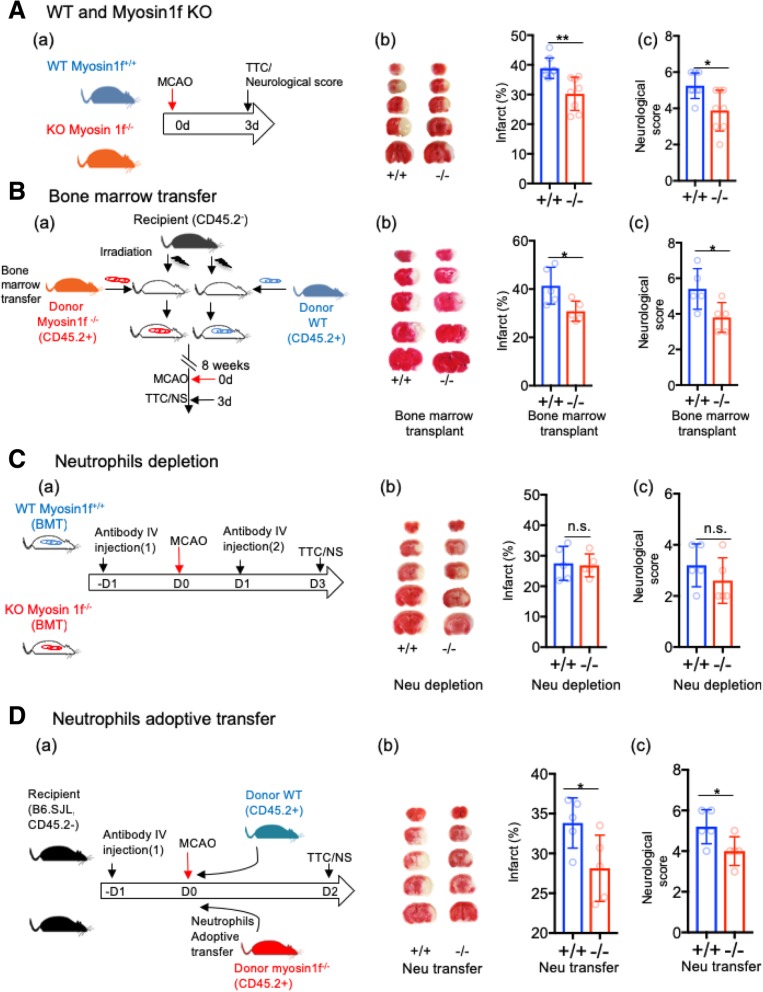
Myosin1f and wild type (WT) mice were subjected to transient middle cerebral artery occlusion (MCAO). To determine which cells determine myosin1f's transmigration ability, bone marrow transplantation, neutrophil depletion, and adoptive neutrophil transfer were performed. The myosin1f RNA level was assessed in peripheral neutrophils by reverse transcription polymerase chain reaction (RT-PCR) at 1 day and 3 days after stroke. The infiltrating neutrophils were quantified by immunofluorescence staining and FACS at 72 h after reperfusion.
The myosin1f mice had significantly smaller infarctions than the myosin1f mice. Bone marrow transplantation from myosin1f mice to recipient mice also had smaller infarctions compared to animals receiving bone marrow from myosin1f mice. By performing neutrophil depletion and adoptive transfer, we confirmed that myosin1f acts mainly in circulating neutrophils. RT-PCR showed that myosin1f gene expression was increased in the circulating blood neutrophils at 3 days after ischemia. The confocal immunostaining and FACS results confirmed that fewer neutrophils infiltrated into the ischemic brain in myosin1f mice compared to WT mice.
Myosin1f determines neutrophil migration into the ischemic hemisphere, which directly affects stroke outcome.
在急性中风阶段,外周血中的中性粒细胞首先到达缺血性大脑,随后吸引其他免疫细胞加剧缺血组织中的神经炎症。肌球蛋白 1f 被报道可特异性介导外周组织中的中性粒细胞迁移,但它是否在缺血性中风后的神经炎症反应中起关键作用尚不清楚。在这项研究中,我们旨在检验肌球蛋白 1f 介导的中性粒细胞迁移在缺血性中风引起的急性神经炎症中起关键作用的假设。
肌球蛋白 1f 和野生型(WT)小鼠接受短暂性大脑中动脉闭塞(MCAO)。为了确定哪些细胞决定了肌球蛋白 1f 的迁移能力,进行了骨髓移植、中性粒细胞耗竭和过继性中性粒细胞转移。中风后 1 天和 3 天,通过逆转录聚合酶链反应(RT-PCR)评估外周血中性粒细胞中的肌球蛋白 1f RNA 水平。在再灌注后 72 小时,通过免疫荧光染色和 FACS 定量浸润的中性粒细胞。
肌球蛋白 1f 小鼠的梗死体积明显小于肌球蛋白 1f 小鼠。来自肌球蛋白 1f 小鼠的骨髓移植到受体小鼠中也比接受肌球蛋白 1f 小鼠骨髓的动物的梗死体积更小。通过进行中性粒细胞耗竭和过继转移,我们证实肌球蛋白 1f 主要作用于循环中的中性粒细胞。RT-PCR 显示,缺血后 3 天,循环血中性粒细胞中肌球蛋白 1f 基因表达增加。共聚焦免疫染色和 FACS 结果证实,与 WT 小鼠相比,肌球蛋白 1f 小鼠缺血大脑中的中性粒细胞浸润较少。
肌球蛋白 1f 决定中性粒细胞向缺血半球的迁移,这直接影响中风的结果。