Christiansen Hanna, Reck Corinna, Zietlow Anna-Lena, Otto Kathleen, Steinmayr Ricarda, Wirthwein Linda, Weigelt Sarah, Stark Rudolf, Ebert David D, Buntrock Claudia, Krisam Johannes, Klose Christina, Kieser Meinhard, Schwenck Christina
Department of Clinical Child and Adolescent Psychology, Faculty of Psychology, Philipps University Marburg, Marburg, Germany.
Department of Clinical Child and Adolescent Psychology, Faculty of Psychology, Ludwig-Maximilians-University München, Munich, Germany.
Front Psychiatry. 2019 Mar 26;10:128. doi: 10.3389/fpsyt.2019.00128. eCollection 2019.
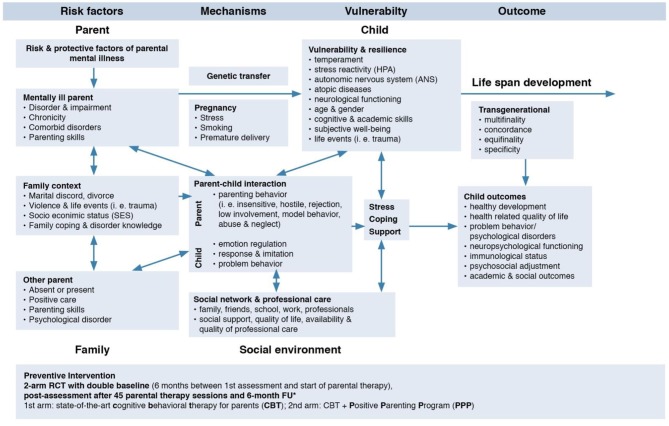
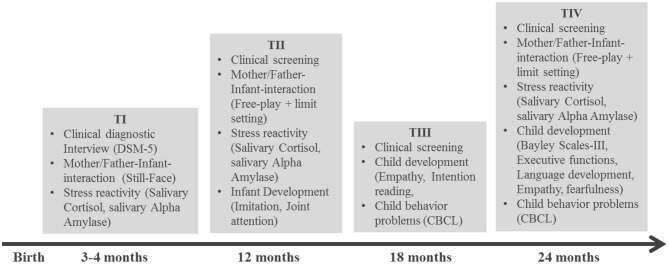
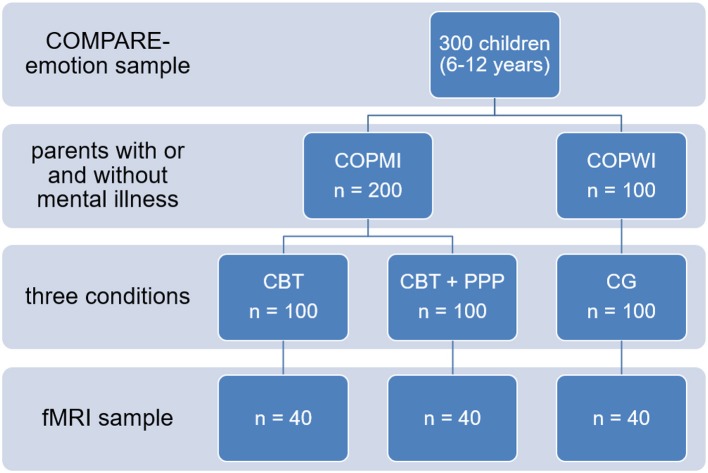
Mental disorders are frequent, associated with disability-adjusted life years, societal, and economic costs. Children of parents with a mental illness (COPMI) are at an increased risk to develop disorders themselves. The transgenerational transmission of mental disorders has been conceptualized in a model that takes parental and family factors, the social environment (i.e., school, work, and social support), parent-child-interaction and possible child outcomes into account. The goal of the "Children of Mentally Ill Parents At Risk Evaluation" (COMPARE) study will thus be twofold: (1) to establish the efficacy and cost-effectiveness of a high-quality randomized controlled trial (RCT) with the aim of interrupting the intergenerational transmission of mental disorders in COPMI, (2) to test the components of the trans-generational transmission model of mental disorders. To implement a randomized controlled trial (RCT: comparison of parental cognitive behavioral therapy/CBT with CBT + Positive Parenting Program) that is flanked by four add-on projects that apply behavioral, psychophysiological, and neuro-imaging methods to examine potential moderators and mediators of risk transmission (projects COMPARE-emotion/-interaction/-work/-school). COMPARE-emotion targets emotion processing and regulation and its impact on the transgenerational disorder transmission; COMPARE-interaction focuses especially on the impact of maternal comorbid diagnoses of depression and anxiety disorders and will concentrate on different pathways of the impact of maternal disorders on socio-emotional and cognitive infant development, such as parent-infant interaction and the infant's stress regulation skills. COMPARE-work analyzes the transmission of strains a person experiences in one area of life to another (i.e., from family to work; spill-over), and how stress and strain are transmitted between individuals (i.e., from parent to child; cross-over). COMPARE-school focuses on the psychosocial adjustment, school performance, and subjective well-being in COPMI compared to an adequate control group of healthy children. This study protocol reports on the interdisciplinary approach of COMPARE testing the model of the transgenerational transmission of mental disorders. The combination of applied basic with clinical research will facilitate the examination of specific risk transmission mechanisms, promotion, dissemination and implementation of results into a highly important but largely neglected field. DRKS-ID: DRKS00013516 (German Clinical Trials Register, https://www.drks.de/drks_web/navigate.do?navigationId=trial.HTML&TRIAL_ID=DRKS00013516).
精神障碍很常见,与伤残调整生命年、社会和经济成本相关。患有精神疾病的父母的子女(COPMI)自身患精神障碍的风险增加。精神障碍的代际传递已在一个模型中得以概念化,该模型考虑了父母及家庭因素、社会环境(即学校、工作和社会支持)、亲子互动以及可能的儿童结局。因此,“高危精神疾病父母的子女评估”(COMPARE)研究的目标将是双重的:(1)确定一项高质量随机对照试验(RCT)的疗效和成本效益,旨在中断COPMI中精神障碍的代际传递;(2)检验精神障碍代际传递模型的各个组成部分。实施一项随机对照试验(RCT:将父母认知行为疗法/CBT与CBT+积极育儿计划进行比较),并辅以四个附加项目,这些项目应用行为、心理生理和神经成像方法来检查风险传递的潜在调节因素和中介因素(COMPARE-情绪/互动/工作/学校项目)。COMPARE-情绪项目针对情绪加工与调节及其对代际障碍传递的影响;COMPARE-互动项目特别关注母亲抑郁和焦虑障碍共病诊断的影响,并将专注于母亲疾病对社会情感和认知婴儿发育影响的不同途径,如亲子互动和婴儿的压力调节技能。COMPARE-工作项目分析一个人在生活的一个领域所经历的压力向另一个领域的传递(即从家庭到工作;溢出效应),以及压力和紧张如何在个体之间传递(即从父母到孩子;交叉效应)。COMPARE-学校项目关注与健康儿童的适当对照组相比,COPMI的心理社会适应、学业成绩和主观幸福感。本研究方案报告了COMPARE对精神障碍代际传递模型进行检验的跨学科方法。应用基础研究与临床研究的结合将有助于检验特定的风险传递机制,将研究结果推广、传播并应用到一个非常重要但在很大程度上被忽视的领域。德国临床试验注册号:DRKS00013516(德国临床试验注册中心,https://www.drks.de/drks_web/navigate.do?navigationId=trial.HTML&TRIAL_ID=DRKS00013516)