Animal Biosciences and Biotechnology Laboratory, U. S. Department of Agriculture, Beltsville Agricultural Research Center, ARS, Beltsville, MD, United States.
College of Veterinary Medicine and Institute of Animal Medicine, Gyeongsang National University, Jinju, South Korea.
Front Immunol. 2019 Mar 26;10:560. doi: 10.3389/fimmu.2019.00560. eCollection 2019.
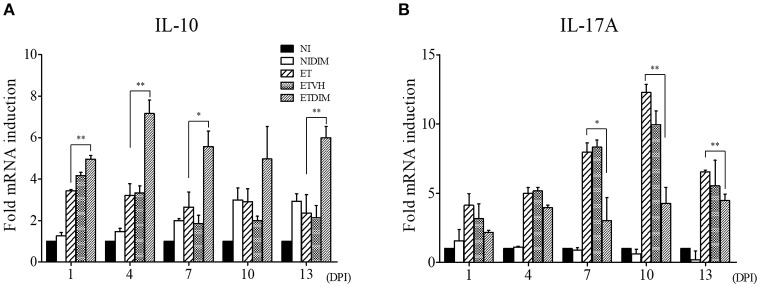
Indoles, as the ligands of aryl hydrocarbon receptor (AhR), have been shown to possess immune-modulating property in terms of the balancing between regulatory T cells (Treg) and T helper 17 cells (Th17) activities. In the present study, we examined the effects of dietary indoles, 3,3'-diindolylmethane (DIM) and indole-3-carbinol (I3C), on CD4T cell population and functions in chickens. Furthermore, the effects of dietary DIM treatment on chicken coccidiosis caused by an apicomplexan parasite were investigated. Dietary treatment of healthy chickens with DIM and I3C induced increased CD4CD25 (Treg) cells and the mRNA expression of IL-10, while decreasing number of CD4IL-17A (Th17) cells and Th17-related cytokines transcripts expression in the intestine. In addition, we explored the role of AhR in indole-treated splenic lymphocytes by using AhR antagonist and our results suggested that DIM is a ligand for chicken AhR. In chicken coccidiosis, treatment of DIM increased the ratio of Treg/Th17 cells and significantly reduced intestinal lesion although no significant changes in body weight and fecal oocyst production were noted compared to non-treated control group. These results indicate that DIM is likely to affect the ratios of Treg/Th17 reducing the level of local inflammatory response induced by or facilitate repairing process of inflamed gut following infection. The results described herein are thus consistent with the concept that AhR ligand modulates the T cell immunity through the alteration of Treg/Th17 cells with Treg dominance. To our knowledge, present study is the first scientific report showing the effects of dietary indole on T cell immunity in poultry species.
吲哚类作为芳香烃受体(AhR)的配体,已被证明在调节性 T 细胞(Treg)和辅助性 T 细胞 17(Th17)活性之间具有免疫调节作用。在本研究中,我们研究了饮食中的吲哚类化合物,3,3′-二吲哚甲烷(DIM)和吲哚-3-甲醇(I3C)对鸡 CD4T 细胞群体和功能的影响。此外,还研究了饮食 DIM 处理对鸡由顶复门寄生虫引起的球虫病的影响。用 DIM 和 I3C 对健康鸡进行饮食处理,可诱导 CD4CD25(Treg)细胞增加,IL-10 的 mRNA 表达增加,而肠道中 CD4IL-17A(Th17)细胞和 Th17 相关细胞因子转录物的数量减少。此外,我们通过使用 AhR 拮抗剂探索了 AhR 在吲哚处理的脾淋巴细胞中的作用,结果表明 DIM 是鸡 AhR 的配体。在鸡球虫病中,与未处理的对照组相比,DIM 处理增加了 Treg/Th17 细胞的比值,显著降低了肠道病变,但体重和粪便卵囊产生没有明显变化。这些结果表明,DIM 可能通过降低由感染引起的局部炎症反应的水平,或者促进发炎肠道的修复过程,从而影响 Treg/Th17 细胞的比值。因此,本研究结果与 AhR 配体通过改变 Treg/Th17 细胞以产生 Treg 优势来调节 T 细胞免疫的概念一致。据我们所知,目前的研究是第一个科学报告,表明饮食中的吲哚类化合物对禽类的 T 细胞免疫有影响。