Breen Nancy E, Bonanno J Alexander, Hunt Sara, Grossman Julia, Brown Jordan, Nolte Hannah, Rhyne Andrew L
Department of Chemistry, Roger Williams University, Bristol, RI, USA.
School for the Environment, University of Massachusetts at Boston, Boston, MA, USA.
PeerJ. 2019 Apr 2;7:e6644. doi: 10.7717/peerj.6644. eCollection 2019.
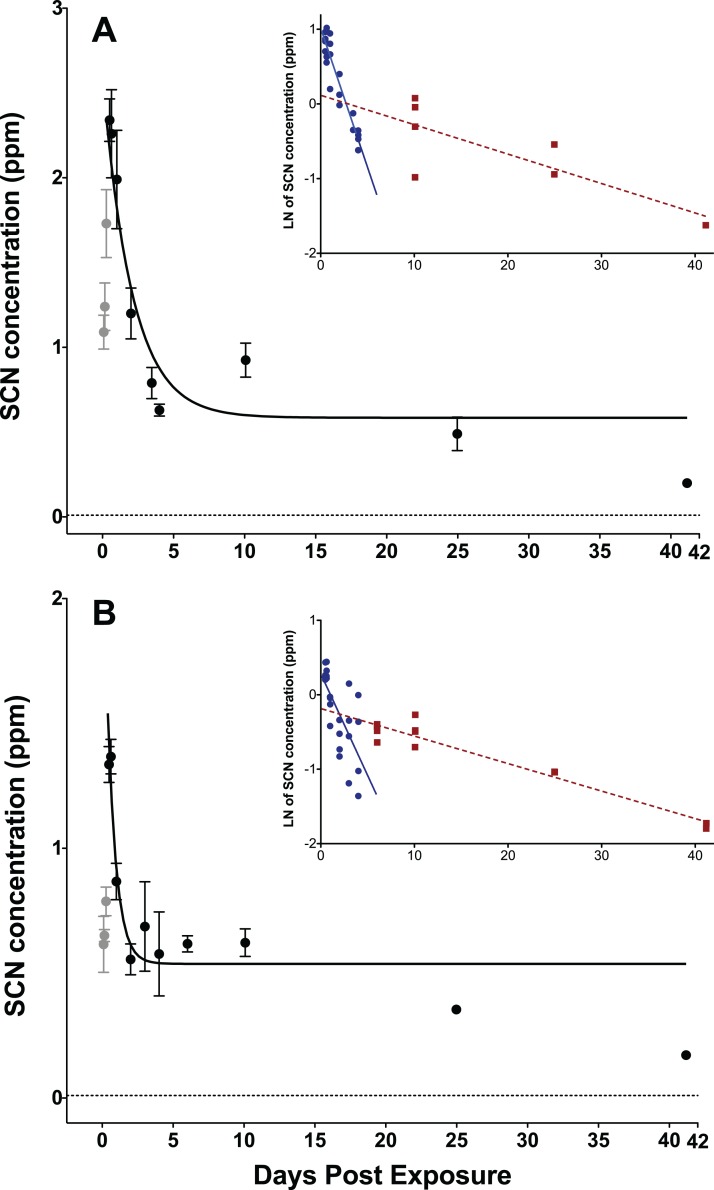
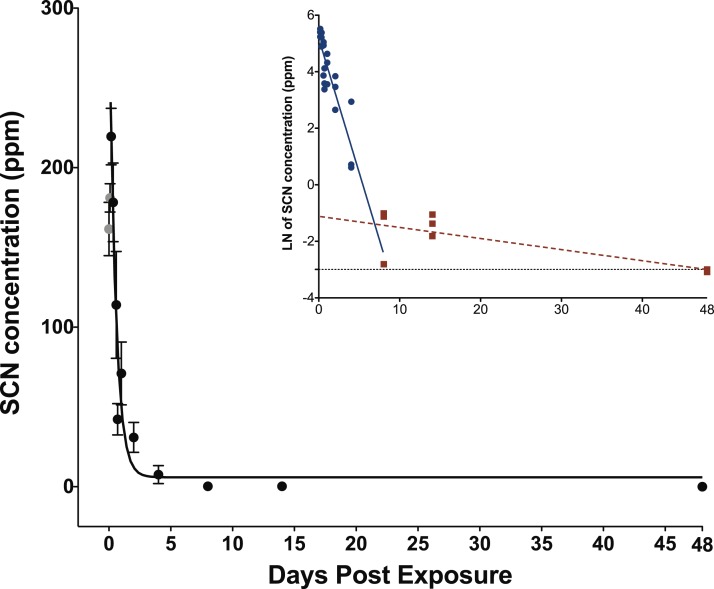
The illegal practice of using cyanide (CN) as a stunning agent to collect fish for both the marine aquarium and live fish food trades has been used throughout the Indo-Pacific for over 50 years. CN fishing is destructive to all life forms within the coral reef ecosystems where it is used and is certainly one of many anthropogenic activities that have led to 95% of the reefs in the Indo-Pacific being labeled at risk for degradation and loss. A field-deployable test for detecting fish caught using CN would assist in combating the use of this destructive practice, however, no reliable and robust test exists. Further, there is little toxicokinetic data available on marine fish to support the development of such a test, yet such data is critical to establishing the concentration range and time scale over which such a test would be viable. This study presents the first direct measurement of the half-life of the metabolite thiocyanate (SCN) after pulsed exposure to CN in a marine fish. SCN was measured in the plasma of after exposure to 50 ppm CN for three exposure times (20, 45, and 60 s) using HPLC-UV and a C30 column pre-treated with polyethylene glycol. Plasma SCN levels observed are dose-dependent, reflecting a longer time for conversion of CN to SCN as the dose of CN increases. SCN plasma levels reached a maximum concentration (1.2-2.3 ppm) 12-20 h after exposure to CN. The half-life for the elimination of SCN was 1.01 ± 0.26 days for 45 s exposure and 0.44 ± 0.15 days for 20 s exposure. Fish were also directly exposed to SCN (100 ppm for 11 days) and the observed half-life for SCN elimination was 0.35 ± 0.07 days. Plasma SCN levels did not return to control levels, even after 41 days when exposed to CN but did return to control levels after 48 days when exposed to SCN. The similar half-lives observed for CN and SCN exposure suggests that SCN exposure can be used as a proxy for measuring the rate of SCN elimination following CN exposure. In order for plasma SCN to be used as a marker for CN exposure, these results must be extended to other species and endogenous levels of SCN in wild caught fish must be established.
在整个印度-太平洋地区,将氰化物(CN)用作使鱼昏迷的药剂,以用于海洋水族馆和活鱼食品贸易的非法行为已持续了50多年。氰化物捕鱼对其使用区域内珊瑚礁生态系统中的所有生命形式都具有破坏性,并且无疑是导致印度-太平洋地区95%的珊瑚礁被标记为有退化和丧失风险的众多人为活动之一。一种可现场部署的检测使用氰化物捕获的鱼类的测试将有助于打击这种破坏性做法,但目前尚无可靠且有效的测试方法。此外,关于海洋鱼类的毒代动力学数据很少,无法支持开发这样的测试,然而这些数据对于确定该测试可行的浓度范围和时间尺度至关重要。本研究首次直接测量了海洋鱼类在脉冲暴露于氰化物后代谢物硫氰酸盐(SCN)的半衰期。使用高效液相色谱-紫外检测法(HPLC-UV)和用聚乙二醇预处理的C30柱,在暴露于50 ppm氰化物三个暴露时间(20、45和60秒)后,测量了鱼血浆中的硫氰酸盐。观察到的血浆硫氰酸盐水平呈剂量依赖性,这反映出随着氰化物剂量增加,氰化物转化为硫氰酸盐的时间更长。暴露于氰化物后12 - 20小时,血浆硫氰酸盐水平达到最高浓度(1.2 - 2.3 ppm)。暴露45秒时,硫氰酸盐消除的半衰期为1.01±0.26天,暴露20秒时为0.44±0.15天。鱼还直接暴露于硫氰酸盐(100 ppm,持续11天),观察到的硫氰酸盐消除半衰期为0.35±0.07天。即使在暴露于氰化物41天后,血浆硫氰酸盐水平仍未恢复到对照水平,但在暴露于硫氰酸盐48天后恢复到了对照水平。氰化物和硫氰酸盐暴露观察到相似的半衰期,这表明硫氰酸盐暴露可作为测量氰化物暴露后硫氰酸盐消除速率的替代指标。为了使血浆硫氰酸盐用作氰化物暴露的标志物,这些结果必须扩展到其他物种,并且必须确定野生捕获鱼类中硫氰酸盐的内源性水平。