Departamento de Biologia & CESAM, Universidade de Aveiro, Campus de Santiago, 3810-193, Aveiro, Portugal.
Departamento de Química & CESAM, Universidade de Aveiro, Campus de Santiago, 3810-193, Aveiro, Portugal.
Sci Rep. 2017 Jul 26;7(1):6566. doi: 10.1038/s41598-017-04940-x.
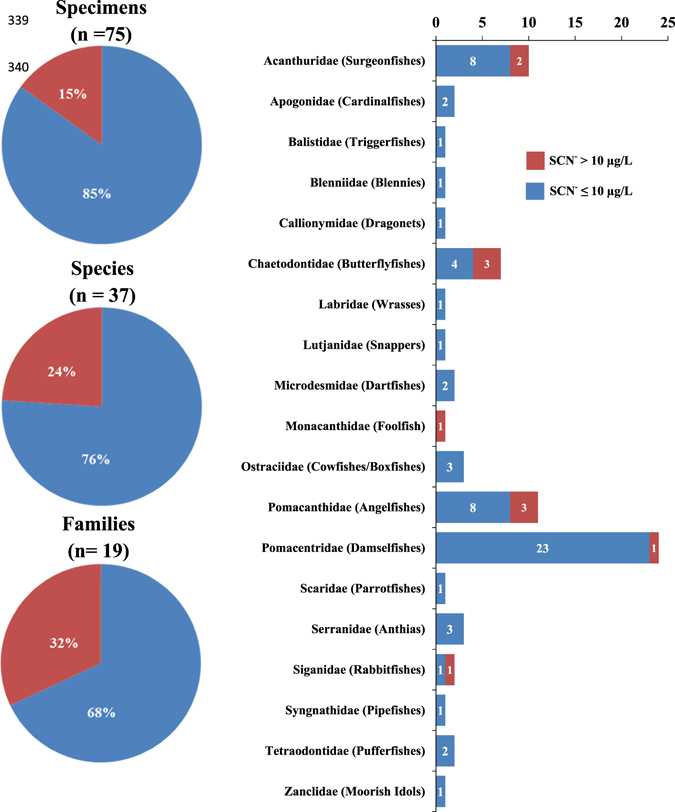
The illegal use of cyanide poisoning to supply live reef fish to several markets is one of the main threats to coral reefs conservation in the Indo-Pacific. The present study performed the first survey ever monitoring the marine aquarium trade in the EU for the presence of physiological evidence consistent with cyanide poisoning in live reef fish. This survey was also the first one worldwide employing a non-invasive sampling approach. Nearly 15% of the fish screened displayed physiological evidence of being illegally collected using cyanide poisoning (by testing positive for the presence of the thiocyanate anion (SCN) in their urine). The efforts promoted so far to completely eradicate cyanide caught fish from the marine aquarium trade have not been effective, as our results suggest that their prevalence in the trade is in line with data reported nearly two decades ago. A new paradigm is urgently needed to effectively ban cyanide caught fish from the marine aquarium trade.
非法使用氰化物中毒来供应活体珊瑚鱼到几个市场是印度洋-太平洋地区珊瑚礁保护的主要威胁之一。本研究首次对欧盟的海洋水族馆贸易进行了监测,以寻找与活体珊瑚鱼氰化物中毒一致的生理证据。这也是全球首次采用非侵入性采样方法进行的调查。近 15%的被筛查鱼类显示出使用氰化物中毒非法采集的生理证据(通过尿液中硫氰酸根阴离子 (SCN) 的存在呈阳性)。到目前为止,为了彻底从海洋水族馆贸易中清除氰化物捕获的鱼类而做出的努力并没有效果,因为我们的结果表明,它们在贸易中的流行程度与近二十年前报告的数据相符。迫切需要一个新的范例来有效地从海洋水族馆贸易中禁止氰化物捕获的鱼类。