Kapadia Chintan H, Tian Shaomin, Perry Jillian L, Luft J Christopher, DeSimone Joseph M
Division of Molecular Pharmaceutics, Eshelman School of Pharmacy, Department of Microbiology & Immunology, Lineberger Comprehensive Cancer Center, and Department of Chemistry, University of North Carolina at Chapel Hill, Chapel Hill, North Carolina 27599, United States.
Department of Chemical and Biomolecular Engineering, NC State University, Raleigh, North Carolina 27695, United States.
ACS Omega. 2019 Mar 31;4(3):5547-5555. doi: 10.1021/acsomega.8b03391. Epub 2019 Mar 19.
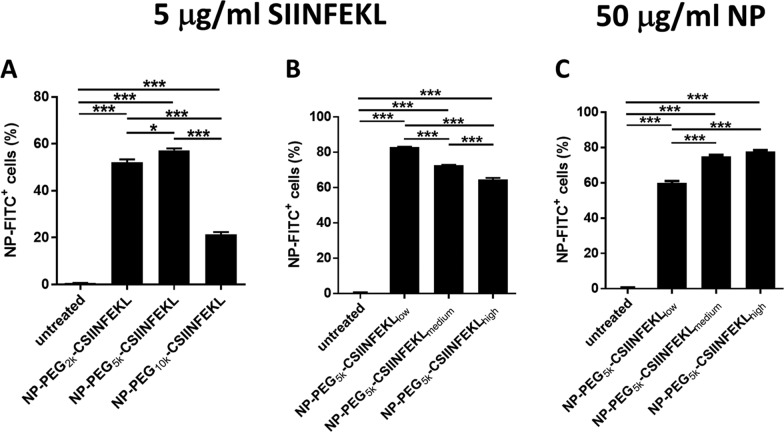
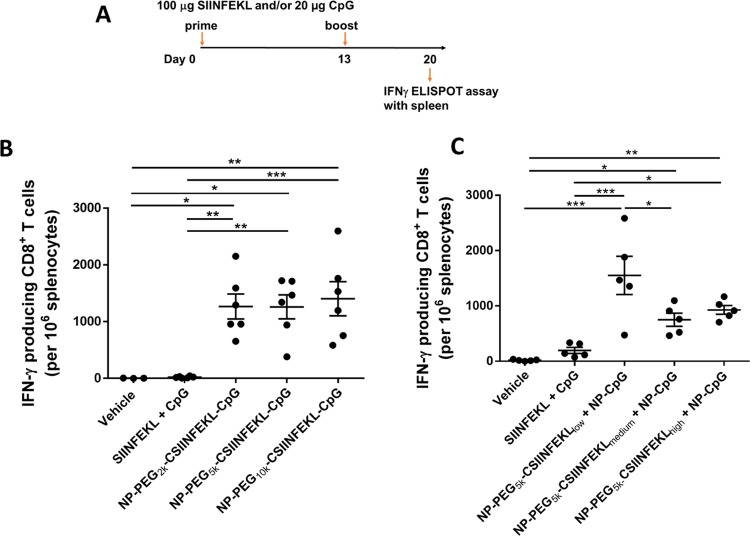
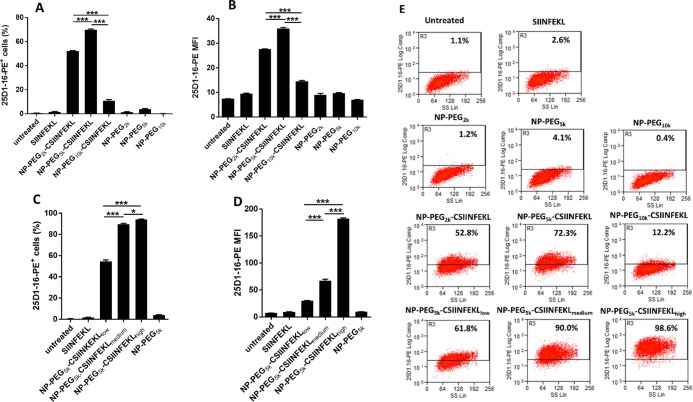
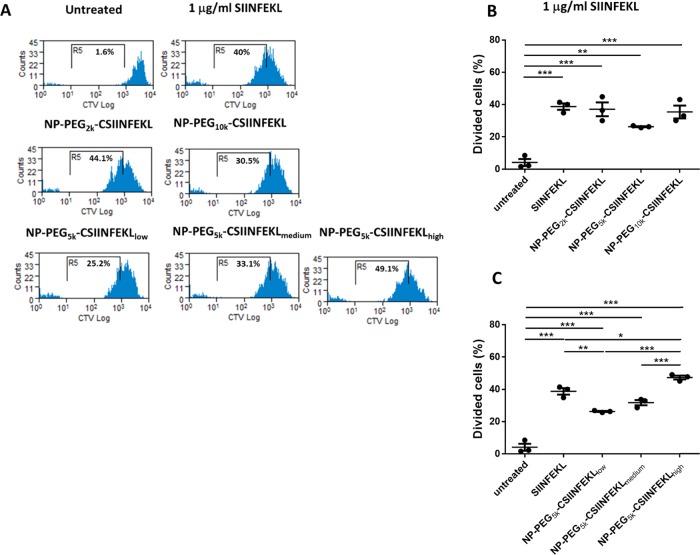
Multiple studies have been published emphasizing the significant role of nanoparticle (NP) carriers in antigenic peptide-based subunit vaccines for the induction of potent humoral and cellular responses. Various design parameters of nanoparticle subunit vaccines such as linker chemistry, the proximity of antigenic peptide to NPs, and the density of antigenic peptides on the surface of NPs play an important role in antigen presentation to dendritic cells (DCs) and in subsequent induction of CD8+ T cell response. In this current study, we evaluated the role of peptide antigen proximity and density on DC uptake, antigen cross-presentation, in vitro T cell proliferation, and in vivo induction of CD8+ T cells. To evaluate the role of antigen proximity, CSIINFEKL peptides were systematically conjugated to poly(ethylene glycol) (PEG) hydrogels through -hydroxysuccinimide-PEG-maleimide linkers of varying molecular weights: 2k, 5k, and 10k. We observed that the peptides conjugated to NPs via the 2k and 5k PEG linkers resulted in higher uptake in bone marrow-derived DCs (BMDCs) and increased p-MHC-I formation on the surface of bone marrow-derived DCs (BMDCs) as compared to the 10k PEG linker formulation. However, no significant differences in vitro T cell proliferation and induction of in vivo CD8+ T cells were found among linker lengths. To study the effect of antigen density, CSIINFEKL peptides were conjugated to PEG hydrogels via 5k PEG linkers at various densities. We found that high antigen density NPs presented the highest p-MHC-I on the surface of BMDCs and induced higher proliferation of T cells, whereas NPs with low peptide density resulted in higher DC cell uptake and elevated frequency of IFN-γ producing CD8+ T cells in mice as compared to the medium- and high-density formulations. Altogether, findings for these experiments highlighted the importance of linker length and peptide antigen density on DC cell uptake, antigen presentation, and induction of in vivo CD8+ T cell response.
多项研究已发表,强调纳米颗粒(NP)载体在基于抗原肽的亚单位疫苗中对诱导强大的体液和细胞免疫反应的重要作用。纳米颗粒亚单位疫苗的各种设计参数,如连接子化学性质、抗原肽与纳米颗粒的接近程度以及纳米颗粒表面抗原肽的密度,在向树突状细胞(DC)呈递抗原以及随后诱导CD8+ T细胞反应中发挥重要作用。在本研究中,我们评估了肽抗原的接近程度和密度对DC摄取、抗原交叉呈递、体外T细胞增殖以及体内CD8+ T细胞诱导的作用。为了评估抗原接近程度的作用,将CSIINFEKL肽通过不同分子量(2k、5k和10k)的N-羟基琥珀酰亚胺-聚乙二醇-马来酰亚胺连接子系统地偶联到聚乙二醇(PEG)水凝胶上。我们观察到,与10k PEG连接子制剂相比,通过2k和5k PEG连接子与纳米颗粒偶联的肽在骨髓来源的DC(BMDC)中摄取更高,并且骨髓来源的DC(BMDC)表面的p-MHC-I形成增加。然而,连接子长度之间在体外T细胞增殖和体内CD8+ T细胞诱导方面未发现显著差异。为了研究抗原密度的影响,将CSIINFEKL肽通过5k PEG连接子以不同密度偶联到PEG水凝胶上。我们发现,高抗原密度的纳米颗粒在BMDC表面呈现最高的p-MHC-I,并诱导T细胞更高的增殖,而与中密度和高密度制剂相比,低肽密度的纳米颗粒在小鼠中导致更高的DC细胞摄取和产生IFN-γ的CD8+ T细胞频率升高。总之,这些实验结果突出了连接子长度和肽抗原密度对DC细胞摄取、抗原呈递以及体内CD8+ T细胞反应诱导的重要性。