Department of Laboratory Medicine, Xiangya School of Medicine, Central South University, Changsha, China.
Hunan Cancer Hospital & The Affiliated Cancer Hospital of Xiangya School of Medicine, Central South University, Changsha, China.
Mol Genet Genomic Med. 2019 Jun;7(6):e672. doi: 10.1002/mgg3.672. Epub 2019 Apr 10.
The serum tumor markers has been widely used in ovarian cancer diagnosis. BRCA1/2 germline mutations are the most common predisposing factors for ovarian cancer development. This study aimed to comprehensively investigate serum tumor markers and BRCA1/2 germline mutations and analyze their associations with ovarian cancer.
Levels of 11 serum tumor markers were examined in ovarian cancer patients and controls with benign gynecologic diseases. By integrating multiplex PCR and next-generation sequencing technologies, BRCA1/2 germline mutations were analyzed and confirmed by Sanger sequencing. The discriminative models with serum tumor markers and BRCA1/2 mutation status were constructed for ovarian cancer detection and patient stratification.
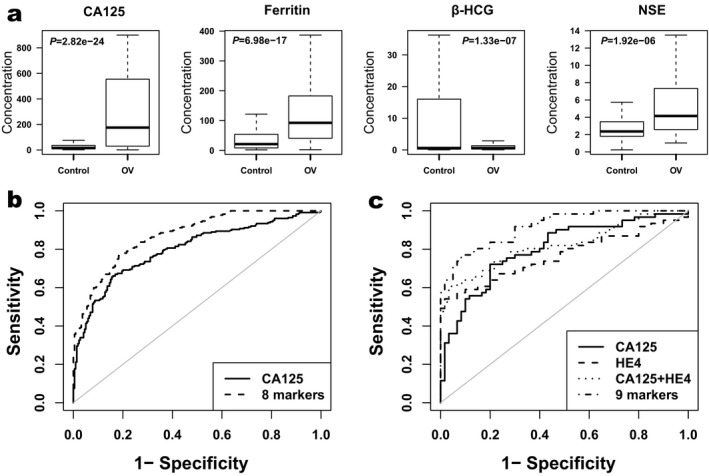
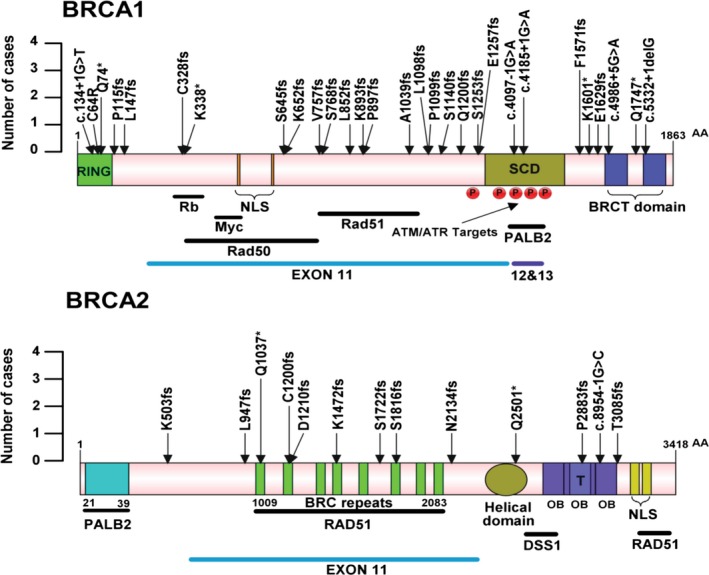
Among 11 markers, six of them were significantly elevated and only beta-human chorionic gonadotropin (β-HCG) was significantly reduced in ovarian cancer patients. A total of 54 (23.3%) ovarian cancer patients were found to harbor BRCA1/2 deleterious mutations, and BRCA1/2 mutations were significantly associated with Hereditary Breast and Ovarian Cancer-related tumors and family history of cancer. Carbohydrate antigen 125 showed a good performance in ovarian cancer detection as a single marker (AUC = 0.799), while a panel of eight markers showed a good performance in BRCA1 mutation detection with an AUC value of 0.974. In addition, a panel of five serum tumor markers combined with BRCA1/2 mutation status showed a good performance in lymph node metastasis prediction (AUC = 0.843).
We found the association between BRCA1/2 germline mutation status and serum tumor marker levels, and identified discriminative models that combined serum tumor markers with BRCA1/2 mutation status for ovarian cancer detection and patient stratification.
血清肿瘤标志物已广泛应用于卵巢癌的诊断。BRCA1/2 种系突变是卵巢癌发展的最常见易感因素。本研究旨在全面研究血清肿瘤标志物和 BRCA1/2 种系突变,并分析它们与卵巢癌的相关性。
检测卵巢癌患者和良性妇科疾病对照者的 11 种血清肿瘤标志物水平。通过整合多重 PCR 和下一代测序技术,分析并通过 Sanger 测序证实 BRCA1/2 种系突变。构建基于血清肿瘤标志物和 BRCA1/2 突变状态的判别模型,用于卵巢癌检测和患者分层。
在 11 个标志物中,有 6 个标志物在卵巢癌患者中显著升高,只有β-人绒毛膜促性腺激素(β-HCG)显著降低。共有 54 例(23.3%)卵巢癌患者携带 BRCA1/2 有害突变,BRCA1/2 突变与遗传性乳腺癌和卵巢癌相关肿瘤以及癌症家族史显著相关。糖抗原 125 作为单一标志物在卵巢癌检测中具有良好的性能(AUC=0.799),而一组 8 种标志物在 BRCA1 突变检测中具有良好的性能,AUC 值为 0.974。此外,一组五种血清肿瘤标志物结合 BRCA1/2 突变状态在预测淋巴结转移方面具有良好的性能(AUC=0.843)。
我们发现了 BRCA1/2 种系突变状态与血清肿瘤标志物水平之间的相关性,并确定了结合血清肿瘤标志物和 BRCA1/2 突变状态的判别模型,用于卵巢癌的检测和患者分层。