Braun Lukas B, Linder Torsten G, Hessberger Tristan, Zentel Rudolf
Institute of Organic Chemistry, Johannes Gutenberg-Universität Mainz, D-55099 Mainz, Germany.
Polymers (Basel). 2016 Dec 14;8(12):435. doi: 10.3390/polym8120435.
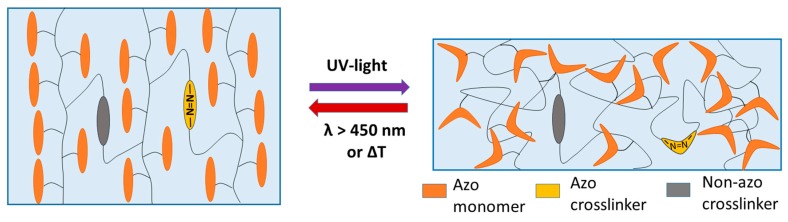
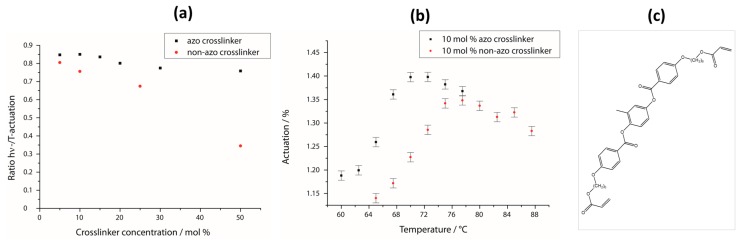
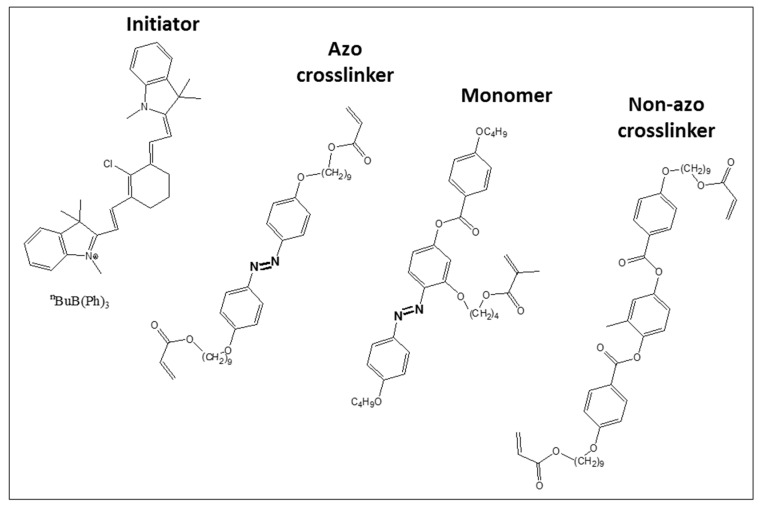
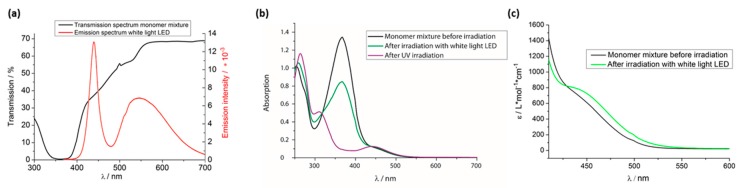
Photoactuating liquid crystalline elastomers (LCE) are promising candidates for an application as artificial muscles in microdevices. In this work, we demonstrate that by optimizing (1) the illumination conditions and (2) the mixture of azo monomer and azo crosslinker, thick films of an all-azo LCE can be prepared, which show a strong length change without bending during photoactuation. This becomes possible by working with white light (about 440 nm), whose absorption is low, leading to a large penetration depth. By adding an azo crosslinker to a previously prepared system, several improvements of the actuation properties-like a stronger photoactuation at lower operational temperatures-could be achieved. In addition, films of different crosslinker concentrations and thicknesses were produced by photopolymerization at varying temperatures within a magnetic field, and their thermo- and photoresponsive behavior was investigated. An extraordinarily strong maximal thermal actuation of 46% and-by exposure to white light at 70 °C-a photoresponsive change in length of up to 40% in just about 13 s could be obtained. Even densely crosslinked samples were still able to photoactuate remarkably. Isothermal back-deformation could either be achieved by irradiation with red light (7 min) or by keeping the film in the dark (13 min).
光驱动液晶弹性体(LCE)是有望应用于微器件中作为人工肌肉的材料。在这项工作中,我们证明通过优化(1)光照条件和(2)偶氮单体与偶氮交联剂的混合物,可以制备出全偶氮LCE厚膜,其在光驱动过程中表现出强烈的长度变化而无弯曲。通过使用白光(约440nm)实现了这一点,其吸收较低,导致穿透深度较大。通过向先前制备的体系中添加偶氮交联剂,可以实现驱动性能的若干改进,如在较低工作温度下更强的光驱动。此外,通过在磁场中不同温度下进行光聚合制备了不同交联剂浓度和厚度的薄膜,并研究了它们的热响应和光响应行为。在仅约13秒内可获得高达46%的极强最大热驱动,以及在70°C下暴露于白光时长度高达40%的光响应变化。即使是高度交联的样品仍能显著地进行光驱动。等温反向变形可以通过用红光照射(7分钟)或使薄膜保持在黑暗中(13分钟)来实现。