• 文献检索
  • 文档翻译
  • 深度研究
  • 学术资讯
  • Suppr Zotero 插件Zotero 插件
  • 邀请有礼
  • 套餐&价格
  • 历史记录
应用&插件
Suppr Zotero 插件Zotero 插件浏览器插件Mac 客户端Windows 客户端微信小程序
定价
高级版会员购买积分包购买API积分包
服务
文献检索文档翻译深度研究API 文档MCP 服务
关于我们
关于 Suppr公司介绍联系我们用户协议隐私条款
关注我们

Suppr 超能文献

核心技术专利:CN118964589B侵权必究
粤ICP备2023148730 号-1Suppr @ 2026

文献检索

告别复杂PubMed语法,用中文像聊天一样搜索,搜遍4000万医学文献。AI智能推荐,让科研检索更轻松。

立即免费搜索

文件翻译

保留排版,准确专业,支持PDF/Word/PPT等文件格式,支持 12+语言互译。

免费翻译文档

深度研究

AI帮你快速写综述,25分钟生成高质量综述,智能提取关键信息,辅助科研写作。

立即免费体验

公众对医疗保健服务的看法:来自中国社交媒体平台的证据。

Public Perception on Healthcare Services: Evidence from Social Media Platforms in China.

机构信息

School of Public Health, Chinese Academy of Medical Sciences and Peking Union Medical College, Beijing 100730, China.

出版信息

Int J Environ Res Public Health. 2019 Apr 10;16(7):1273. doi: 10.3390/ijerph16071273.

DOI:10.3390/ijerph16071273
PMID:30974729
原文链接:https://pmc.ncbi.nlm.nih.gov/articles/PMC6479867/
Abstract

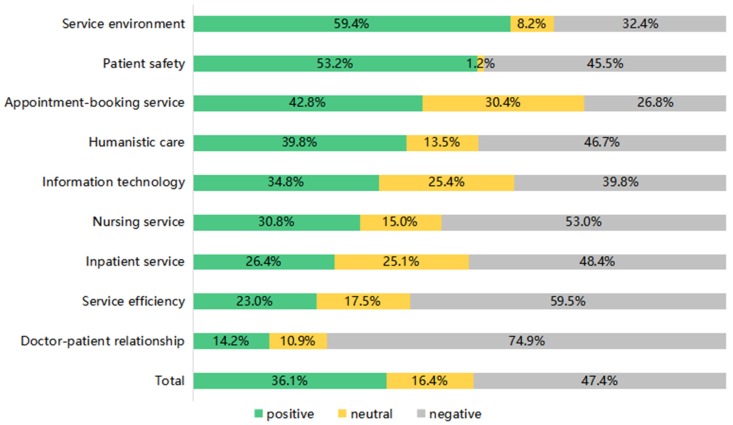
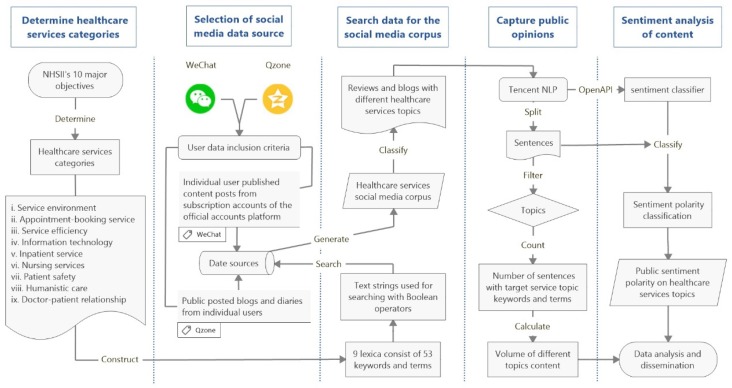
Social media has been used as data resource in a growing number of health-related research. The objectives of this study were to identify content volume and sentiment polarity of social media records relevant to healthcare services in China. A list of the key words of healthcare services were used to extract data from WeChat and Qzone, between June 2017 and September 2017. The data were put into a corpus, where content analyses were performed using Tencent natural language processing (NLP). The final corpus contained approximately 29 million records. Records on patient safety were the most frequently mentioned topic (approximately 8.73 million, 30.1% of the corpus), with the contents on humanistic care having received the least social media references (0.43 Million, 1.5%). Sentiment analyses showed 36.1%, 16.4%, and 47.4% of positive, neutral, and negative emotions, respectively. The doctor-patient relationship category had the highest proportion of negative contents (74.9%), followed by service efficiency (59.5%), and nursing service (53.0%). Neutral disposition was found to be the highest (30.4%) in the contents on appointment-booking services. This study added evidence to the magnitude and direction of public perceptions on healthcare services in China's hospital and pointed to the possibility of monitoring healthcare service improvement, using readily available data in social media.

摘要

社交媒体已被越来越多地用于与健康相关的研究。本研究的目的是确定与中国医疗服务相关的社交媒体记录的内容量和情绪极性。使用医疗服务的关键词列表从微信和 QQ 空间中提取 2017 年 6 月至 9 月的数据。将数据放入语料库中,使用腾讯自然语言处理(NLP)进行内容分析。最终语料库包含约 2900 万条记录。患者安全记录是最常被提及的话题(约 873 万条,占语料库的 30.1%),人文关怀的内容在社交媒体上的提及率最低(0.43 万条,占 1.5%)。情感分析显示,积极、中性和消极情绪的比例分别为 36.1%、16.4%和 47.4%。医患关系类别中负面内容的比例最高(74.9%),其次是服务效率(59.5%)和护理服务(53.0%)。在预约服务的内容中,发现中性态度的比例最高(30.4%)。本研究为中国医院对医疗服务的公众看法的规模和方向提供了证据,并指出了利用社交媒体中现成数据监测医疗服务改进的可能性。
https://cdn.ncbi.nlm.nih.gov/pmc/blobs/abff/6479867/60b14efb5503/ijerph-16-01273-g002.jpg
https://cdn.ncbi.nlm.nih.gov/pmc/blobs/abff/6479867/ed55f2bd2f41/ijerph-16-01273-g001.jpg
https://cdn.ncbi.nlm.nih.gov/pmc/blobs/abff/6479867/60b14efb5503/ijerph-16-01273-g002.jpg
https://cdn.ncbi.nlm.nih.gov/pmc/blobs/abff/6479867/ed55f2bd2f41/ijerph-16-01273-g001.jpg
https://cdn.ncbi.nlm.nih.gov/pmc/blobs/abff/6479867/60b14efb5503/ijerph-16-01273-g002.jpg

相似文献

1
Public Perception on Healthcare Services: Evidence from Social Media Platforms in China.公众对医疗保健服务的看法:来自中国社交媒体平台的证据。
Int J Environ Res Public Health. 2019 Apr 10;16(7):1273. doi: 10.3390/ijerph16071273.
2
Exploring public opinion on health effects of prepared dishes in China through social media comments.通过社交媒体评论探索中国公众对预制菜健康影响的看法。
Front Public Health. 2024 Sep 12;12:1424690. doi: 10.3389/fpubh.2024.1424690. eCollection 2024.
3
Social media as a sensor of air quality and public response in China.社交媒体作为中国空气质量及公众反应的一种监测手段。
J Med Internet Res. 2015 Mar 26;17(3):e22. doi: 10.2196/jmir.3875.
4
How the public uses social media wechat to obtain health information in china: a survey study.公众如何在中国使用社交媒体微信获取健康信息:一项调查研究。
BMC Med Inform Decis Mak. 2017 Jul 5;17(Suppl 2):66. doi: 10.1186/s12911-017-0470-0.
5
Understanding the Function Constitution and Influence Factors on Communication for the WeChat Official Account of Top Tertiary Hospitals in China: Cross-Sectional Study.了解中国顶级三甲医院微信公众号传播的功能构成及影响因素:横断面研究
J Med Internet Res. 2019 Dec 9;21(12):e13025. doi: 10.2196/13025.
6
Social Media Landscape of the Tertiary Referral Hospitals in China: Observational Descriptive Study.中国三级转诊医院的社交媒体格局:观察性描述性研究。
J Med Internet Res. 2018 Aug 9;20(8):e249. doi: 10.2196/jmir.9607.
7
New media platform's understanding of Chinese social workers' anti-epidemic actions: an analysis of network public opinion based on COVID-19.新媒体平台对中国社会工作者抗疫行动的认知:基于 COVID-19 的网络舆情分析。
Soc Work Public Health. 2021 Nov 17;36(7-8):770-785. doi: 10.1080/19371918.2021.1954127. Epub 2021 Jul 30.
8
Public Perceptions Regarding Use of Virtual Reality in Health Care: A Social Media Content Analysis Using Facebook.公众对虚拟现实在医疗保健中应用的认知:一项使用脸书的社交媒体内容分析
J Med Internet Res. 2017 Dec 19;19(12):e419. doi: 10.2196/jmir.7467.
9
A comparison of health communication effectiveness and the improvement of management strategies: taking two Chinese traditional medicine hospitals' WeChat public accounts as examples.健康传播效果比较及管理策略改进:以两家中医医院微信公众号为例。
BMC Health Serv Res. 2020 Nov 20;20(1):1055. doi: 10.1186/s12913-020-05901-3.
10
Expanding public health in China: an empirical analysis of healthcare inputs and outputs.中国公共卫生的扩展:医疗投入与产出的实证分析。
Public Health. 2017 Jan;142:73-84. doi: 10.1016/j.puhe.2016.10.007. Epub 2016 Nov 22.

引用本文的文献

1
The Use of Natural Language Processing to Interpret Unstructured Patient Feedback on Health Services: Scoping Review.利用自然语言处理解读关于医疗服务的非结构化患者反馈:范围综述
J Med Internet Res. 2025 Aug 14;27:e72853. doi: 10.2196/72853.
2
Video platforms and sexual healthcare in China: assessment of content on premature ejaculation.中国的视频平台与性健康护理:早泄内容评估
Transl Androl Urol. 2025 Mar 30;14(3):729-739. doi: 10.21037/tau-2025-104. Epub 2025 Mar 26.
3
Game-theoretic analysis of governance and corruption in China's pharmaceutical industry.

本文引用的文献

1
What Predicts Patients' Adoption Intention Toward mHealth Services in China: Empirical Study.在中国,哪些因素能预测患者对移动医疗服务的采用意愿:实证研究。
JMIR Mhealth Uhealth. 2018 Aug 29;6(8):e172. doi: 10.2196/mhealth.9316.
2
Social Media Landscape of the Tertiary Referral Hospitals in China: Observational Descriptive Study.中国三级转诊医院的社交媒体格局:观察性描述性研究。
J Med Internet Res. 2018 Aug 9;20(8):e249. doi: 10.2196/jmir.9607.
3
Characterizing Depression Issues on Sina Weibo.微博上的抑郁问题分析
中国制药行业治理与腐败问题的博弈论分析
Front Med (Lausanne). 2024 Aug 14;11:1439864. doi: 10.3389/fmed.2024.1439864. eCollection 2024.
4
Analyzing patients satisfaction level for medical services using twitter data.利用推特数据分析患者对医疗服务的满意度水平。
PeerJ Comput Sci. 2024 Jan 9;10:e1697. doi: 10.7717/peerj-cs.1697. eCollection 2024.
5
Advanced Sentiment Analysis for Managing and Improving Patient Experience: Application for General Practitioner (GP) Classification in Northamptonshire.高级情感分析在患者体验管理和改善中的应用:北安普顿郡全科医生(GP)分类应用。
Int J Environ Res Public Health. 2023 Jun 13;20(12):6119. doi: 10.3390/ijerph20126119.
6
Patient satisfaction impact indicators from a psychosocial perspective.从社会心理角度看患者满意度的影响因素。
Front Public Health. 2023 Feb 22;11:1103819. doi: 10.3389/fpubh.2023.1103819. eCollection 2023.
7
Framing Public Opinion on Physician-Patient Conflicts on Microblog: A Comparative Content Analysis.在微博上构建医患冲突的公众舆论:一项比较内容分析。
Front Public Health. 2022 Feb 4;10:831638. doi: 10.3389/fpubh.2022.831638. eCollection 2022.
8
Hospital Facebook Reviews Analysis Using a Machine Learning Sentiment Analyzer and Quality Classifier.使用机器学习情感分析器和质量分类器对医院脸书评论进行分析
Healthcare (Basel). 2021 Dec 3;9(12):1679. doi: 10.3390/healthcare9121679.
9
Patient Satisfaction and Hospital Quality of Care Evaluation in Malaysia Using SERVQUAL and Facebook.马来西亚使用SERVQUAL模型和脸书进行的患者满意度与医院护理质量评估
Healthcare (Basel). 2021 Oct 14;9(10):1369. doi: 10.3390/healthcare9101369.
10
Assessing Patient-Perceived Hospital Service Quality and Sentiment in Malaysian Public Hospitals Using Machine Learning and Facebook Reviews.利用机器学习和 Facebook 评论评估马来西亚公立医院的患者感知医院服务质量和情绪
Int J Environ Res Public Health. 2021 Sep 21;18(18):9912. doi: 10.3390/ijerph18189912.
Int J Environ Res Public Health. 2018 Apr 16;15(4):764. doi: 10.3390/ijerph15040764.
4
What do patients care most about in China's public hospitals? Interviews with patients in Jiangsu Province.在中国的公立医院中,患者最关心的是什么?对江苏省患者的访谈。
BMC Health Serv Res. 2018 Feb 8;18(1):97. doi: 10.1186/s12913-018-2903-6.
5
Unhappy Patients Are Not Alike: Content Analysis of the Negative Comments from China's Good Doctor Website.不满意的患者各有不同:对中国好医生网站负面评论的内容分析
J Med Internet Res. 2018 Jan 25;20(1):e35. doi: 10.2196/jmir.8223.
6
Capturing the Patient's Perspective: a Review of Advances in Natural Language Processing of Health-Related Text.捕捉患者视角:健康相关文本自然语言处理进展综述
Yearb Med Inform. 2017 Aug;26(1):214-227. doi: 10.15265/IY-2017-029. Epub 2017 Sep 11.
7
How the public uses social media wechat to obtain health information in china: a survey study.公众如何在中国使用社交媒体微信获取健康信息:一项调查研究。
BMC Med Inform Decis Mak. 2017 Jul 5;17(Suppl 2):66. doi: 10.1186/s12911-017-0470-0.
8
Workplace violence against medical staff of Chinese children's hospitals: A cross-sectional study.中国儿童医院医护人员遭受的工作场所暴力:一项横断面研究。
PLoS One. 2017 Jun 13;12(6):e0179373. doi: 10.1371/journal.pone.0179373. eCollection 2017.
9
Using Social Media to Characterize Public Sentiment Toward Medical Interventions Commonly Used for Cancer Screening: An Observational Study.利用社交媒体刻画公众对癌症筛查常用医疗干预措施的情绪:一项观察性研究。
J Med Internet Res. 2017 Jun 7;19(6):e200. doi: 10.2196/jmir.7485.
10
Systematic review of surveillance by social media platforms for illicit drug use.社交媒体平台监测非法药物使用的系统评价。
J Public Health (Oxf). 2017 Dec 1;39(4):763-776. doi: 10.1093/pubmed/fdx020.