Mori da Cunha Marina Gabriela M C, Hympanova Lucie, Rynkevic Rita, Mes Tristan, Bosman Anton W, Deprest Jan
Department of Development and Regeneration, Woman and Child, Group Biomedical Sciences, KU Leuven, 3000 Leuven, Belgium.
Institute for the Care of Mother and Child, Third Faculty of Medicine, Charles University, 14700 Prague, Czech Republic.
Materials (Basel). 2019 Apr 10;12(7):1174. doi: 10.3390/ma12071174.
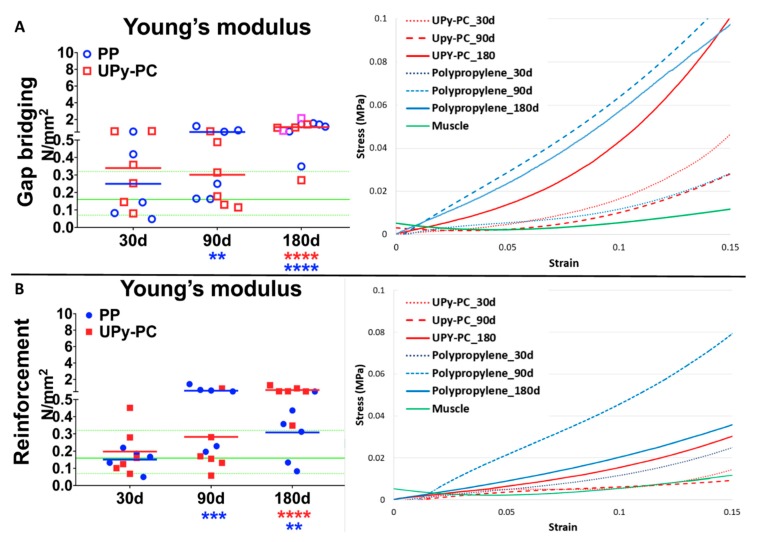
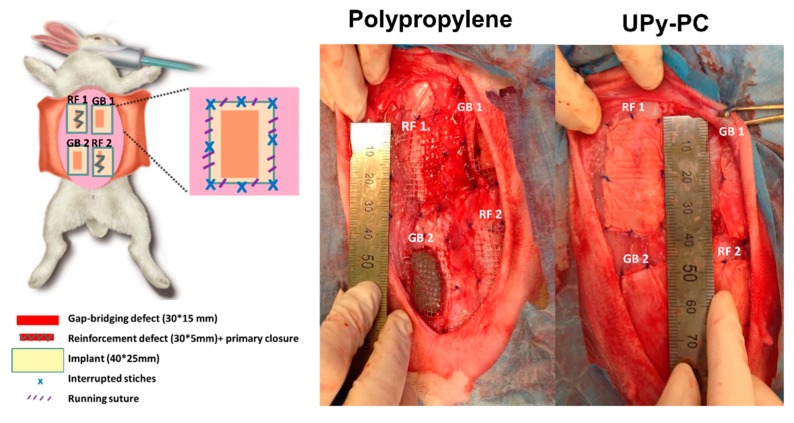
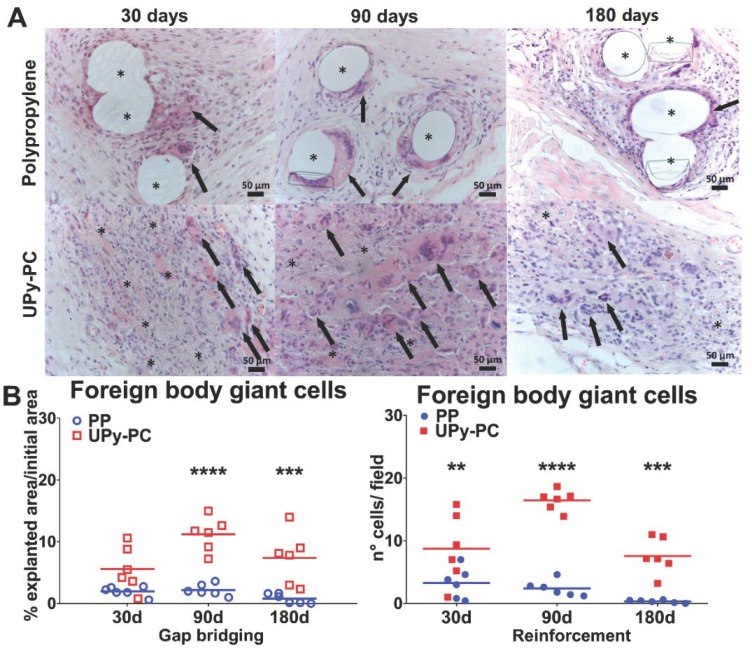
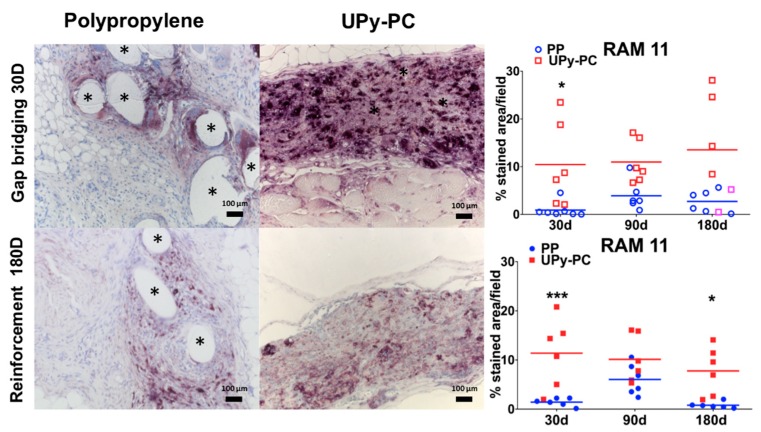
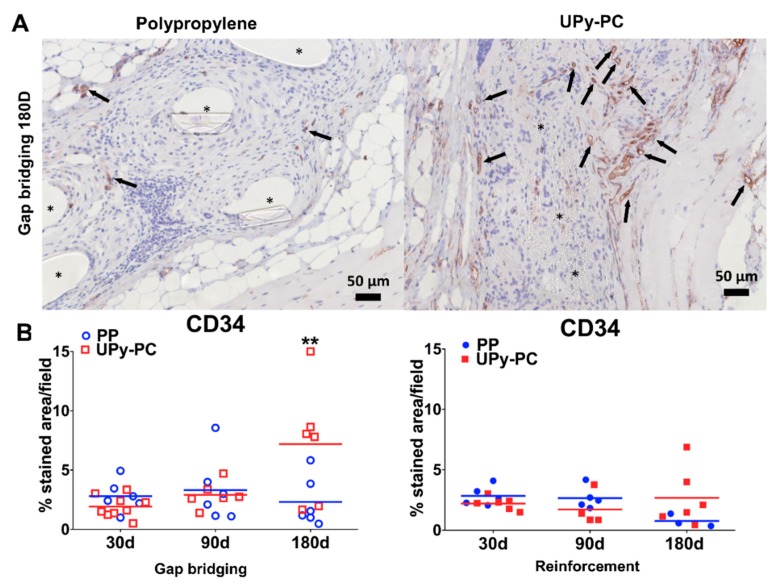
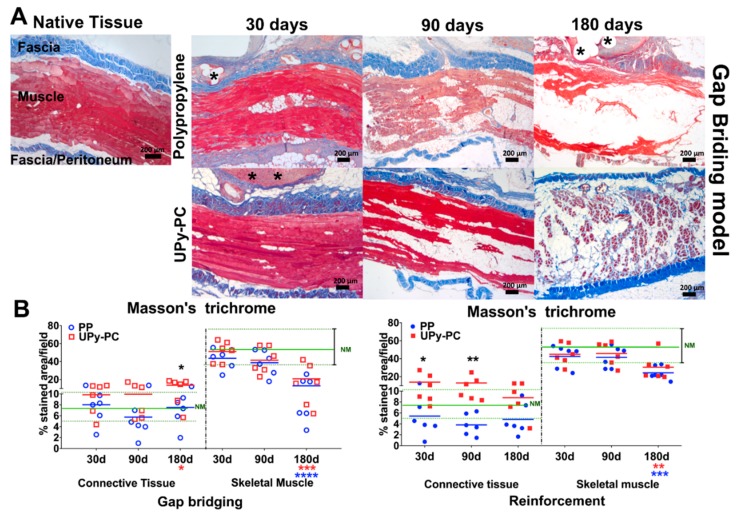
Although mesh use has significantly improved the outcomes of hernia and pelvic organ prolapse repair, long-term recurrence rates remain unacceptably high. We aim to determine the in vivo degradation and functional outcome of reconstructed abdominal wall defects, using slowly degradable electrospun ureidopyrimidinone moieties incorporated into a polycarbonate backbone (UPy-PC) implant compared to an ultra-lightweight polypropylene (PP) textile mesh with high pore stability. Twenty four New-Zealand rabbits were implanted with UPy-PC or PP to either reinforce a primary fascial defect repair or to cover (referred to as gap bridging) a full-thickness abdominal wall defect. Explants were harvested at 30, 90 and 180 days. The primary outcome measure was uniaxial tensiometry. Secondary outcomes were the recurrence of herniation, morphometry for musculofascial tissue characteristics, inflammatory response and neovascularization. PP explants compromised physiological abdominal wall compliance from 90 days onwards and UPy-PC from 180 days. UPy-PC meshes induced a more vigorous inflammatory response than PP at all time points. We observed progressively more signs of muscle atrophy and intramuscular fatty infiltration in the entire explant area for both mesh types. UPy-PC implants are replaced by a connective tissue stiff enough to prevent abdominal wall herniation in two-thirds of the gap-bridged full-thickness abdominal wall defects. However, in one-third there was sub-clinical herniation. The novel electrospun material did slightly better than the textile PP yet outcomes were still suboptimal. Further research should investigate what drives muscular atrophy, and whether novel polymers would eventually generate a physiological neotissue and can prevent failure and/or avoid collateral damage.
尽管使用补片显著改善了疝修补和盆腔器官脱垂修复的效果,但长期复发率仍然高得令人难以接受。我们旨在确定重建腹壁缺损的体内降解情况和功能结果,将掺入聚碳酸酯主链(UPy-PC)的可缓慢降解的电纺脲嘧啶酮部分植入物与具有高孔隙稳定性的超轻质聚丙烯(PP)纺织补片进行比较。将24只新西兰兔植入UPy-PC或PP,以加强原发性筋膜缺损修复或覆盖(称为间隙桥接)全层腹壁缺损。在30天、90天和180天时采集植入物。主要结局指标是单轴张力测定。次要结局包括疝复发、肌肉筋膜组织特征的形态测量、炎症反应和新生血管形成。从90天起,PP植入物损害了生理腹壁顺应性,而UPy-PC从180天起损害了生理腹壁顺应性。在所有时间点,UPy-PC补片比PP诱导更强烈的炎症反应。我们观察到两种补片类型在整个植入物区域的肌肉萎缩和肌内脂肪浸润迹象都逐渐增多。在三分之二的间隙桥接全层腹壁缺损中,UPy-PC植入物被足够坚硬的结缔组织替代,以防止腹壁疝形成。然而,在三分之一的病例中存在亚临床疝。这种新型电纺材料比纺织PP稍好,但结果仍不理想。进一步的研究应调查是什么导致肌肉萎缩,以及新型聚合物最终是否会产生生理性新组织,并能否预防失败和/或避免附带损害。