Department of Clinical Pharmacy and Pharmacology, School of Pharmacy, Muhimbili University of Health and Allied Sciences, P. O. BOX 65013, Dar es Salaam, Tanzania.
Department of Clinical Pharmacology, School of Medicine, Muhimbili University of Health and Allied Sciences, P. O. BOX 6515, Dar es Salaam, Tanzania.
Malar J. 2019 Apr 11;18(1):133. doi: 10.1186/s12936-019-2769-z.
In 2006, artemether-lumefantrine (ALU), specifically Coartem (Novartis Pharma AG, Basel Switzerland), was approved as the first-line drug for treatment of uncomplicated malaria in Tanzania. Due to poor availability and affordability of the innovator's product, the government of Tanzania in 2013 prequalified the use of generic anti-malarial drugs, whereby Artefan (Ajanta, Pharma Ltd, India) was the first to be approved.
This was an equivalence prospective study that aimed to determine the effectiveness of anti-malarial generic Artefan in comparison with innovator's product Coartem. Patients aged 6 to 59 months with uncomplicated malaria were recruited and randomized to either receive Artefan or Coartem as a control. Participants were required to revisit clinic five times as follow up to monitor treatment outcome as per World Health Organization recommendations. On each visit, thick and thin blood smears, dried blood spot (DBS), haemoglobin concentrations and auxiliary temperature were performed and documented.
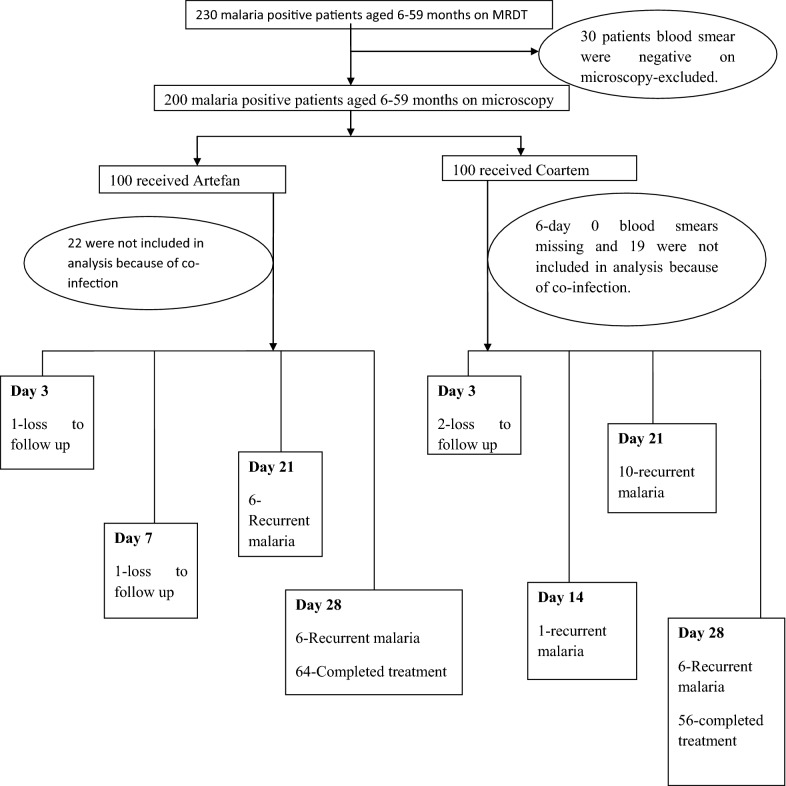
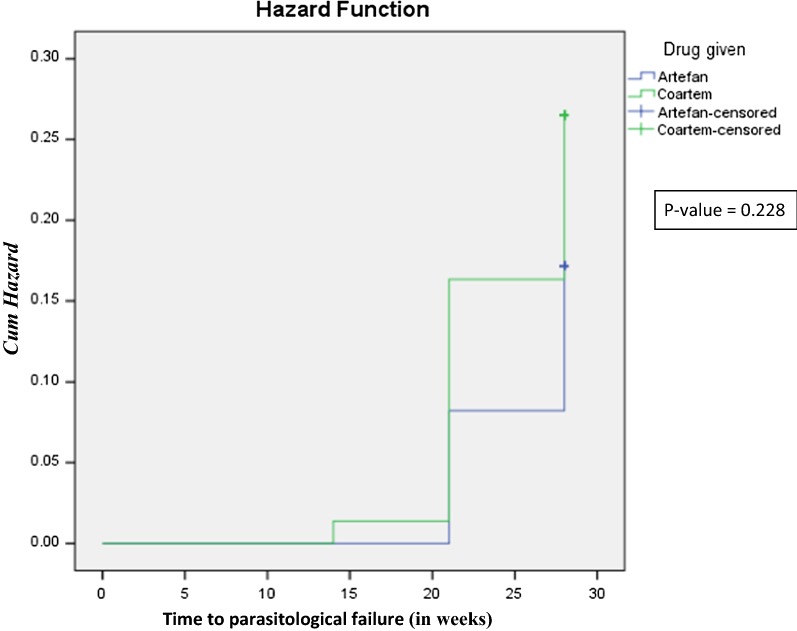
Out of 230 recruited participants, 200 met inclusion criteria and were randomized equally to receive Artefan and Coartem. The overall PCR uncorrected cure rate were 80% for Artefan and 75% for Coartem (p = 0.44). Adequate clinical and parasitological response were 82.1% for Artefan and 74.7% for Coartem, and there was no early treatment failure (ETF) observed in both arms of treatment. Both drugs showed excellent early parasite clearance, whereby no participants had peripheral parasitaemia on day 3. Late clinical failures (LCF) were 3.6% for Artefan and 1.3% for Coartem (p = 0.31), and late parasitological failure (LPF) were 15.4% for Artefan and 22.7% for Coartem (p = 0.32). Mean haemoglobin (g/dl) concentrations observed on day 28 were higher compared to day 0 for both drugs, although not statistically significant. Only one (1.3%) participant on Artefan had temperature ≥ 37.5 °C on day 3.
The findings of this study indicate that both Artefan and Coartem are equivalent and effective in the management of uncomplicated malaria amongst children in the Coast part of Tanzania.
2006 年,青蒿琥酯-咯萘啶(ALU),特指科泰新(瑞士巴塞尔诺华制药),被批准为坦桑尼亚治疗无并发症疟疾的一线药物。由于原研产品的供应和可负担性差,坦桑尼亚政府于 2013 年有条件批准使用通用抗疟药物,由此 Artefan(Ajanta,Pharma Ltd,印度)成为第一个获得批准的药物。
这是一项等效性前瞻性研究,旨在确定通用抗疟药 Artefan 的疗效与原研产品 Coartem 的疗效相比。招募了年龄在 6 至 59 个月之间患有无并发症疟疾的患者,并将他们随机分为 Artefan 或 Coartem 作为对照组。根据世界卫生组织的建议,要求参与者五次复诊以监测治疗结果。每次就诊时,都进行厚、薄血涂片、干血斑(DBS)、血红蛋白浓度和辅助体温检测,并记录。
在招募的 230 名参与者中,200 名符合纳入标准,并被平均随机分为 Artefan 和 Coartem 组。PCR 未校正的总治愈率分别为 Artefan 组的 80%和 Coartem 组的 75%(p=0.44)。 Artefan 组的充分临床和寄生虫学反应率为 82.1%,Coartem 组为 74.7%,治疗组均未观察到早期治疗失败(ETF)。两种药物均显示出良好的早期寄生虫清除效果,第 3 天无参与者出现外周寄生虫血症。 Artefan 组的晚期临床失败(LCF)率为 3.6%,Coartem 组为 1.3%(p=0.31), Artefan 组的晚期寄生虫学失败(LPF)率为 15.4%,Coartem 组为 22.7%(p=0.32)。与治疗前相比,第 28 天的平均血红蛋白(g/dl)浓度在两种药物中均升高,尽管无统计学意义。 Artefan 组只有 1 名(1.3%)参与者在第 3 天体温≥37.5°C。
本研究结果表明, Artefan 和 Coartem 在坦桑尼亚沿海地区治疗儿童无并发症疟疾方面均具有等效性和有效性。