Feng Qiushi, Yeung Wei-Jun Jean, Wang Zhenglian, Zeng Yi
1Department of Sociology, Centre for Family and Population Research (CFPR), National University of Singapore, Singapore, Singapore.
2Department of Sociology, Centre for Family and Population Research (CFPR), Changing Family in Asia Cluster of Asia Research Institute (ARI), Faculty of Arts and Social Sciences, National University of Singapore, Singapore, Singapore.
Eur J Popul. 2018 Feb 13;35(1):29-62. doi: 10.1007/s10680-018-9467-3. eCollection 2019 Feb 15.
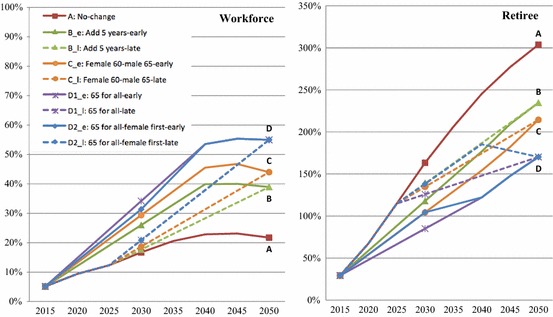
As China continues to age rapidly, whether the country should adjust the official retirement age, and if so, when and how, are currently major policy concerns. We examine the impact of postponing the retirement age on the human capital of China in the next four decades. Two critical aspects of human capital-health and education-are incorporated to account for the quality of the work force. Our projections reveal the impact of nine scenarios on the Chinese labor force in the next few decades, highlighting the changes in "the high human capital workforce"-those with good health and education. We show substantial impact with added work force ranging from 28 to 92 million per year depending on which scenarios are implemented. Furthermore, the retained workers are increasingly better educated. The gain in female workers is particularly significant, reaping the benefits of the education expansion since the 1990s.
随着中国老龄化速度持续加快,该国是否应调整法定退休年龄,若要调整,何时调整以及如何调整,目前是重大政策关切问题。我们研究了推迟退休年龄对中国未来四十年人力资本的影响。人力资本的两个关键方面——健康和教育——被纳入考量以评估劳动力质量。我们的预测揭示了九种情景对中国未来几十年劳动力的影响,突出了“高人力资本劳动力”(即健康且受过良好教育的人群)的变化。我们发现,根据实施的情景不同,每年新增劳动力数量在2800万至9200万之间,会产生巨大影响。此外,留用的工人受教育程度越来越高。女性工人的收益尤为显著,收获了自20世纪90年代以来教育扩张的成果。