Türková Alžběta, Zdrazil Barbara
Department of Pharmaceutical Chemistry, Divison of Drug Design and Medicinal Chemistry, University of Vienna, Althanstraße 14, A-1090 Vienna, Austria.
Comput Struct Biotechnol J. 2019 Mar 8;17:390-405. doi: 10.1016/j.csbj.2019.03.002. eCollection 2019.
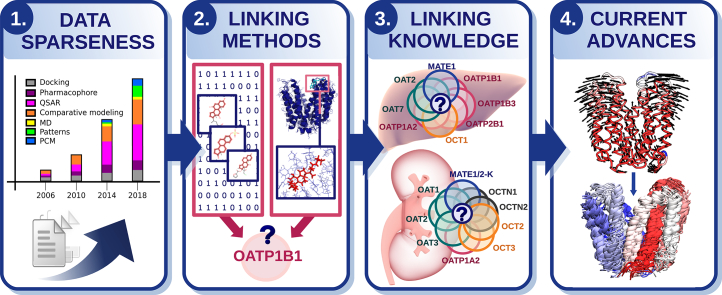
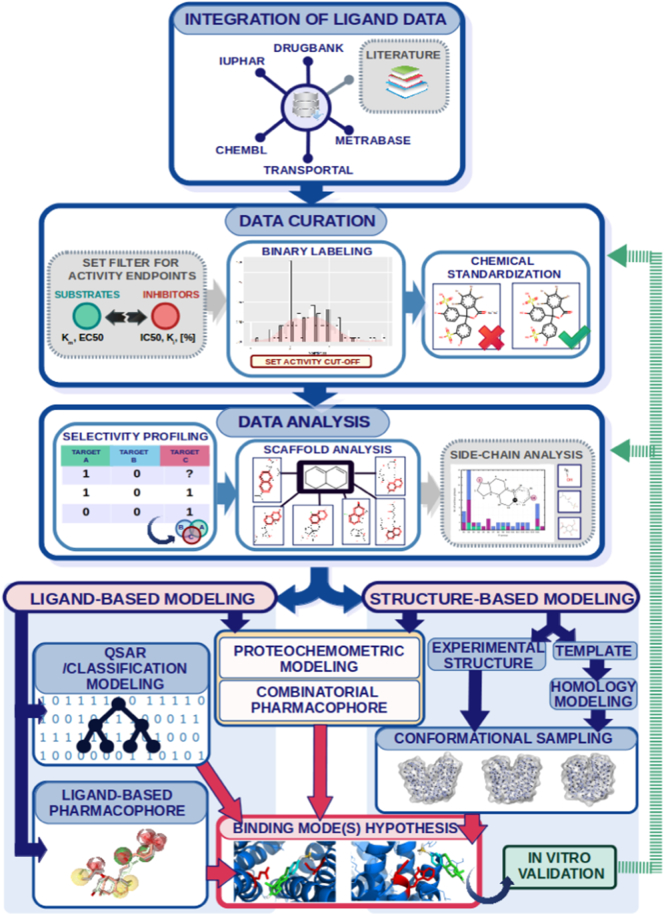
Organic anion and cation transporting proteins (OATs, OATPs, and OCTs), as well as the Multidrug and Toxin Extrusion (MATE) transporters of the Solute Carrier (SLC) family are playing a pivotal role in the discovery and development of new drugs due to their involvement in drug disposition, drug-drug interactions, adverse drug effects and related toxicity. Computational methods to understand and predict clinically relevant transporter interactions can provide useful guidance at early stages in drug discovery and design, especially if they include contemporary data science approaches. In this review, we summarize the current state-of-the-art of computational approaches for exploring ligand interactions and selectivity for these drug (uptake) transporters. The computational methods discussed here by highlighting interesting examples from the current literature are ranging from semiautomatic data mining and integration, to ligand-based methods (such as quantitative structure-activity relationships, and combinatorial pharmacophore modeling), and finally structure-based methods (such as comparative modeling, molecular docking, and molecular dynamics simulations). We are focusing on promising computational techniques such as fold-recognition methods, proteochemometric modeling or techniques for enhanced sampling of protein conformations used in the context of these ADMET-relevant SLC transporters with a special focus on methods useful for studying ligand selectivity.
有机阴离子和阳离子转运蛋白(OATs、OATPs和OCTs)以及溶质载体(SLC)家族的多药和毒素外排(MATE)转运蛋白,由于它们参与药物处置、药物-药物相互作用、药物不良反应及相关毒性,在新药的发现和开发中发挥着关键作用。理解和预测临床相关转运蛋白相互作用的计算方法,可在药物发现和设计的早期阶段提供有用的指导,特别是当这些方法包含当代数据科学方法时。在本综述中,我们总结了探索这些药物(摄取)转运蛋白的配体相互作用和选择性的计算方法的当前技术水平。通过突出当前文献中的有趣实例来讨论的计算方法,范围从半自动数据挖掘和整合,到基于配体的方法(如定量构效关系和组合药效团建模),最后是基于结构的方法(如比较建模、分子对接和分子动力学模拟)。我们专注于有前景的计算技术,如折叠识别方法、蛋白质化学计量学建模或用于增强这些与ADMET相关的SLC转运蛋白背景下蛋白质构象采样的技术,特别关注有助于研究配体选择性的方法。