1The University of Sydney School of Pharmacy, Sydney, NSW Australia.
2Population Health Research Centre, Department of Medicine, Faculty of Medicine, University of Ruhuna, Galle, Sri Lanka.
Antimicrob Resist Infect Control. 2019 Mar 29;8:60. doi: 10.1186/s13756-019-0510-x. eCollection 2019.
Inappropriate over-the-counter supply of antibiotics in pharmacies for common infections is recognised as a source of antibiotic misuse that can worsen the global burden of antibiotic resistance.
To assess responses of community pharmacy staff to pseudo-patients presenting with symptoms of common infections and factors associated with such behaviour.
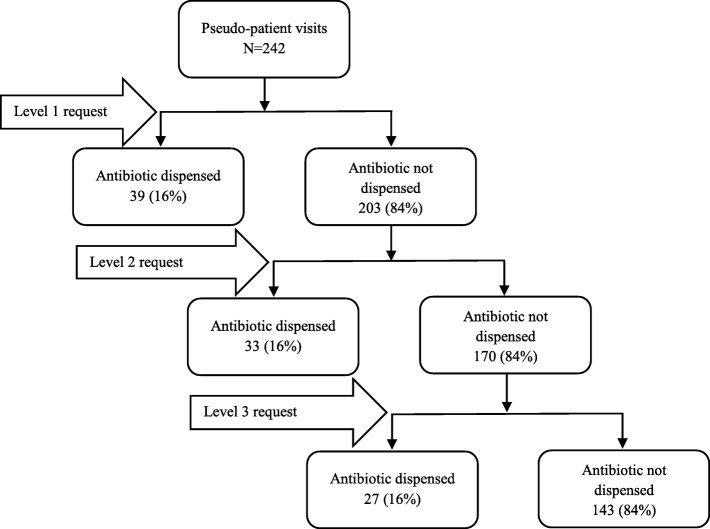
A cross-sectional pseudo-patient study was conducted from Jan-Sept 2017 among 242 community pharmacies in Sri Lanka. Each pharmacy was visited by one trained pseudo-patient who pretended to have a relative with clinical symptoms of one of four randomly selected clinical scenarios of common infections (three viral infections: acute sore throat, common cold, acute diarrhoea) and a bacterial uncomplicated urinary tract infection. Pseudo-patients requested an unspecified medicine for their condition. Interactions between the attending pharmacy staff and the pseudo-patients were audio recorded (with prior permission). Interaction data were also entered into a data collection form immediately after each visit.
In 41% (99/242) of the interactions, an antibiotic was supplied illegally without a prescription. Of these, 66% ( = 65) were inappropriately given for the viral infections. Antibiotics were provided for 55% of the urinary tract infections, 50% of the acute diarrhoea, 42% of the sore throat and 15% of the common cold cases. Patient history was obtained in less than a quarter of the interactions. In 18% (44/242) of the interactions staff recommended the pseudo-patient to visit a physician, however, in 25% (11/44) of these interactions an antibiotic was still dispensed. Pharmacy staff advised the pseudo-patient on how to take (in 60% of the interactions where an antibiotic was supplied), when to take (47%) and when to stop (22%) the antibiotics supplied. Availability of a pharmacist reduced the likelihood of unlawful antibiotic supply (OR = 0.53, 95% CI: 0.31-0.89; = 0.016) but not appropriate practice.
Illegal and inappropriate dispensing of antibiotics was evident in the participating community pharmacies. This may be a public health threat to Sri Lanka and beyond. Strategies to improve the appropriate dispensing practice of antibiotics among community pharmacies should be considered seriously.
在药店中非处方供应抗生素治疗常见感染被认为是抗生素滥用的一个来源,这可能会加重全球抗生素耐药性的负担。
评估社区药剂师对出现常见感染症状的模拟患者的反应,并分析相关因素。
2017 年 1 月至 9 月,在斯里兰卡的 242 家社区药店中进行了一项横断面模拟患者研究。每家药店都有一名经过培训的模拟患者来访,这名患者假装自己有一位亲戚出现了四种随机选择的常见感染临床情况(三种病毒性感染:急性咽痛、普通感冒、急性腹泻)和一种细菌性单纯性尿路感染的临床症状。模拟患者要求为其病情开一种未指明的药物。与值班药剂师的互动过程被录音(事先征得同意)。每次访问结束后,互动数据也立即输入到数据收集表中。
在 41%(99/242)的互动中,未经处方非法供应了抗生素。其中,66%(65 例)不合理地用于治疗病毒性感染。55%的尿路感染、50%的急性腹泻、42%的咽痛和 15%的普通感冒病例开具了抗生素。不到四分之一的互动中获取了患者的病史。在 18%(44/242)的互动中,工作人员建议模拟患者去看医生,但在 25%(11/44)的互动中仍开出了抗生素。药剂师向模拟患者告知了如何(在提供抗生素的互动中占 60%)、何时(47%)和何时停止(22%)服用抗生素。药剂师的存在降低了非法供应抗生素的可能性(OR=0.53,95%CI:0.31-0.89;P=0.016),但不能规范实践。
参与的社区药店中存在非法和不适当的抗生素配药情况。这可能对斯里兰卡乃至其他地区的公共卫生构成威胁。应认真考虑采取策略来改善社区药店中抗生素的合理配药实践。