Lorentzian Amanda, Biegel Jaclyn A, Ostrow D Gigi, Rolf Nina, Liu Chi-Chao, Rassekh S Rod, Deyell Rebecca J, Triche Timothy, Schultz Kirk R, Rozmus Jacob, Reid Gregor S D, Lim C James, Lange Philipp F, Maxwell Christopher A
Department of Pediatrics, University of British Columbia, Vancouver, BC, Canada.
Department of Pathology and Laboratory Medicine, Children's Hospital Los Angeles.
JNCI Cancer Spectr. 2018 Oct;2(4):pky079. doi: 10.1093/jncics/pky079. Epub 2019 Jan 25.
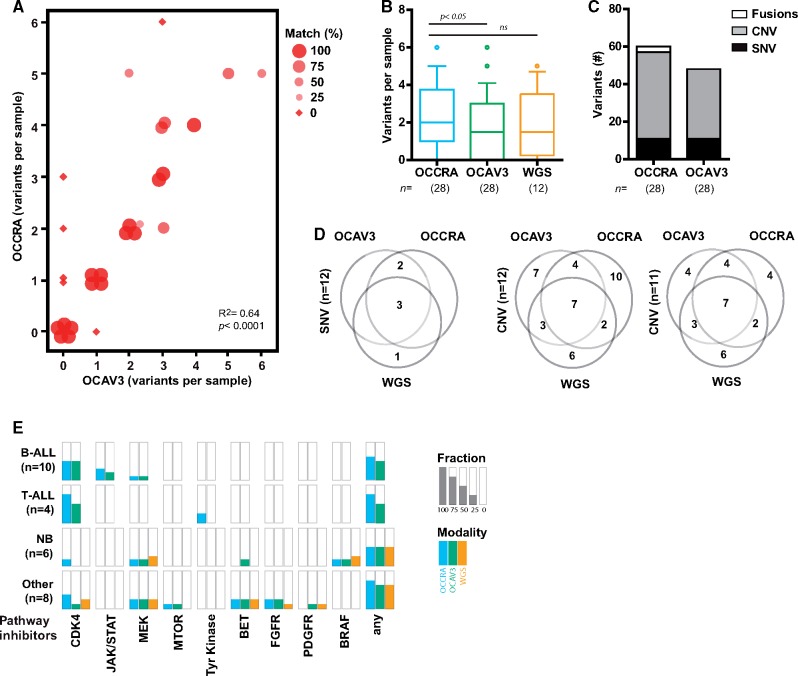
Precision oncology trials for pediatric cancers require rapid and accurate detection of genetic alterations. Tumor variant identification should interrogate the distinctive driver genes and more frequent copy number variants and gene fusions that are characteristics of pediatric tumors. Here, we evaluate tumor variant identification using whole genome sequencing (n = 12 samples) and two amplification-based next-generation sequencing assays (n = 28 samples), including one assay designed to rapidly assess common diagnostic, prognostic, and therapeutic biomarkers found in pediatric tumors. Variant identification by the three modalities was comparable when filtered for 151 pediatric driver genes. Across the 28 samples, the pediatric cancer-focused assay detected more tumor variants per sample (two-sided, <.05), which improved the identification of potentially druggable events and matched pathway inhibitors. Overall, our data indicate that an assay designed to evaluate pediatric cancer-specific variants, including gene fusions, may improve the detection of target-agent pairs for precision oncology.
针对儿童癌症的精准肿瘤学试验需要快速准确地检测基因改变。肿瘤变异鉴定应探究儿童肿瘤特有的驱动基因以及更常见的拷贝数变异和基因融合。在此,我们使用全基因组测序(n = 12个样本)和两种基于扩增的二代测序检测方法(n = 28个样本)评估肿瘤变异鉴定,其中一种检测方法旨在快速评估儿童肿瘤中常见的诊断、预后和治疗生物标志物。当针对151个儿童驱动基因进行筛选时,三种方法的变异鉴定结果相当。在这28个样本中,针对儿童癌症的检测方法每个样本检测到的肿瘤变异更多(双侧,<.05),这提高了对潜在可用药事件的鉴定以及匹配的通路抑制剂。总体而言,我们的数据表明,一种旨在评估儿童癌症特异性变异(包括基因融合)的检测方法可能会改善精准肿瘤学中靶向药物对的检测。