1 Offord Centre for Child Studies & Department of Psychiatry & Behavioural Neurosciences, McMaster University, Hamilton, Ontario.
2 Department of Health Research Methods, Evidence & Impact, McMaster University, Hamilton, Ontario.
Can J Psychiatry. 2019 Apr;64(4):285-293. doi: 10.1177/0706743719830027.
To determine if levels of neighbourhood poverty and neighbourhood antisocial behaviour modify associations between household poverty and child and youth mental health problems.
Data come from the 2014 Ontario Child Health Study-a provincially representative survey of 6537 families with 10,802 four- to 17-year-olds. Multivariate multilevel modelling was used to test if neighbourhood poverty and antisocial behaviour interact with household poverty to modify associations with children's externalizing and internalizing problems based on parent assessments of children (4- to 17-year-olds) and self-assessments of youth (12- to 17-year-olds).
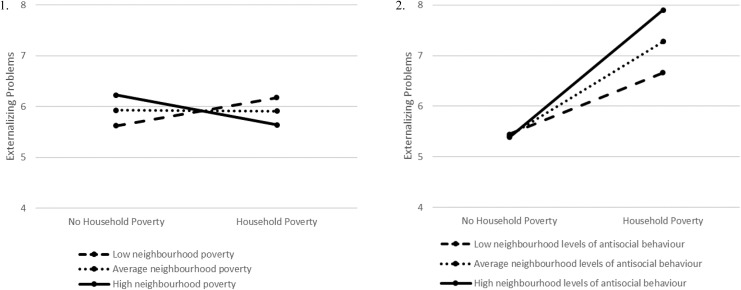
Based on parent assessments, neighbourhood poverty, and antisocial behaviour modified associations between household poverty and children's mental health problems. Among children living in households below the poverty line, levels of mental health problems were 1) lower when living in neighbourhoods with higher concentrations of poverty and 2) higher when living in neighbourhoods with more antisocial behaviour. These associations were stronger for externalizing versus internalizing problems when conditional on antisocial behaviour and generalized only to youth-assessed externalizing problems.
The lower levels of externalizing problems reported among children living in poor households in low-income neighbourhoods identify potential challenges with integrating poorer households into more affluent neighbourhoods. More important, children living in poor households located in neighbourhoods exhibiting more antisocial behaviour are at dramatically higher risk for mental health problems. Reducing levels of neighbourhood antisocial behaviour could have large mental health benefits, particularly among poor children.
确定邻里贫困程度和邻里反社会行为是否会改变家庭贫困与儿童和青少年心理健康问题之间的关联。
数据来自 2014 年安大略省儿童健康研究——一项针对 6537 个家庭的具有代表性的调查,涉及 10802 名 4 至 17 岁的儿童。采用多变量多层次模型来检验邻里贫困和反社会行为是否与家庭贫困相互作用,从而改变基于父母对儿童(4 至 17 岁)和青少年(12 至 17 岁)自我评估的儿童外部和内部问题与儿童心理健康问题之间的关联。
基于父母评估,邻里贫困和反社会行为改变了家庭贫困与儿童心理健康问题之间的关联。在生活在贫困线以下的家庭中,当居住在贫困程度较高的社区时,心理健康问题的水平较低,而当居住在反社会行为较多的社区时,心理健康问题的水平较高。这些关联在外部问题上比内部问题更强,而且仅在反社会行为条件下具有普遍性,并且仅适用于青少年评估的外部问题。
居住在贫困社区的贫困家庭中的儿童报告的外部问题水平较低,这表明将较贫困的家庭融入较富裕的社区存在潜在挑战。更重要的是,居住在反社会行为较多的社区中的贫困家庭的儿童面临着极高的心理健康问题风险。减少邻里反社会行为的水平可能会对心理健康产生重大益处,尤其是对贫困儿童而言。