National Institute of Environmental Health Sciences, National Health Research Institutes, Miaoli 35053, Taiwan.
Department of Forestry and Natural Resources, National Chiayi University, Chiayi 60004, Taiwan.
Int J Environ Res Public Health. 2019 Apr 11;16(7):1300. doi: 10.3390/ijerph16071300.
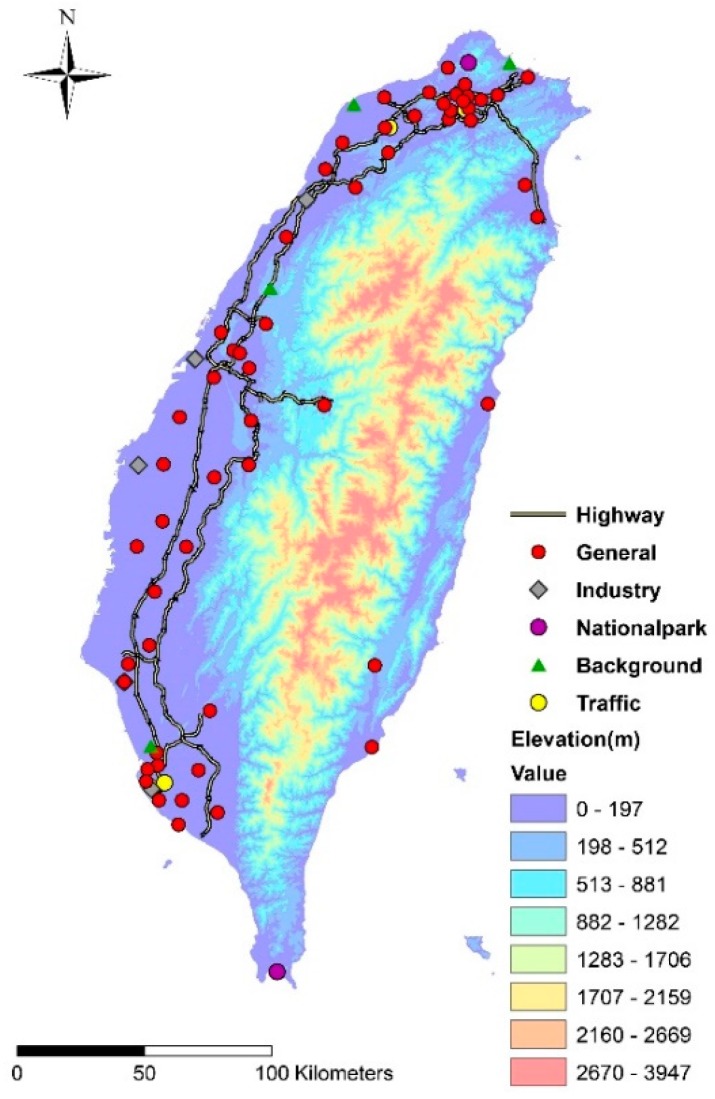
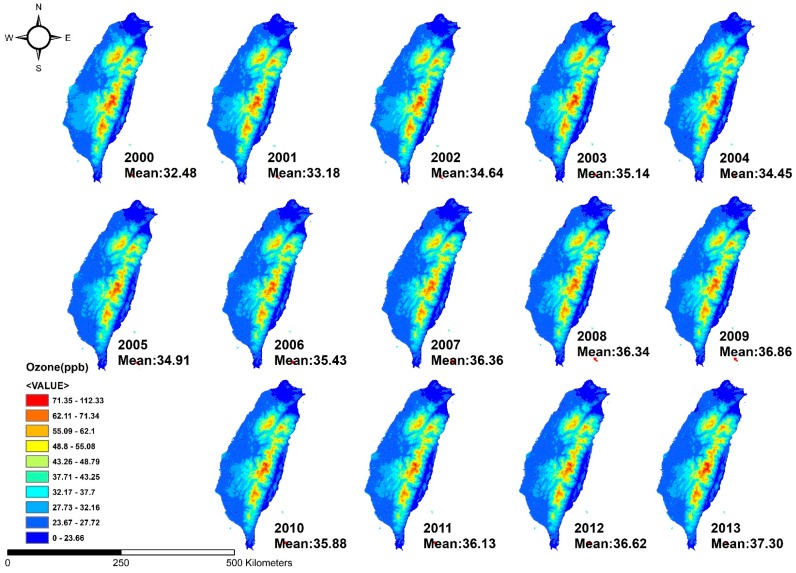
This paper developed a land use regression (LUR) model to study the spatial-temporal variability of O₃ concentrations in Taiwan, which has typical Asian cultural characteristics with diverse local emission sources. The Environmental Protection Agency's (EPA) data of O₃ concentrations from 2000 and 2013 were used to develop this model, while observations from 2014 were used as the external data verification to assess model reliability. The distribution of temples, cemeteries, and crematoriums was included for a potential predictor as an Asian culturally specific source for incense and joss money burning. We used stepwise regression for the LUR model development, and applied 10-fold cross-validation and external data for the verification of model reliability. With the overall model R² of 0.74 and a 10-fold cross-validated R² of 0.70, this model presented a mid-high prediction performance level. Moreover, during the stepwise selection procedures, the number of temples, cemeteries, and crematoriums was selected as an important predictor. By using the long-term monitoring data to establish an LUR model with culture specific predictors, this model can better depict O₃ concentration variation in Asian areas.
本研究旨在建立一个用于研究台湾地区臭氧浓度时空变化的土地利用回归(LUR)模型,该地区具有典型的亚洲文化特征,存在多样的本地排放源。该模型使用了 2000 年至 2013 年期间环境保护署(EPA)的臭氧浓度数据进行开发,而 2014 年的观测数据则用于外部数据验证,以评估模型的可靠性。本研究还将庙宇、公墓和火葬场的分布纳入潜在预测因子中,因为在亚洲文化中,焚烧香和纸钱是一种特殊的污染源。本研究采用逐步回归法进行 LUR 模型开发,并应用 10 折交叉验证和外部数据进行模型可靠性验证。该模型的整体模型 R²为 0.74,10 折交叉验证 R²为 0.70,表明该模型具有中高水平的预测性能。此外,在逐步选择过程中,庙宇、公墓和火葬场的数量被选为重要的预测因子。通过利用长期监测数据建立具有文化特异性预测因子的 LUR 模型,该模型可以更好地描绘亚洲地区臭氧浓度的变化情况。