Alzagameem Abla, Klein Stephanie Elisabeth, Bergs Michel, Do Xuan Tung, Korte Imke, Dohlen Sophia, Hüwe Carina, Kreyenschmidt Judith, Kamm Birgit, Larkins Michael, Schulze Margit
Department of Natural Sciences, Bonn-Rhein-Sieg University of Applied Sciences, von-Liebig-Str. 20, D-53359 Rheinbach, Germany.
Brandenburg University of Technology BTU Cottbus-Senftenberg, Faculty of Environment and Natural Sciences, Platz der Deutschen Einheit 1, D-03046 Cottbus, Germany.
Polymers (Basel). 2019 Apr 11;11(4):670. doi: 10.3390/polym11040670.
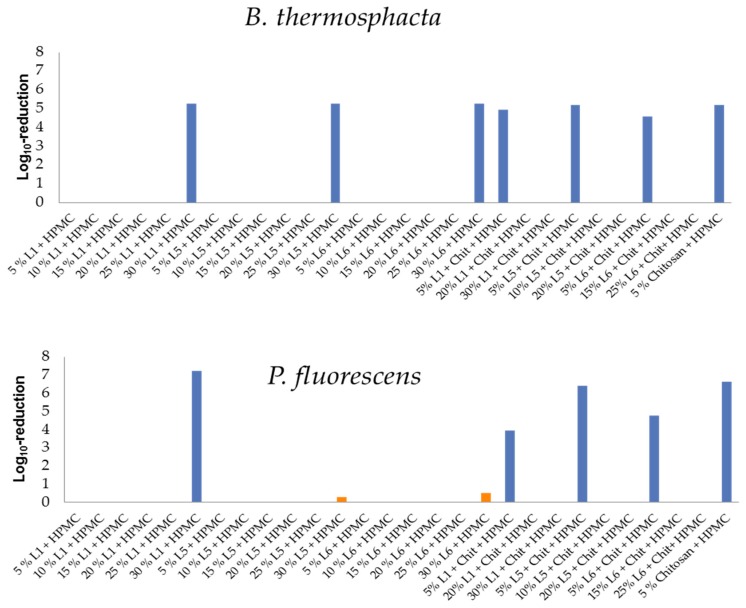
The antiradical and antimicrobial activity of lignin and lignin-based films are both of great interest for applications such as food packaging additives. The polyphenolic structure of lignin in addition to the presence of O-containing functional groups is potentially responsible for these activities. This study used DPPH assays to discuss the antiradical activity of HPMC/lignin and HPMC/lignin/chitosan films. The scavenging activity (SA) of both binary (HPMC/lignin) and ternary (HPMC/lignin/chitosan) systems was affected by the percentage of the added lignin: the 5% addition showed the highest activity and the 30% addition had the lowest. Both scavenging activity and antimicrobial activity are dependent on the biomass source showing the following trend: organosolv of softwood > kraft of softwood > organosolv of grass. Testing the antimicrobial activities of lignins and lignin-containing films showed high antimicrobial activities against Gram-positive and Gram-negative bacteria at 35 °C and at low temperatures (0-7 °C). Purification of kraft lignin has a negative effect on the antimicrobial activity while storage has positive effect. The lignin release in the produced films affected the activity positively and the chitosan addition enhances the activity even more for both Gram-positive and Gram-negative bacteria. Testing the films against spoilage bacteria that grow at low temperatures revealed the activity of the 30% addition on HPMC/L1 film against both and while L5 was active only against . In HPMC/lignin/chitosan films, the 5% addition exhibited activity against both and
木质素及木质素基薄膜的抗自由基和抗菌活性对于食品包装添加剂等应用而言都极具吸引力。木质素的多酚结构以及含氧基官能团的存在可能是这些活性的原因所在。本研究采用DPPH测定法来探讨羟丙基甲基纤维素/木质素和羟丙基甲基纤维素/木质素/壳聚糖薄膜的抗自由基活性。二元体系(羟丙基甲基纤维素/木质素)和三元体系(羟丙基甲基纤维素/木质素/壳聚糖)的清除活性均受添加木质素百分比的影响:添加5%时活性最高,添加30%时活性最低。清除活性和抗菌活性均取决于生物质来源,呈现出以下趋势:软木有机溶剂木质素>软木硫酸盐木质素>草类有机溶剂木质素。对木质素及含木质素薄膜的抗菌活性进行测试表明它们在35℃和低温(0 - 7℃)下对革兰氏阳性菌和革兰氏阴性菌均具有较高的抗菌活性。硫酸盐木质素的纯化对抗菌活性有负面影响,而储存则有正面影响。所制备薄膜中木质素的释放对活性有积极影响,添加壳聚糖对革兰氏阳性菌和革兰氏阴性菌的活性增强作用更大。对在低温下生长的腐败菌测试薄膜发现,添加30%的HPMC/L1薄膜对[具体菌种1]和[具体菌种2]均有活性,而L5仅对[具体菌种1]有活性。在羟丙基甲基纤维素/木质素/壳聚糖薄膜中,添加5%时对[具体菌种1]和[具体菌种2]均表现出活性