Huang Limei, Li Meishan, Wu Dan, Ma Xiuling, Wu Zhenyue, Xiang Shengchang, Chen Sheng
College of Chemistry and Chemical Engineering, Fujian Provincial Key Laboratory of Polymer Materials, Fujian Normal University, Fuzhou 350007, China.
School of Ocean Science and Biochemistry Engineering, Fuqing Branch of Fujian Normal University, Fuqing 350300, China.
Polymers (Basel). 2016 Jun 22;8(6):222. doi: 10.3390/polym8060222.
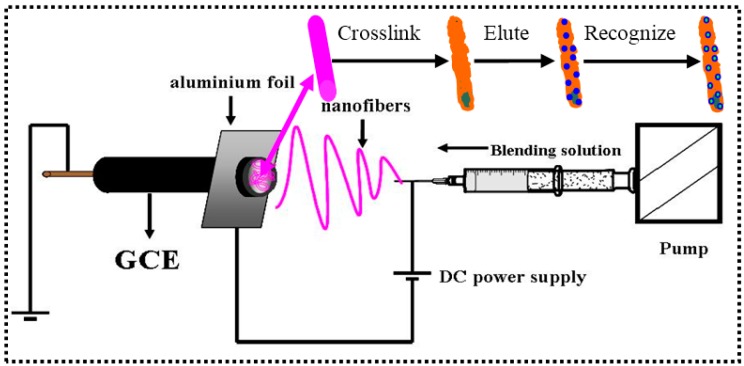
The determination of brominated flame retardants is of great importance, but remains a challenge. Particularly, universal and facile approaches are limited. Here we report a new general approach, combining molecular imprinting and electrospinning, for the efficient and facile imprinting sensor of 2,4,6-tribromophenol (TBP), which was used as a "novel" brominated flame retardant. With TBP as the template molecular, β-cyclodextrin (β-CD) as the functional monomer, and poly-vinylbutyral (PVB) as the electro-spinning matrix, the nanofiber film was deposited on the glassy carbon electrode (GCE) via electrospinning technique directly. The β-CD-PVB/GCE sensor system exhibited excellent TBP sensing performances, such as a low detection limit (6.29 × 10 mol·L) at room temperature, selective recognition to TBP/phenol/4-methyl-phenol, and good regeneration performance. The approach of fabricating a molecular imprinting nanofiber sensor may shed new light in the detection of other phenolic pollutants.
溴化阻燃剂的测定至关重要,但仍然是一项挑战。特别是,通用且简便的方法有限。在此,我们报告一种新的通用方法,即将分子印迹与静电纺丝相结合,用于高效、简便地制备2,4,6-三溴苯酚(TBP)的印迹传感器,TBP被用作“新型”溴化阻燃剂。以TBP为模板分子,β-环糊精(β-CD)为功能单体,聚乙烯醇缩丁醛(PVB)为静电纺丝基质,通过静电纺丝技术将纳米纤维膜直接沉积在玻碳电极(GCE)上。β-CD-PVB/GCE传感器系统表现出优异的TBP传感性能,例如在室温下具有低检测限(6.29×10 mol·L),对TBP/苯酚/4-甲基苯酚具有选择性识别能力,以及良好的再生性能。制备分子印迹纳米纤维传感器的方法可能为其他酚类污染物的检测提供新的思路。