Social, Genetic and Developmental Psychiatry Centre, Institute of Psychiatry, Psychology and Neuroscience, King's College London, London, UK.
Department of Psychiatry and Behavioral Health, State University New York (SUNY) Stony Brook University, Stony Brook, NY, USA.
Transl Psychiatry. 2019 Apr 12;9(1):137. doi: 10.1038/s41398-019-0469-7.
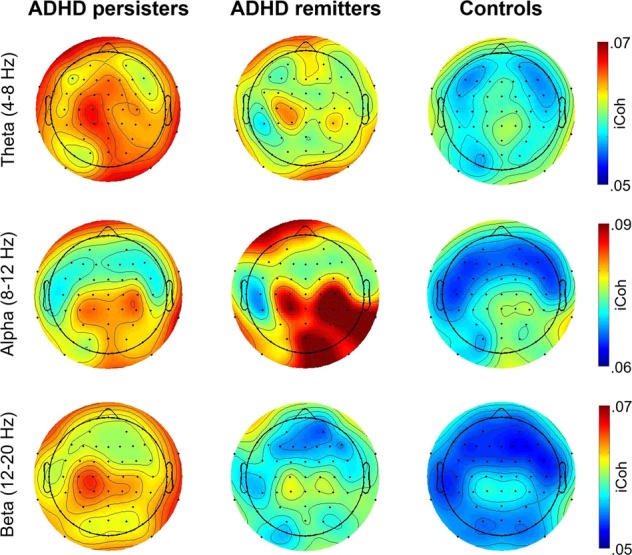
We previously provided initial evidence for cognitive and event-related potential markers of persistence/remission of attention-deficit/hyperactivity disorder (ADHD) from childhood to adolescence and adulthood. Here, using a novel brain-network connectivity approach, we aimed to examine whether task-based functional connectivity reflects a marker of ADHD remission or an enduring deficit unrelated to ADHD outcome. High-density EEG was recorded in a follow-up of 110 adolescents and young adults with childhood ADHD (87 persisters, 23 remitters) and 169 typically developing individuals during an arrow-flanker task, eliciting cognitive control. Functional connectivity was quantified with network-based graph-theory metrics before incongruent (high-conflict) target onset (pre-stimulus), during target processing (post-stimulus) and in the degree of change between pre-stimulus/post-stimulus. ADHD outcome was examined with parent-reported symptoms and impairment using both a categorical (DSM-IV) and a dimensional approach. Graph-theory measures converged in indicating that, compared to controls, ADHD persisters showed increased connectivity in pre-stimulus theta, alpha, and beta and in post-stimulus beta (all p < .01) and reduced pre-stimulus/post-stimulus change in theta connectivity (p < .01). In the majority of indices showing ADHD persister-control differences, ADHD remitters differed from controls (all p < .05) but not from persisters. Similarly, connectivity measures were unrelated to continuous outcome measures of ADHD symptoms and impairment in participants with childhood ADHD. These findings indicate that adolescents and young adults with persistent and remitted ADHD share atypical over-connectivity profiles and reduced ability to modulate connectivity patterns with task demands, compared to controls. Task-based functional connectivity impairments may represent enduring deficits in individuals with childhood ADHD irrespective of diagnostic status in adolescence/young adulthood.
我们之前提供了初步证据,证明从儿童期到青春期和成年期,注意力缺陷/多动障碍(ADHD)的认知和事件相关电位标志物具有持续性/缓解。在这里,我们使用一种新的脑网络连接方法,旨在检查基于任务的功能连接是否反映了 ADHD 缓解的标志物,还是与 ADHD 结果无关的持久缺陷。在对 110 名患有儿童期 ADHD 的青少年和年轻人(87 名持续者,23 名缓解者)和 169 名典型发育个体的随访中,使用箭头-flanker 任务记录了高密度 EEG,以引发认知控制。在不一致(高冲突)目标出现之前(刺激前)、在目标处理期间(刺激后)以及刺激前后变化程度,使用基于网络的图论指标量化功能连接。使用父母报告的症状和障碍,使用分类(DSM-IV)和维度方法来检查 ADHD 结果。图论测量结果表明,与对照组相比,ADHD 持续者在刺激前 theta、alpha 和 beta 以及刺激后 beta 中表现出更高的连接性(所有 p < 0.01),并且刺激前/post 刺激的 theta 连接性变化减少(p < 0.01)。在大多数显示 ADHD 持续者-对照组差异的指标中,ADHD 缓解者与对照组(均 p < 0.05)但与持续者不同。同样,连接性测量与儿童 ADHD 参与者的 ADHD 症状和障碍的连续结果测量无关。这些发现表明,与对照组相比,持续性和缓解性 ADHD 的青少年和年轻人表现出异常的过度连接模式和降低的能力,以根据任务需求调节连接模式。基于任务的功能连接损伤可能代表儿童 ADHD 个体的持久缺陷,而与青少年/成年期的诊断状态无关。