Cheung Celeste H M, McLoughlin Gráinne, Brandeis Daniel, Banaschewski Tobias, Asherson Philip, Kuntsi Jonna
MRC Social, Genetic and Developmental Psychiatry Centre, Institute of Psychiatry, Psychology and Neuroscience, King's College London, London, UK.
Department of Child and Adolescent Psychiatry and Psychotherapy, Central Institute of Mental Health, Medical Faculty Mannheim, Heidelberg University, Mannheim, Germany.
Brain Topogr. 2017 May;30(3):320-332. doi: 10.1007/s10548-017-0554-2. Epub 2017 Mar 14.
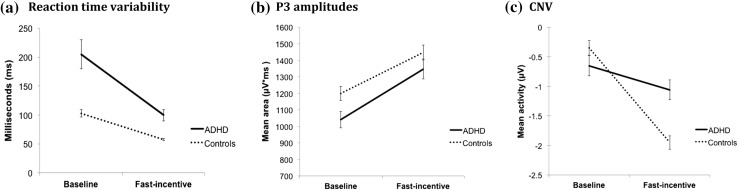
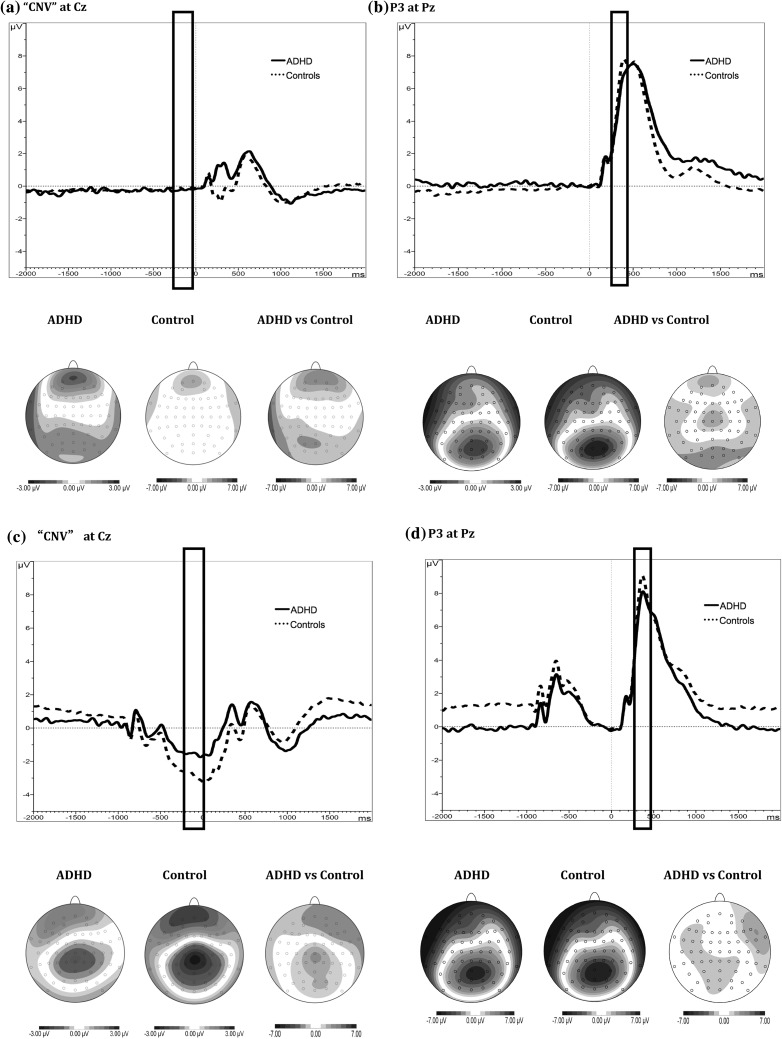
Cognitive performance in attention-deficit/hyperactivity disorder (ADHD) is characterised, in part, by frequent fluctuations in response speed, resulting in high reaction time variability (RTV). RTV captures a large proportion of the genetic risk in ADHD but, importantly, is malleable, improving significantly in a fast-paced, rewarded task condition. Using the temporal precision offered by event-related potentials (ERPs), we aimed to examine the neurophysiological measures of attention allocation (P3 amplitudes) and preparation (contingent negative variation, CNV), and their associations with the fluctuating RT performance and its improvement in ADHD. 93 participants with ADHD and 174 controls completed the baseline and fast-incentive conditions of a four-choice reaction time task, while EEG was simultaneously recorded. Compared to controls, individuals with ADHD showed both increased RTV and reduced P3 amplitudes during performance on the RT task. In the participants with ADHD, attenuated P3 amplitudes were significantly associated with high RTV, and the increase in P3 amplitudes from a slow baseline to a fast-paced, rewarded condition was significantly associated with the RTV decrease. Yet, the individuals with ADHD did not show the same increase in CNV from baseline to fast-incentive condition as observed in controls. ADHD is associated both with a neurophysiological impairment of attention allocation (P3 amplitudes) and an inability to adjust the preparatory state (CNV) in a changed context. Our findings suggest that both neurophysiological and cognitive performance measures of attention are malleable in ADHD, which are potential targets for non-pharmacological interventions.
注意力缺陷多动障碍(ADHD)的认知表现部分特征在于反应速度频繁波动,导致反应时间变异性(RTV)较高。RTV在ADHD的遗传风险中占很大比例,但重要的是,它具有可塑性,在快节奏、有奖励的任务条件下会显著改善。利用事件相关电位(ERP)提供的时间精度,我们旨在研究注意力分配(P3波幅)和准备(关联性负变,CNV)的神经生理学指标,以及它们与ADHD中波动的反应时表现及其改善之间的关联。93名ADHD患者和174名对照组完成了四选一反应时任务的基线和快速激励条件,同时记录脑电图。与对照组相比,ADHD患者在反应时任务表现期间表现出RTV增加和P3波幅降低。在ADHD患者中,P3波幅减弱与高RTV显著相关,并且从缓慢基线到快节奏、有奖励条件下P3波幅的增加与RTV降低显著相关。然而,ADHD患者从基线到快速激励条件下的CNV增加幅度与对照组不同。ADHD既与注意力分配的神经生理学损害(P3波幅)有关,也与在变化的情境中无法调整准备状态(CNV)有关。我们的研究结果表明,ADHD中注意力的神经生理学和认知表现指标都是可塑的,这是非药物干预的潜在靶点。