Children's Nutrition Research Center, Department of Pediatrics, Baylor College of Medicine, One Baylor Plaza, Houston, TX, 77030, USA.
University of Cambridge Metabolic Research Laboratories, and NIHR Cambridge Biomedical Research Centre, Wellcome Trust-MRC Institute of Metabolic Science, Addenbrooke's Hospital, Cambridge, CB2 0QQ, UK.
Nat Commun. 2019 Apr 12;10(1):1718. doi: 10.1038/s41467-019-08737-6.
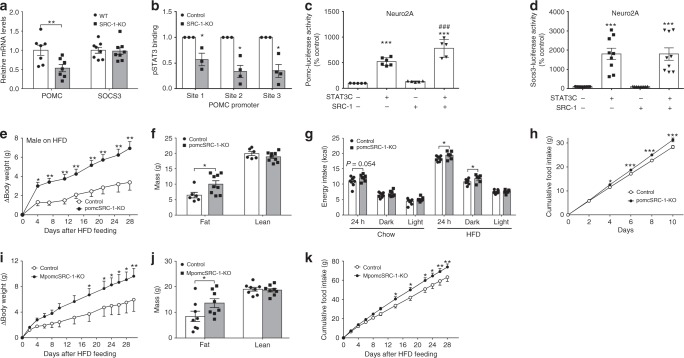
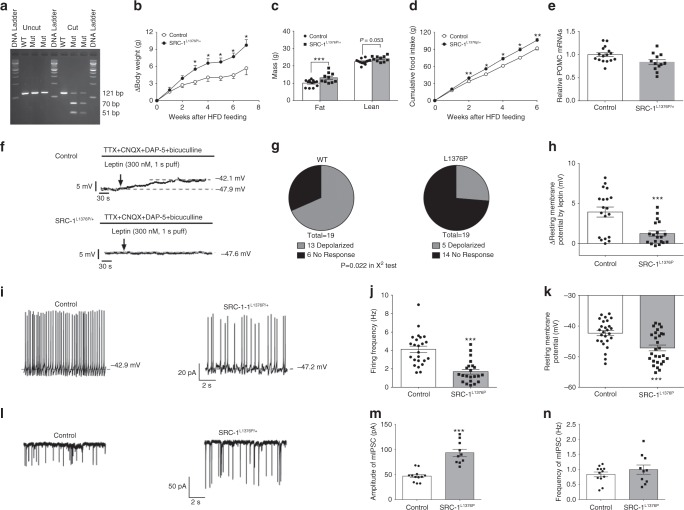
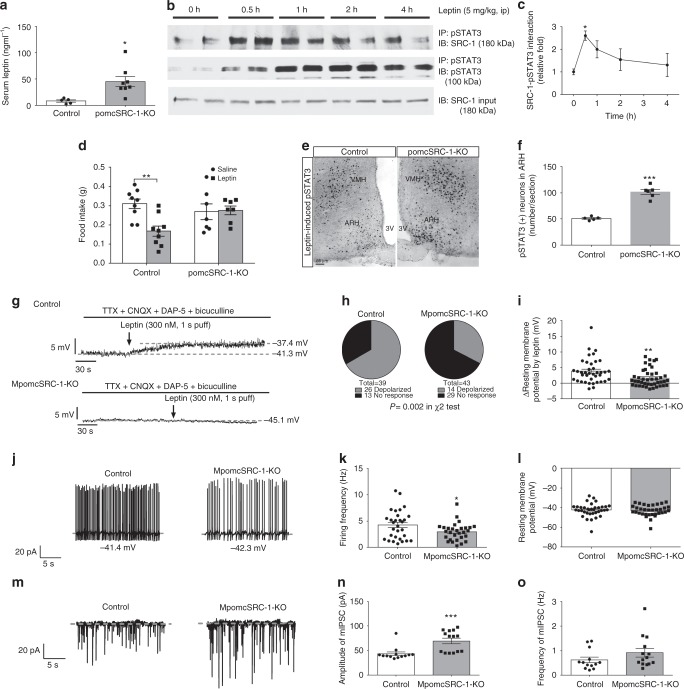
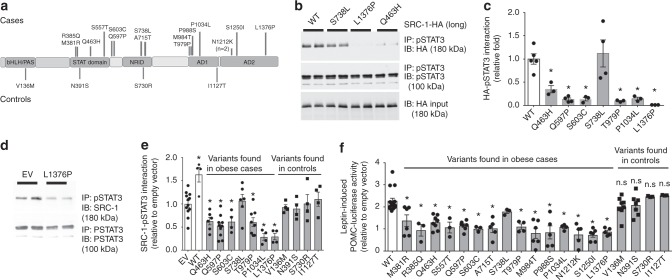
Hypothalamic neurons expressing the anorectic peptide Pro-opiomelanocortin (Pomc) regulate food intake and body weight. Here, we show that Steroid Receptor Coactivator-1 (SRC-1) interacts with a target of leptin receptor activation, phosphorylated STAT3, to potentiate Pomc transcription. Deletion of SRC-1 in Pomc neurons in mice attenuates their depolarization by leptin, decreases Pomc expression and increases food intake leading to high-fat diet-induced obesity. In humans, fifteen rare heterozygous variants in SRC-1 found in severely obese individuals impair leptin-mediated Pomc reporter activity in cells, whilst four variants found in non-obese controls do not. In a knock-in mouse model of a loss of function human variant (SRC-1), leptin-induced depolarization of Pomc neurons and Pomc expression are significantly reduced, and food intake and body weight are increased. In summary, we demonstrate that SRC-1 modulates the function of hypothalamic Pomc neurons, and suggest that targeting SRC-1 may represent a useful therapeutic strategy for weight loss.
表达厌食肽 Pro-opiomelanocortin (Pomc) 的下丘脑神经元调节食物摄入和体重。在这里,我们表明类固醇受体共激活剂-1 (SRC-1) 与瘦素受体激活的靶标磷酸化 STAT3 相互作用,增强 Pomc 转录。在小鼠中,Pomc 神经元中 SRC-1 的缺失减弱了瘦素对其的去极化作用,降低了 Pomc 的表达并增加了食物摄入,导致高脂肪饮食诱导的肥胖。在人类中,在严重肥胖个体中发现的 SRC-1 的十五种罕见杂合变异体损害了细胞中瘦素介导的 Pomc 报告基因活性,而在非肥胖对照个体中发现的四种变异体则没有。在 SRC-1 功能丧失的人类变异体的敲入小鼠模型中,瘦素诱导的 Pomc 神经元去极化和 Pomc 表达显著降低,食物摄入和体重增加。总之,我们证明 SRC-1 调节下丘脑 Pomc 神经元的功能,并表明靶向 SRC-1 可能代表一种有用的减肥治疗策略。